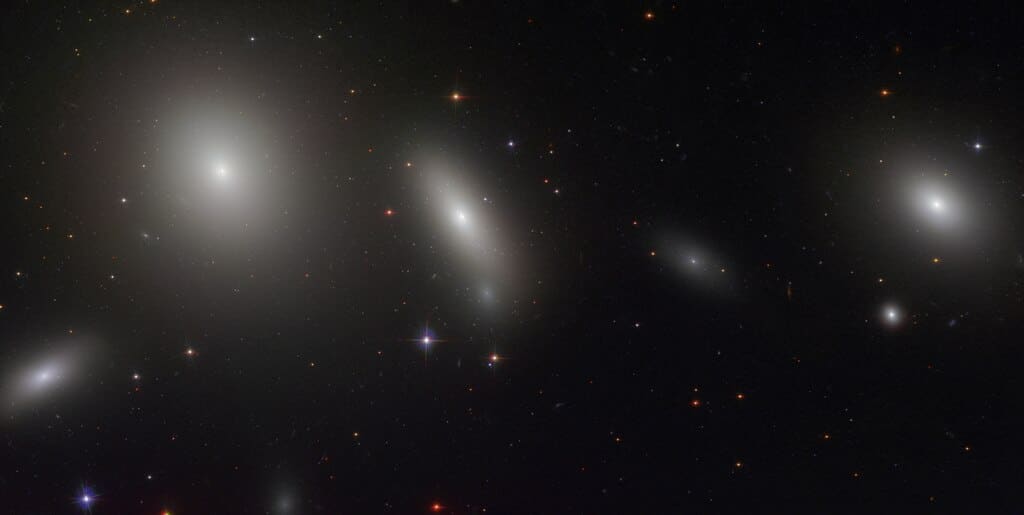
An international team of scientists has discovered a distant galaxy, named KiDS J0842+0059, with the help of the Large Binocular Telescope in Arizona. This galaxy has remained unchanged for 7 billion years, like a cosmic fossil— a rarity in the world of astronomy. This galaxy, along with an enigmatic collection of celestial bodies, is a type of relic or “fossil galaxy”. Fossil galaxies give us a glimpse into cosmic history.
Fossil galaxies are formed after an initial phase of intense star formation; the galaxy does not take its usual evolutionary path. While other galaxies expand and merge with other galaxies, fossil galaxies remain inactive. These act as celestial time capsules, providing a view into the ancient universe and allowing astronomers to study the mechanisms of galaxy formation.
The galaxy KiDS J0842+0059 is the most distant and the first of its kind observed beyond the local universe, a region marked by 1 billion light-years in radius. This fossil galaxy was found by a team of astronomers led by the Italian National Institute for Astrophysics (INAF), using high-resolution imaging from the Large Binocular Telescope in Arizona.
According to Crescenzo Tortora, a researcher at INAF and the first author of a study on the finding published Monday, May 31, in the journal Monthly Notices of the Royal Astronomical Society, relic galaxies did not merge with other galaxies by chance, remaining more or less intact over time. These celestial bodies are scarce as the probability of merging with another galaxy increases with time.
Astronomers believe that the most massive galaxies form in two phases. The first phase is characterized by a rapid burst of star formation, accompanied by fast and violent activity. This gives a small, compact precursor to the relic. The galaxies interact, eat, and merge with other galaxies in the second phase. The relic galaxies are those in which the second phase is almost non-existent, and 75% of their mass has been created in the first phase. Telltale features of fossil galaxies are that they are ancient, compact, and dense. These galaxies formed when the universe was very young, and for reasons unknown, didn’t interact or merge with other galaxy systems. They evolved undisturbed and remained unchanged over time. Fossil galaxies are vital because they provide a direct link to the massive galaxy population that existed billions of years ago, said Michele Cappellari, a professor of astrophysics at the University of Oxford who was not involved with the study. These galaxies have avoided mergers and growth that most galaxies have undergone. Studying fossil galaxies can be a key tool in reconstructing the conditions of the universe in its infancy and understanding the initial bursts of star formation.
Scientists first identified KiDS J0842+0059 in 2018 using the VLT Survey Telescope (VST) at the Paranal Observatory in Chile. The observation revealed that ancient stars populated the galaxy, but it only provided an estimate of its mass and size. Therefore, a more detailed observation was needed to confirm that it was a fossil galaxy. The Large Binocular Telescope used for this confirmation can produce very sharp images due to its ability to nullify atmospheric turbulence, which otherwise can make it difficult for Earth-based telescopes to focus on distant objects.
The newly discovered fossil galaxy joins a group of a few others that have been observed at the same level of detail; the most pristine of these—called NGC 1277—was confirmed by the Hubble Space Telescope in 2018. NGC 1277 and KiDS J0842+0059 are almost similar, but the latter is much farther away from Earth. This new fossil galaxy fits the description of a relic almost perfectly. This is because nearly all of the stars, or 99.5% of the stars, formed early on in the cosmic timeframe, and then the galaxy did nothing thereafter.
The fossil galaxy has stars and planets just like the Milky Way, but in a tiny, compact space, so everything is super-crowded. Finding a solar system like ours is also challenging, as other companion stars can interfere with the movement of the planets.
KiDS J0842+0059 looks how it did 3 billion years ago, because that’s how long it takes for the light coming from the galaxy to reach Earth. Astronomers hypothesize that the relic will likely remain unchanged forever. Still, scientists cannot be sure since they have no idea what prevents it from interacting with other galaxies.
It is very challenging to identify and confirm fossil galaxies, partly due to their uniqueness and small size compared to traditional galaxies. Astronomers cannot determine the exact rarity of a fossil galaxy, but they estimate that one in a million is likely a fossil galaxy. The INSPIRE project — a new initiative to find and catalogue fossil galaxies, which led to the discovery of KiDS J0842+0059 — has already identified several dozen other candidates that are in the pipeline for further scrutiny.
New instruments, such as Euclid, a European Space Agency telescope launched in 2023, will also help explore dark matter and dark energy, as well as observe fossil galaxies.
“Euclid will be transformational,” according to study coauthor Chiara Spiniello, a researcher at the University of Oxford in the UK, “because rather than observing one single object at a time, its wide sky survey configuration will cover a lot more. The idea is to find all the galaxies in a patch of sky, and then isolate all the ones that are ultra-compact. And if you do that, then you can actually estimate how rare (fossil galaxies) are.”
Confirming the relic galaxy KiDS J0842+0059 at such a distance is a fantastic achievement, and the future of this field is highly fruitful. With the help of new telescopes like James Webb and Euclid, and on the ground with adaptive optics, astronomers can expect to find and study more such relic galaxies.
Copyright @smorescience. All rights reserved. Do not copy, cite, publish, or distribute this content without permission.
SUBSCRIBE TO OUR NEWSLETTER
.......... ..........Subscribe to our mailing list to get updates to your email inbox.
Monthly Newsletter