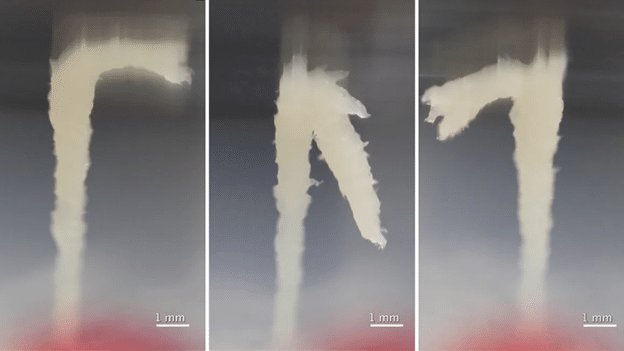
New research has uncovered tiny towers made of worms in rotten fruits. These tiny architects are called nematodes, and they are found all over the world. Scientists in Germany have observed their creative and architectural side for the first time ever. After inspecting rotten pears and apples, researchers from the Max Planck Institute of Animal Behavior and the University of Konstanz were able to spot hundreds of the 1-millimeter-long worms climbing onto one another to form a structure 10 times their own size.
To learn more about the slimy structures these worms built, the scientists brought nematodes called Caenorhabditis elegans into the lab and analyzed their building capacity. In their experiment, they found that the worms could assemble in a matter of hours. Some of the worms also extended as exploratory arms from the twisting mass of worm towers. Through the inputs received from the exploration, the worms would build accordingly. However, the reason why the nematodes formed such structures was not very clear.
According to senior study author Serena Ding, a Max Planck research group leader of genes and behavior, these worms were not merely worms standing on top of one another, but a superorganism that coordinated and moved as a whole.
The team prodded and poked the worms stacked in a tower formation to record their reactions to the stimulus and see what motivated the worms to build such towers. The team also arranged a scenario where a fly visited the tower. According to the study’s first author, Daniela Perez, who is a postdoctoral researcher at the Max Planck Institute of Animal Behavior, the worm towers are highly reactive to these stimuli. The worm tower senses the presence of the stimulus, attaching itself to a metal pick or a fly buzzing around. The coordinated movement suggests that hungry nematodes use flies or other insects as a ride to another rotten fruit.
According to Perez, it is almost impossible for the 1-millimeter-long nematodes to crawl over 2 meters (6.6 feet) away to a different fruit. The worms can easily die or get eaten by predators along the way. Nematodes can hitch a ride, solo, too, but when they are in a group, they can increase the chances of reproduction. The towering structures also serve as a mode of transport, as observed by how some worms formed a bridge across gaps within the petri dish to move from one region to another.
“This discovery is really exciting,” said Orit Peleg, an associate professor of computer science who studies living systems at the University of Colorado Boulder’s BioFrontiers Institute. “It’s both establishing the ecological function of creating a tower, and it really opens up the door to do more controlled experimentation to try to understand the perceptual world of these organisms, and how they communicate within a large group.” Peleg was not involved in the study.
The next step is to study whether the worms building the towers are cooperative or competitive. Studying how other self-assembling creatures behave can offer new clues into how the nematodes behave. For example, ants assemble to form buoyant rafts to stay afloat in floodwaters. They are incredibly sacrificial for one another and generally do not fight in their colony, as they are like siblings. This is because they all come from the same queen. However, unlike ants, the nematodes didn’t display any role differentiation or hierarchy. Each worm from the top to the tower’s base was equally strong and mobile, indicating no competition was present. However, the lab-grown worms were clones of one another, having the same genetic makeup. Role differentiation and hierarchy might be present in nature, where the nematode population will genetically differ.
Socially cooperative animals rely on some form of communication. For example, ants have pheromone trails that allow communication, while slime molds have pulsing chemical signals. In the case of the nematodes, no such communication signals have been discovered.
Copyright @smorescience. All rights reserved. Do not copy, cite, publish, or distribute this content without permission.
SUBSCRIBE TO OUR NEWSLETTER
.......... ..........Subscribe to our mailing list to get updates to your email inbox.
Monthly Newsletter