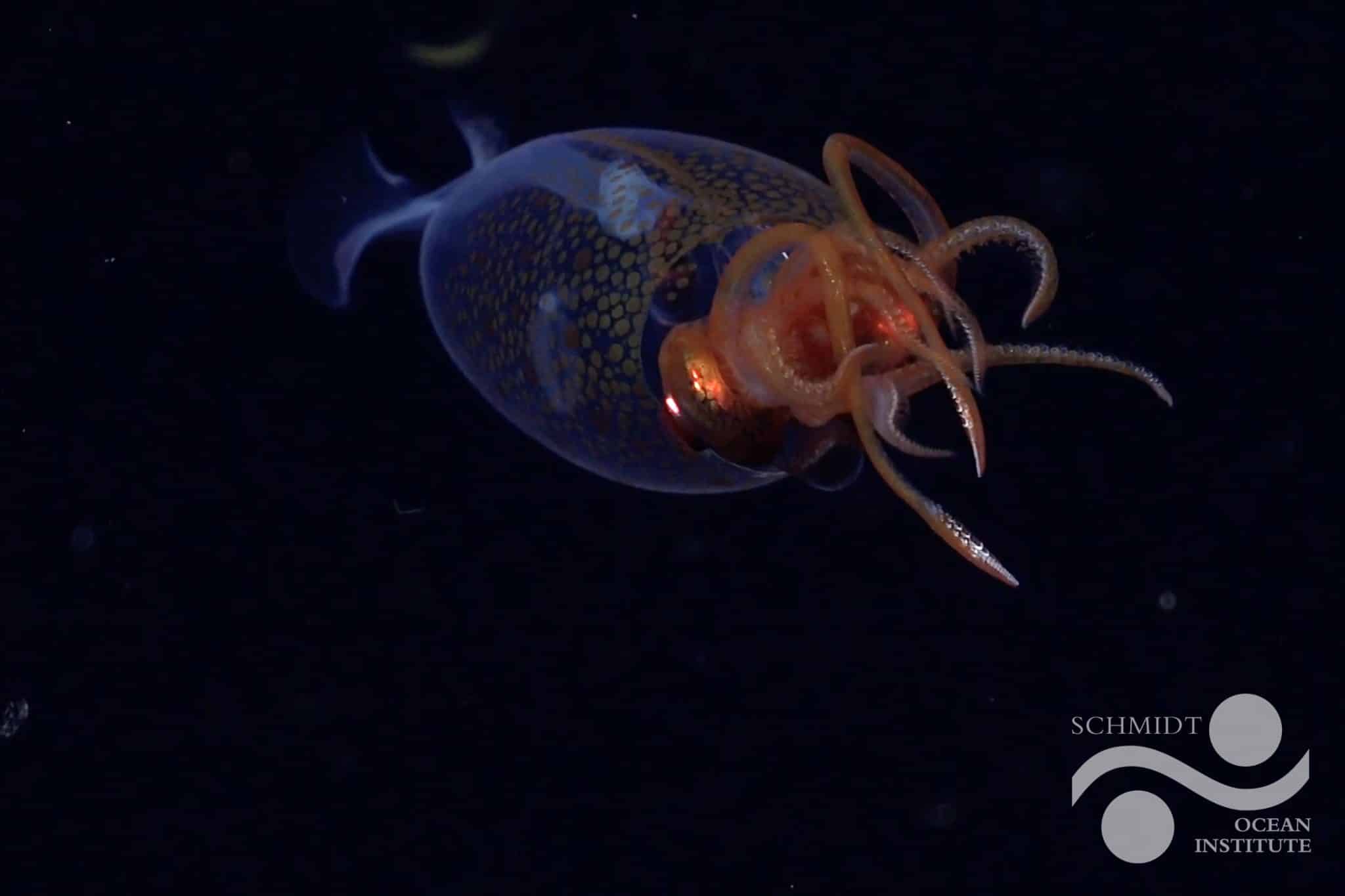
Imagine capturing a glimpse of a deep-sea legend—something no human has ever seen alive in its natural habitat. That dream turned into reality this March when scientists aboard the research vessel Falkor (too) recorded the first confirmed footage of a colossal squid in the wild—and not just any colossal squid, but a juvenile, only about 30 centimeters long.
The baby colossal squid, Credit: Wikipedia
Filmed at a chilling depth of 600 meters in the waters near the South Sandwich Islands, this translucent baby was caught on camera by SuBastian, the remotely operated vehicle of the Schmidt Ocean Institute. While it may only be the size of a school ruler today, this baby could someday grow into a sea giant—over 7 meters (23 feet) long and weighing up to 1,100 pounds, making it the heaviest invertebrate on Earth.
This year marks 100 years since scientists first named the colossal squid, and until now, most of what we knew came from remains found in the bellies of whales or floating lifeless at sea. But this stunning discovery changes everything. “It’s exciting to see the first in situ footage of a juvenile colossal and humbling to think that they have no idea that humans exist,” said Dr. Kat Bolstad of the Auckland University of Technology.
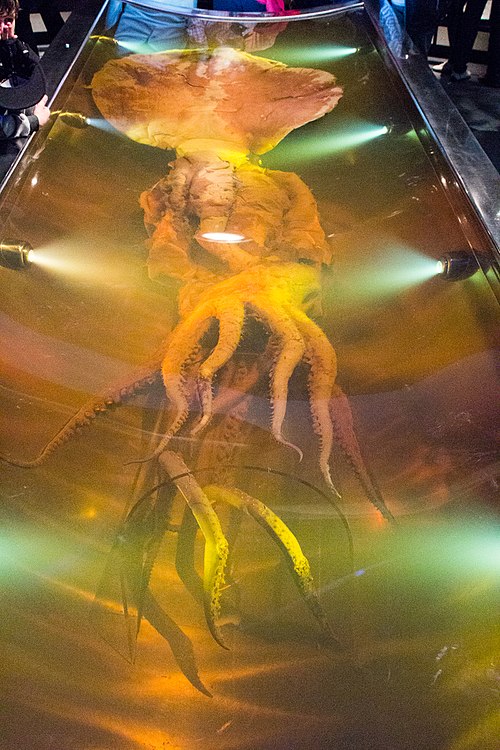
Colossal squid preserved in the Museum of New Zealand Te Papa Tongarewa, Credit: Wikimedia Commons/Oren Rozen
Using the latest ocean exploration tech, scientists have now taken us one step closer to understanding the secret life of these elusive giants.
And the surprises didn’t stop there. Just weeks before, the Falkor (too) team recorded another first—footage of a glacial glass squid (Galiteuthis glacialis) alive in its natural setting in the Southern Ocean near Antarctica. These two “firsts” back-to-back are more than just lucky finds—they’re a glimpse into an ocean still teeming with wonders we’ve barely begun to explore.
While both squid species have similar ghostly, transparent bodies, experts like Dr. Aaron Evans and Dr. Bolstad distinguished the colossal squid by its hooked arms, a key trait setting it apart from its glassy cousin.
The expedition, part of the Ocean Census initiative led by a global team of researchers, used live-streaming tech and deep-sea ROVs to share their discoveries with experts around the world, turning the moment into a global scientific celebration. “The Ocean Census international science network is proud to work together with the Schmidt Ocean Institute to accelerate species discovery,” said Dr. Michelle Taylor, Chief Scientist of the South Sandwich Islands expedition.
The glacial glass squid, captured on film at 687 meters deep, was seen raising its arms in a peculiar “cockatoo” pose—just one of many behaviors that hint at how much more we have to learn.
“The first sighting of two different squids on back-to-back expeditions is remarkable and shows how little we have seen of the magnificent inhabitants of the Southern Ocean,” said Schmidt Ocean Institute’s executive director, Dr. Jyotika Virmani. “Fortunately, we caught enough high-resolution imagery of these creatures to allow the global experts, who were not on the vessel, to identify both species.” This juvenile squid might be small for now, but it represents a giant leap for ocean discovery. These moments remind us that the ocean, vast and mysterious, is still full of secrets waiting to be revealed.
So, the next time you look out at the endless blue, just imagine—somewhere deep below, a baby giant might be swimming, unseen… until now.
Copyright @smorescience. All rights reserved. Do not copy, cite, publish, or distribute this content without permission.
Join 20,000+ parents and educators
To get the FREE science newsletter in your inbox!
SUBSCRIBE TO OUR NEWSLETTER
.......... ..........
Subscribe to our mailing list to get updates to your email inbox.