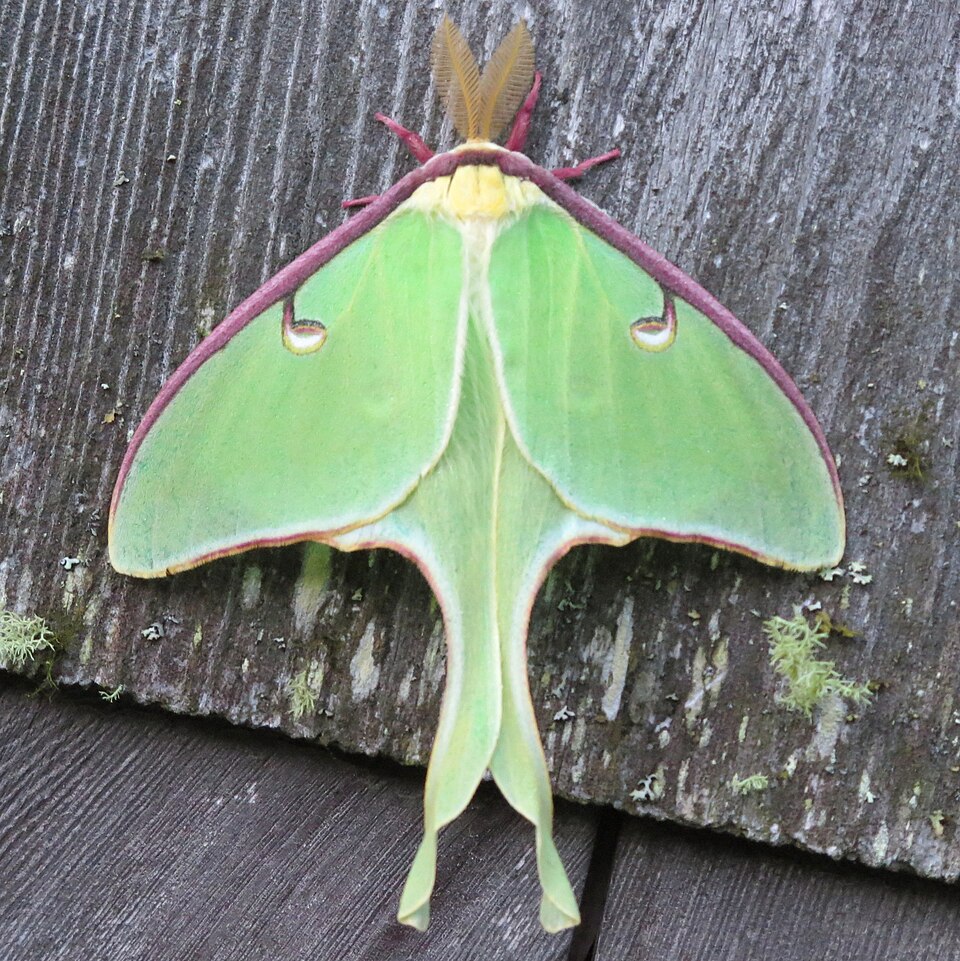
Luna moths are beautiful in themselves, with twisted or cupped streamers, which are ribbony ends present in the hind wings. For the first time, biologists have established a link between the tail-like streamers and warm weather.
Wing streamers with twisting or cupped ends have evolved independently at least five times in the family of luna and other moon moths (Saturniidae), says behavioral ecologist Juliette Rubin, now at the Smithsonian Tropical Research Institute in Balboa, Panama. The wings make it into the list of evolution novelties like the peacock’s large feather and the narwhal’s singular tusk. Moon moths can grow wings as big as a human palm, often vibrantly colored. The winged phase lasts only during the last week of a moth’s life, during which they mate.
The streamers don’t use their extensive hind-wing tail ends to mate. Instead, they confuse bats with the help of these streamers—the predatory bats, which use echolocation, are constantly fooled across time and the night sky.
Unlike many other prey, luna moths fail to listen to bats’ sonar clicks. They are also unable to make sounds that scare off the bats. Instead, the fluttering ends attract the bats that bite off these thin streamers instead of targeting some other vital organ close to the main body.
The evolution of large body parts generally comes with their own risks, which are tough to find. For example, extra-large wings might create flight problems, although these moths don’t show any problem with flight. More experiments can uncover further details regarding the wingspan evolution. What makes more sense now is to find the physical cost of growing such large wings. Rubin’s team looked at photos posted by citizen scientists on iNaturalist to check where moths have pompous wings and where they don’t. To standardize size comparison, the team looked at antenna length.
Two main factors drive this evolution in luna moths. Firstly, the presence of insect-eating bats favored evolving longer wing tails, giving an anti-predator approach. Secondly, a less obvious factor is the presence of warm and steady temperatures. Warmer areas provide the moth larvae with more time to feed. Increased nourishment helps the moth to develop large wings for their adult grandeur.
Copyright @smorescience. All rights reserved. Do not copy, cite, publish, or distribute this content without permission.
SUBSCRIBE TO OUR NEWSLETTER
.......... ..........Subscribe to our mailing list to get updates to your email inbox.
Monthly Newsletter