Imagine, the very thing helping to protect you from deadly bacteria might already be living on your skin quietly, invisibly, and without asking for anything in return.

That’s exactly what researchers at the University of Oregon discovered in a surprising twist of biology. Their study, recently published in Current Biology, reveals that a common skin fungus called Malassezia, which most of us carry without ever noticing, is a powerful weapon in the fight against one of the most dangerous hospital superbugs—Staphylococcus aureus.
You might not know it, but Staphylococcus aureus (or “staph”) is a big problem. It usually lives harmlessly inside the noses of about a third of people, but under the wrong conditions—like a scrape, a surgical wound, or a weakened immune system—it can cause serious infections. Every year, this bacterium is responsible for over 500,000 hospitalizations in the U.S. alone.
And here’s the scary part: it’s becoming harder and harder to treat, thanks to antibiotic resistance. But in a discovery that almost feels poetic, your skin may be fighting back all on its own.
“There are lots of studies that identify new antibiotic structures,” said Caitlin Kowalski, a postdoctoral researcher who led the study. “But what was fun and interesting about ours is that we identified [a compound] that is well-known and that people have studied before.”
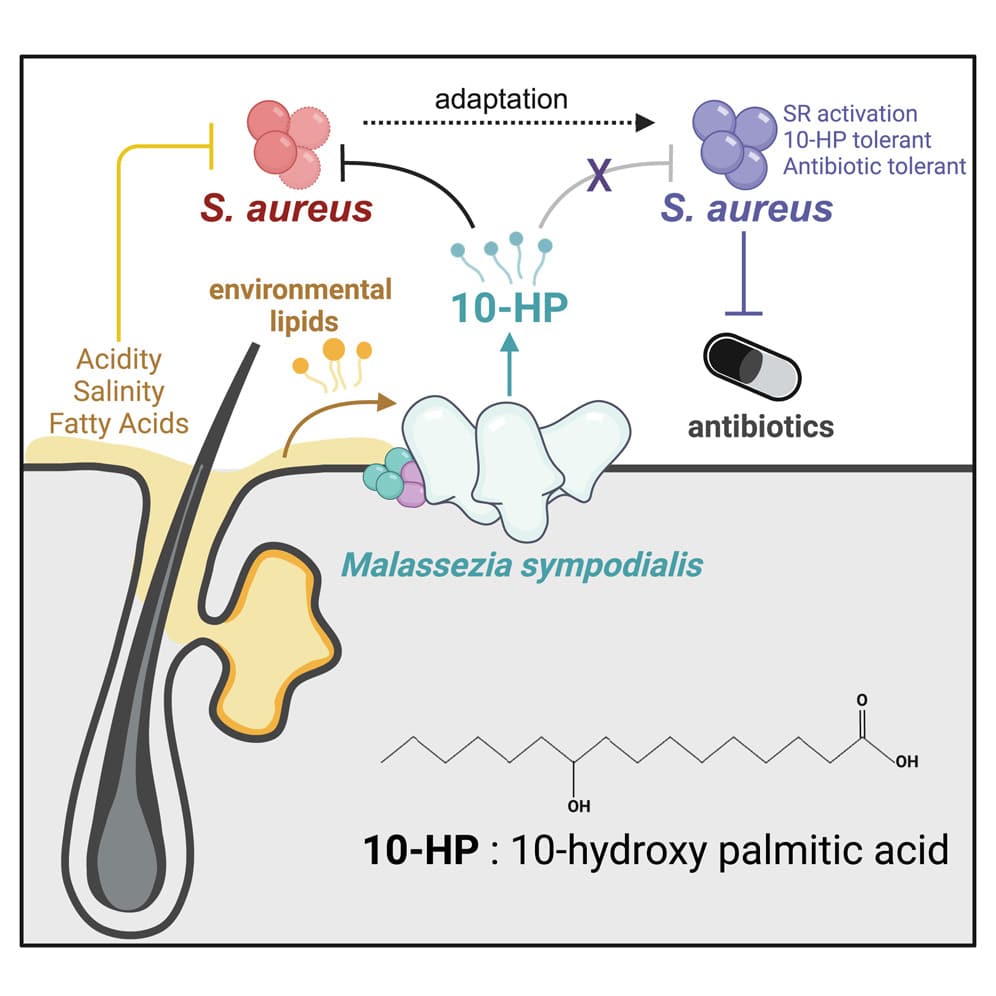
The fungus Malassezia, which usually gets attention for causing dandruff or dry patches on skin, actually breaks down skin oils into special fatty acids. These fatty acids act like microscopic disinfectant soap. They punch holes in the bacteria’s outer layers, causing them to leak and die.
And it works fast. In lab experiments, the fungus wiped out Staphylococcus aureus in just 15 minutes. But this powerful effect only happens under acidic conditions, and while our skin naturally has a low pH, most lab experiments don’t mimic that. That’s probably why this compound, even though it was known, hadn’t been recognized before as a bacterial assassin.
“I think that’s why in some cases we may have missed these kinds of antimicrobial mechanisms,” Kowalski added, “because the pH in the lab wasn’t low enough. But human skin is acidic.”
It turns out our skin has been creating its antibiotics all along; we just hadn’t been looking in the right way. The more scientists looked, the more fascinating the story became. When Staphylococcus aureus was exposed to the fungus for a long time, it started to fight back, evolving to become more tolerant, just like it does with traditional antibiotics.
Kowalski and her team found that the bacteria mutated a specific gene that helps them survive under stress, the same mutation seen in human patients during tough infections.
It’s a sobering reminder: even natural solutions can trigger resistance. And when we use bacteria or fungi as medicine, a strategy growing in popularity, we must tread carefully.
“There’s growing interest in applying microbes as a therapeutic,” Kowalski said. “But it can have consequences that we have not yet fully understood.”
Finding the fatty acid behind this effect took three years and a team of researchers from both Oregon and Canada. It was no small feat; “It was like finding a needle in a haystack but with molecules you can’t see,” as Kowalski’s advisor, Dr. Matthew Barber, put it.
But now that they’ve uncovered this microbial marvel, Kowalski is already planning the next step. She’s launching her lab to dive deeper into the world of skin fungi, a frontier that has been largely overlooked in medicine.
“The skin is a parallel system to what’s happening in the gut, which is really well-studied,” she said. We’ve long known that our gut bacteria play a key role in our health. Now it seems our skin microbiome, especially when it involves fungi, may be just as important.
This discovery isn’t just about science, but about rethinking what health means. It’s about realizing that our bodies are ecosystems, full of invisible helpers working quietly in the background.
So it might be possible that the next life-saving antibiotic won’t come from a research laboratory, but from the yeast already living on your skin.
Copyright @smorescience. All rights reserved. Do not copy, cite, publish, or distribute this content without permission.
SUBSCRIBE TO OUR NEWSLETTER
.......... ..........Subscribe to our mailing list to get updates to your email inbox.
Monthly Newsletter