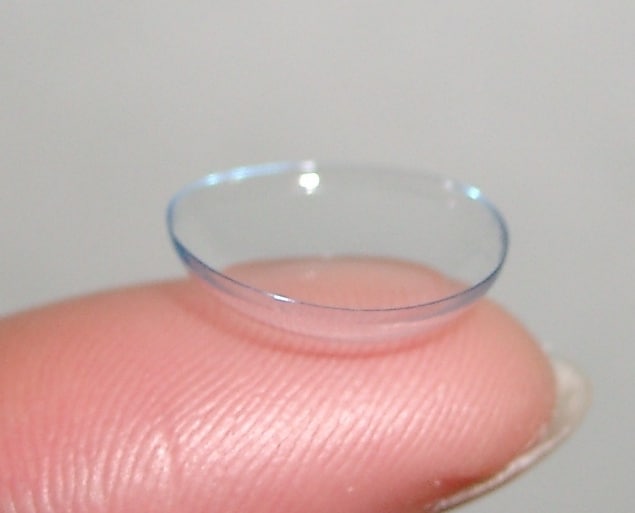
Till now, to see infrared light, humans had to rely on clunky night-vision goggles. Now, a new type of contact lens has been invented by a team led by scientists at the University of Science and Technology of China (USTC) in Hefei that can convey infrared vision. Interestingly, the device allows viewing infrared light even when the eyes are closed.
The researchers embedded nanoparticles into the lenses to convert light in the near infrared range of 800-1,600 nanometers to that of the visible light range of 400-700 nanometers. Near-infrared light is just beyond the range of wavelengths that humans can normally detect. Although some animals can sense infrared light, they are not good at forming images. Night vision goggles allow humans to see light in the infrared zone, but are bulky and need a power source. These new contact lenses remove the need for a power source and reduce the bulk, all while producing multicolored, richer images that night vision goggles fail to provide in their monochrome green scale.
Although all seems good for this new tech, the technology has certain cons. Firstly, the lenses work well only in high-intensity infrared light, like that produced by an LED. On the other hand, night vision goggles amplify low-level infrared light signals to produce an image. The other problem is the resolution of the image. The images are blurry due to the presence of the nanoparticles that scatter light. The team was able to partially correct this by adding additional lenses that redirect the light.
Despite the shortcomings, the researchers and authors think that the lenses can be further optimized and can be used in various scenarios. For instance, wearers could read anti-counterfeit marks that emit infrared wavelengths but are otherwise invisible to the human eye, says co-author Yuqian Ma, a neuroscientist at the USTC. Another use of these contact lenses can provide better vision during near-infrared fluorescence surgery to directly detect and remove cancerous tumors and lesions without using bulky equipment. However, some critics think the invention will not be as useful as it seems on the surface level.
To make the contact lenses, the scientists previously added nanoparticles to the retinas of mice to give them infrared vision. This time, they have taken a different approach by adding nanoparticles of ytterbium and erbium to a soup of polymers that served as the building blocks of the soft lenses, before testing them for safety. According to Ma, the main roadblock was to fit enough nanoparticles into the lenses to convert infrared light into visible light. They also had to keep an eye on maintaining the properties of the lenses, such as transparency.
Tests in mice wearing the contact lenses showed that they chose a box that was dark as a ‘safe’ one, over a box lit up with infrared light. Mice without the lenses didn’t have any preference. On the other hand, humans could recognize flickering infrared light from an LED to sense Morse code and also figure out the direction from which the signals were coming. Moreover, the lenses’ performance became better when the eyes were closed. This happened because near-infrared light penetrates the eyelids easily, while visible light does so to a lesser degree. In fact, visible light could have interfered with image formation.
Future plans involve putting more nanoparticles into the lenses to increase the sensitivity of the technology. Designing new particles that are more efficient at converting infrared light into visible light is also a priority.
Copyright @smorescience. All rights reserved. Do not copy, cite, publish, or distribute this content without permission.
SUBSCRIBE TO OUR NEWSLETTER
.......... ..........Subscribe to our mailing list to get updates to your email inbox.
Monthly Newsletter