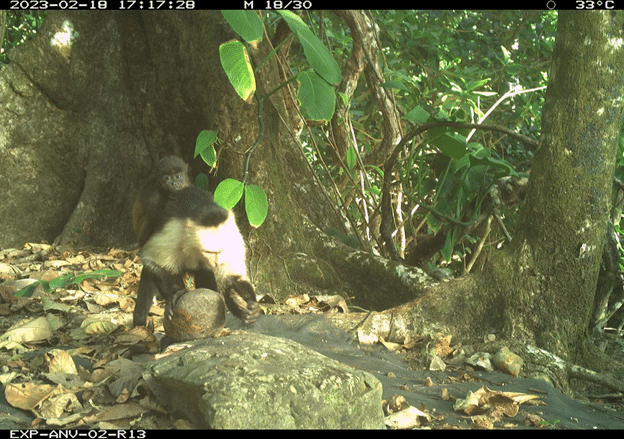
White-faced capuchins on Jicarón Island in Coiba National Park have been recorded using stone tools, and scientists have been tracking this unique tradition with an array of motion-triggered cameras on the island since 2017. However, when a doctoral researcher at the Max Planck Institute of Animal Behavior, Zoë Goldsborough, was looking through the camera trap footage in 2022, she found an unusual event, something they had never recorded in the previous five years of data: a white-faced capuchin monkey carrying an infant howler monkey on his back. Since then, biologists have seen five male capuchin monkeys, mostly juvenile and subadult, carrying at least eleven different infant howler monkeys — a behavior never before seen in wild primates. Eighty-five camera traps allowed scientists to find the origin and subsequent spread of this social tradition or “fad” over 15 months.
Goldsborough recalls consulting his advisor to understand what was going on. The biologists established the behavior as rare and jumped straight to investigation. “We had all the footage from cameras on Jicarón for the whole year,” says Brendan Barrett, a group leader at MPI-AB and Goldsborough’s advisor, “so we could reconstruct the scene to see if this weird behavior was just a one-off, or something bigger.”
After digging through thousands of pictures and videos captured by their cameras, she found that one specific subadult male capuchin, whom she named Joker, carried four different howler monkeys. At first, the team thought this behavior could be similar to adoption. In 2006, a pair of capuchins raised a baby marmoset to adulthood, so this wasn’t an uncommon behavior. However, females mainly carry out animal adoption to practice caring for infants. In this case, it was exclusively adults carrying the howlers.
However, for a few months, the act of kidnapping baby howlers stopped. As per Barrett, the capuchins tried something new, which sits well with their curious behavior and exploratory nature. Eventually, though, the team discovered more juvenile, young adults kidnapping and carrying more infant howler monkeys. Over a 15-month period, these five capuchins carried 11 different howlers up to 9-day periods. The camera footage unraveled the sight of the howler babies clinging to the backs or bellies of their young male carriers. These males appeared to be going about their day normally: travelling or using tools to crack open food sources. The authors describe this as a social tradition or cultural fad. Cultural fads are learnt through social learning. It is similar to trends seen in other animals, such as killer whales donning “salmon hats” or chimpanzees wearing a blade of grass like an accessory on their ears.
The behavior of the capuchins is shrouded in mystery as they do not gain much from the abduction. They don’t get more attention from group mates, do not eat the babies, nor do they play with the four-week-old howler infants. Four of the eleven howlers also perished due to malnutrition, as males couldn’t provide the breast milk necessary for the survival of the young ones. As per Goldsborough, there is no clear gain for the capuchins.
Boredom is one of the main reasons why the juvenile capuchins abducted the howlers. It has been seen that capuchins are innovative when they are bored. From imitating human behavior to using stone tools, male capuchins on Jicarón Island know it all. Most primates grow independent from their mothers’ influence during adolescence, when they start to explore and forage on their own. The monkeys also aren’t fully imbibed into their group’s society yet either. Thus, this period becomes an important one for learning new stuff.
“One of the ways we are different from many animals is that we have many of these sort of arbitrary, nearly functionless cultural traditions that really harm other animals,” she added. Truly enough, the activity of kidnapping in capuchins is arbitrary, or maybe moderately entertaining. The scientists hope that the capuchins let go of this behavior, just as human fads come and go. The other option is that howler monkeys catch on to this behavior and trigger safety measures.
Copyright @smorescience. All rights reserved. Do not copy, cite, publish, or distribute this content without permission.
SUBSCRIBE TO OUR NEWSLETTER
.......... ..........Subscribe to our mailing list to get updates to your email inbox.
Monthly Newsletter