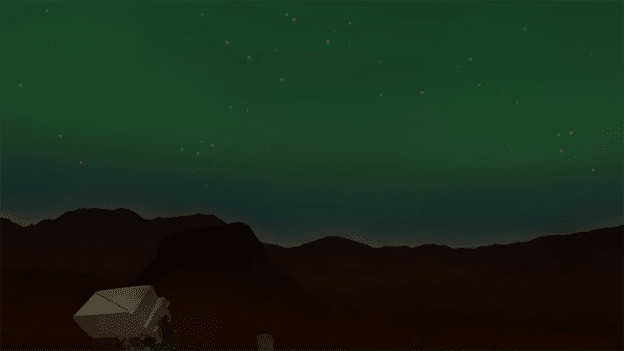
NASA’s Perseverance rover has captured pictures of a visible-light aurora from the surface of Mars. Although they aren’t as vivid and beautiful as Earth’s, they still produce a color show that’s fascinating to watch. This is the first time an aurora has been observed from the surface of another planet, and the first visible aurora seen on Mars. The faint greenish glow of the aurora was photographed in March last year, and the pictures have been published in a new study in Science Advances.
Auroras on Earth are caused by particles arising from the Sun that interact with the Earth’s magnetic field. Auroras have been observed on every other planet in the Solar System. It has been 20 years since the aurora on Mars was observed from space. Unlike Earth, Mars lacks a global magnetic field, but has patches of magnetic field. Slightly different phenomena therefore form the auroras.
One type of aurora comes from super-energised particles from the Sun hitting the Martian atmosphere. This is known as the solar energetic particle (SEP) aurora. These auroras have been observed before through NASA’s MAVEN instrument that orbits Mars, in UV light.
However, spotting an aurora from the surface of Mars became possible only when a solar flare and a coronal mass ejection (CME), which is a large burst of magnetic field and plasma from the outer surface of the Sun, the corona, headed in the direction of Mars last year. The team scrambled to ready the rover, which was moving slowly along the Jezero Crater on Mars.
To spot the aurora, the team used a computer model to predict the location and when the aurora would show in the Martian sky. They also predicted the possible intensity and color of the aurora lights. As expected, the particles from CME reacted with oxygen atoms in the Martian atmosphere to produce a faint greenish glow.
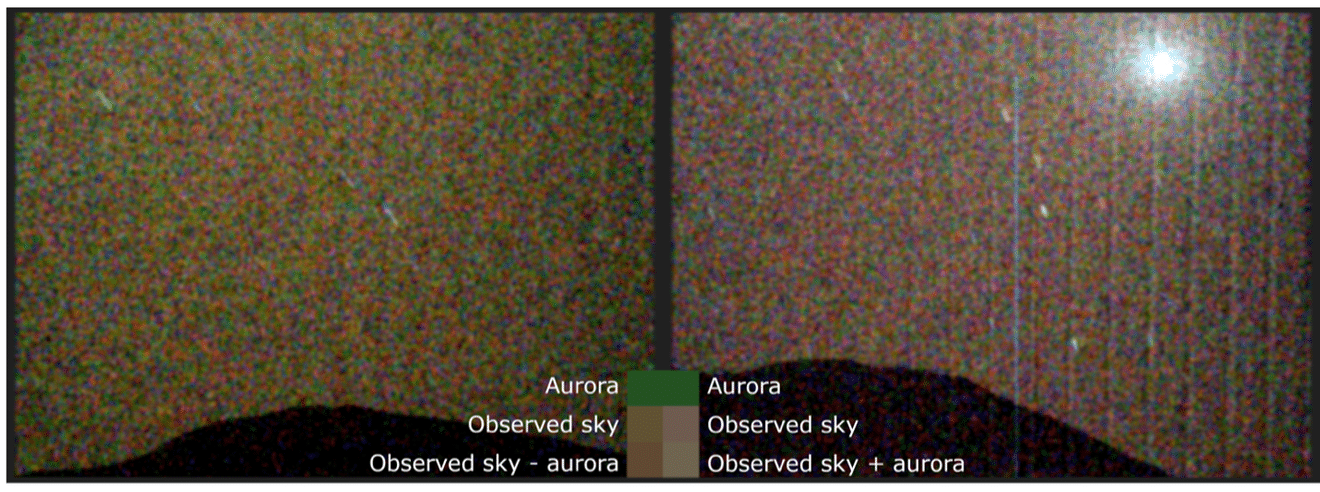
Elise Knutsen, a physicist at the University of Oslo and lead author of the study, said the team needed to pick a strong CME to test their models. When they checked the strength of this specific CME, they had high hopes about possibly photographing an aurora arising out of this CME. Days after the solar flare, two instruments on Perseverance recorded an exact shade of green in the Martian sky as predicted.
Despite being cool, Martian auroras are hardly as dazzling as the ones on Earth. In fact, on Earth, photographs that show such dazzling aurora lights come after they are exposed for a few minutes, while in reality, they lack such vividness and brightness. The same goes for Martian auroras, as they would lack the brightness and produce even fainter glows than those produced on Earth. Mars lacks a magnetic field, so the solar particles that crash into the atmosphere produce less light. As Dr. Schunker, a physicist at the University of Newcastle who wasn’t involved in the research, puts it, the observed light will not be too obvious to the eye.
Although Martian auroras are not the best light show in the Solar system, the research can shed some light on solar weather from various angles. We can expect more observations like this in the future, says Dr. Schunker, due to solar maximum. Solar maximum is the point during the 11-year solar cycle when the Sun produces the highest number of solar flares and sunspots. This is also the reason why Earth received a greater number of auroras last year, and also in areas far from the poles. Since Mars is not aligned with Earth, the particular CME that caused the Martian auroras didn’t affect Earth. As for solar maximum, we are possibly in the middle of it, or approaching a solar maximum; it’s hard to tell until one has passed through one.
Copyright @smorescience. All rights reserved. Do not copy, cite, publish, or distribute this content without permission.
SUBSCRIBE TO OUR NEWSLETTER
.......... ..........Subscribe to our mailing list to get updates to your email inbox.
Monthly Newsletter