A Giant Galaxy From the Early Universe Is Breaking the Rules of Space and Time

What if we told you that a galaxy as big as the Milky Way formed when the universe was just getting started? That’s exactly what astronomers discovered when they found the “Big Wheel”—a massive, swirling galaxy from just 2 billion years after the Big Bang. It’s like finding a full-grown tree in a world of saplings. This shocking discovery, made using NASA’s James Webb Space Telescope (JWST), is shaking up everything scientists thought they knew about how galaxies grow and evolve.

Big Wheel galaxy
The Big Wheel galaxy and its cosmic environment. The galaxy is a giant rotating disk at redshift z = 3.25, with clear spiral arms. It is so far unique for its large disk size of around 10 kpc, larger than any other galaxy disks confirmed at similar redshifts. Credit: Nature Astronomy

For decades, scientists believed that large disk galaxies, like our Milky Way, took billions of years to grow and settle into their smooth spiral shapes. But the Big Wheel—a disk galaxy nearly 98,000 light-years wide—is turning that idea on its head. Found in a dense region of space packed with galaxies, this cosmic giant is living proof that galaxies could grow up much faster than expected.

The Big Wheel didn’t just form early—it also spins fast, at nearly 300 kilometers per second. That’s the same speed as many well-developed galaxies today. Its massive size and well-formed spiral structure were spotted by JWST, with support from other powerful telescopes like Hubble, ALMA (Atacama Large Millimeter Array), and VLT (Very Large Telescope).

This discovery happened in a surprisingly crowded patch of space—a so-called “proto-cluster” of galaxies about 11–12 billion light-years away. These jam-packed environments may have created the perfect storm for rapid galaxy growth. Scientists believe gentle galaxy mergers or smooth gas inflows could have helped the Big Wheel maintain its beautiful shape while growing quickly.

“This dense environment likely provided ideal conditions for rapid growth,” explains Themiya Nanayakkara from Swinburne University of Technology in Australia. “It probably experienced mergers that were gentle enough to let the galaxy maintain its disk shape.”

Da-sinistra
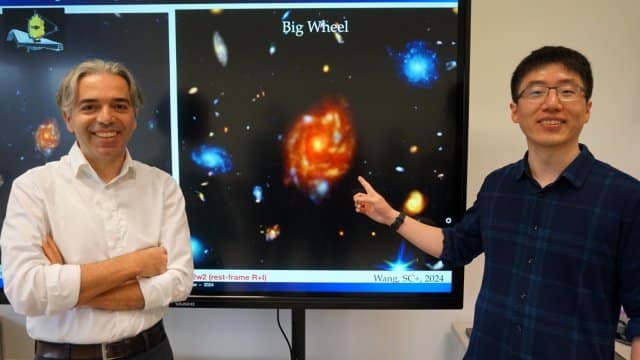
Sebastiano Cantalupo (on the left) and Weichen Wang. Scientists have found a massive disk galaxy in the early universe, defying expectations about how quickly such structures can form. Credit: University of Milano-Bicocca

Astronomers used JWST’s powerful infrared instruments to zoom into this crowded part of the sky. They studied the shapes, distances, and speeds of galaxies to pick out the Big Wheel and understand how it’s rotating. They even saw blue clumps of young stars glowing in its spiral arms—a sign of intense star formation.

“We analyzed their distances, shapes, and motions to confirm the presence of a galactic disk,” said researcher Weichen Wang from the University of Milano-Bicocca.

The Big Wheel’s existence suggests we might need to rewrite the rules of galaxy formation. Until now, most models assumed it would take most of the universe’s lifetime—13.8 billion years—for galaxies to grow this big. But if more “Big Wheels” are out there, scientists may have to rethink how fast galaxies can mature.

“Finding one of these galaxies isn’t a problem for current models, but if we keep finding more, we may need to refine our understanding,” Nanayakkara adds.

How does the Big Wheel stack up against other famous galaxies?

  • Milky Way: Roughly the same size, about 100,000 light-years across.
  • Andromeda: Bigger, at 150,000 light-years, but it took far longer to grow.
  • Messier 87: Giant elliptical galaxy with an enormous black hole—not disk-shaped.
  • Triangulum Galaxy (M33): A modest 60,000 light-years wide, still growing.
  • Sombrero Galaxy (M104): Strikingly beautiful, but more traditional in structure.

Unlike many of these galaxies, the Big Wheel might have formed from a cosmic collision, creating its rare ring-like features and starburst zones.

Scientists say there was less than a 2% chance of spotting a galaxy like the Big Wheel during this survey. But now that they have, the hunt is on to find more. If astronomers uncover other massive galaxies from the early universe, it could signal a whole new chapter in our understanding of cosmic history.

The Big Wheel is more than just a beautiful cosmic object — it’s a time machine showing us that the universe may have built its giants sooner than we thought. As scientists continue to explore deep space with JWST and beyond, we may soon discover that the early universe was full of surprises that are still waiting to be revealed.

For now, the Big Wheel spins on, challenging everything we thought we knew about the beginning of time.

For more details, refer to Nature Astronomy.

Copyright @smorescience. All rights reserved. Do not copy, cite, publish, or distribute this content without permission.


Join 20,000+ parents and educators
To get the FREE science newsletter in your inbox!