Researchers have done the “impossible”, as stated by scientists before. The previously thought unattainable goal of building a complete functional wiring diagram of a portion of the brain has finally been attained through research involving 150 neuroscientists and researchers during the last seven years. The Machine Intelligence from Cortical Networks (MICrONS) Project has built a mammalian brain’s most intricate and detailed wiring diagram to date. The overall diagram and data amount to 1.6 petabytes, which equals 22 years of non-stop HD video.
According to David A. Markowitz, PhD., former IARPA manager who coordinated the work, the advances of MICrONS are at par with the Human Genome Project in their transformative potential. This is also the first platform that leveraged studying the “relationship between neural structure and function at scales necessary to understand intelligence.”, says Markowitz.
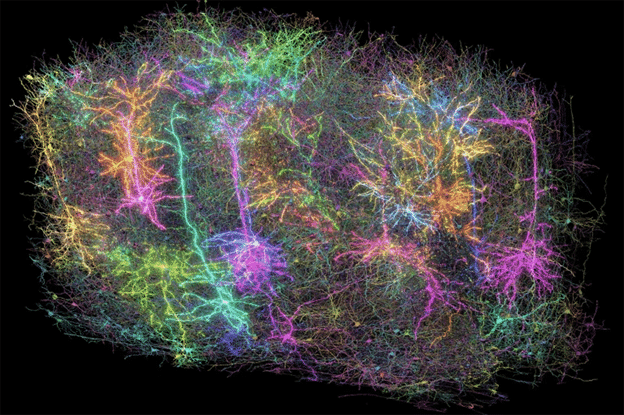
To create the groundbreaking map, the researchers recorded the firing of 76,000 neurons in the visual cortex of a mouse as it watched movies and YouTube clips through specialized microscopes. The recorded activity was on one cubic millimeter portion of the mouse’s brain. Later, researchers at Allen Institute sliced the same cubic millimeter of the brain into more than 25,000 layers, each with one-four-hundredth of the width of a human hair. Electron microscopes were then used to take high-resolution pictures of each slice. Finally, a team at Princeton University used artificial intelligence and machine learning to reconstruct the cells and connections into a 3D map. Along with recordings of brain activity, the result is the designing of the largest functional and wiring diagram of the brain to date. The wiring diagram contains more than 200,000 cells, 523 million synapses (connection points between neurons and cells) and 4 kilometer of axons, which are branches coming out of neurons that connect with other cells. According to Clay Reid, PhD., senior investigator, the tiny speck holds an entire architecture within itself, and is a great way to test old neuroscience theories and hope to find new ones that have not been observed before.
The findings revealed new cell types, organizational and functional principles, etc. One of the most interesting find involves the discovery of a new principle of inhibition within the brain. What was previously thought as random actions of inhibitory cells, has now been seen in a new light, which involves high selectivity in their actions.
Understanding the brain’s form and function and how the neurons network can help in analyzing diseases like Alzheimer’s, Parkinson’s, schizophrenia, etc. in near future. In 1979, molecular biologist Francis Crick, stated that creating an exact wiring diagram for a cubic millimeter of brain tissue is impossible. However, MICrONS has proved this theory wrong, and is making landmark research developments as it progresses in their mission of mapping the brain.
Copyright @smorescience. All rights reserved. Do not copy, cite, publish, or distribute this content without permission.
SUBSCRIBE TO OUR NEWSLETTER
.......... ..........Subscribe to our mailing list to get updates to your email inbox.
Monthly Newsletter