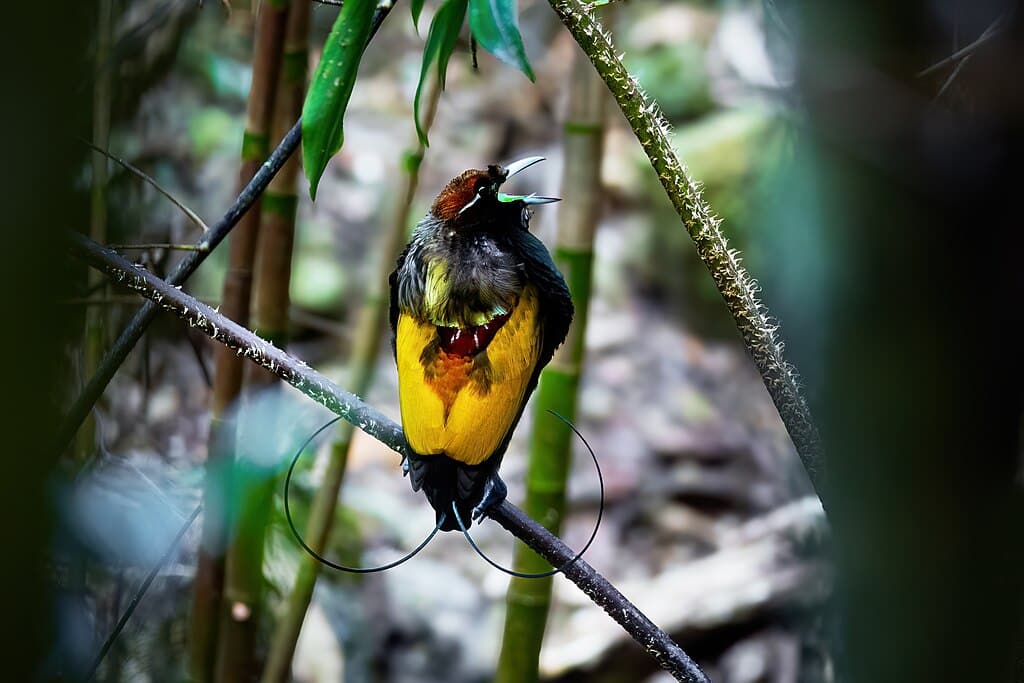
Birds of paradise have a unique color palette. Ranging from emerald and ruby, these vividly colored birds also display color signals that are invisible to the human eye. New research claims that their feathers and some body parts glow in certain areas when viewed under blue and ultraviolet (UV) light. The parts appear bright green or yellow-green and are most likely used as visual cues during courtship displays and territorial disputes.

These bio-fluorescent feathers differ from bioluminescence, which involves light production due to chemical reactions within the animal’s body. For example, the glowing light of fireflies is due to chemical reactions within their body, producing light. On the other hand, biofluorescence occurs when certain parts and the feathers of the birds absorb high-energy wavelengths of light, like UV, light in the violet and blue spectrum, and then emit light in a lower-energy wavelength, like yellow or green.
Researchers have detected biofluoroscence in 37 of the 45 known species of birds-of-paradise, which are found only in remote tropical forests of Papua New Guinea, parts of Australia, and eastern Indonesia.
Many birds can see colors in the UV spectrum. However, little information is available about the color vision of birds of paradise. Closely related species, such as crows, ravens, fantails, and the Pica genus, a type of magpie, can view colors in the violet spectrum. To them, green or yellow-green fluorescent signals shine like beacons in the dark. Lead researcher Dr. Rene Martin sees this research as a new opportunity to retrace the questions about how birds use visual cues. Although studies have described how birds-of-paradise communicate using colors, visual communication through fluorescent signals has not been described before.
Senior study author Dr. John Sparks, a curator at the American Museum of Natural History, identified biofluroscence in fish. In his search for similar traits, he swept through the museum’s ornithology collection with blue light, revealing the biofluorescent display. When Rene Martin joined the museum as a postdoctoral researcher, she delved deeper. She swept through the specimens using UV and blue flashlights. She wore goggles that filtered out the blue light, leaving the fluorescent light to be seen by Martin. Then, the biofluorescent species were photographed in a lightless room, and their emissions were measured. Fluorescence was found in different body parts like necks, bellies, and heads. Some species had gleaming bills and glowing feathers. Darkly pigmented feathers contrasted these fluorescent areas. Ultra-black feathers were also found, which sucked in most of the light.
With this new discovery, a lot more about communication in birds can be unearthed. Biofluorescent substances themselves can be beneficial in our advancement. For example, a biofluorescent protein found in a certain jellyfish is used to stain biological samples. Overall, this discovery might open doors to new research into the world of birds-of-paradise.
Copyright @smorescience. All rights reserved. Do not copy, cite, publish, or distribute this content without permission.
SUBSCRIBE TO OUR NEWSLETTER
.......... ..........Subscribe to our mailing list to get updates to your email inbox.
Monthly Newsletter