The European Space Agency launched Euclid in 2023 to discover the shrouded secrets of dark matter and dark energy. In September 2023, Euclid sent back its first pictures as part of the early testing phase. The pictures were blurred for calibration purposes, but one photo caught the attention of Euclid Archive Scientist Bruno Altieri. He recognized the unusual in the picture—a rare cosmic event.
Euclid Space Telescope, Credit: Wikimedia/European Space Agency
Einstein predicted this rare cosmic event in his concept of general relativity. Known as an Einstein ring, this kind of event occurs due to gravitational lensing, in which the huge celestial mass bends light due to its enormous gravitational force. Gravitational lensing allows scientists to view faraway galaxies which would otherwise be hidden from our eyes. Euclid’s early find is a special one, and we have only started to fathom what the capabilities of this space telescope are yet to bring in the future. As Altieri puts it, his lifelong interest in gravitational lensing brought him a fantastic reward. This perfectly shaped Einstein ring shows the power of gravity in warping the space-time fabric.
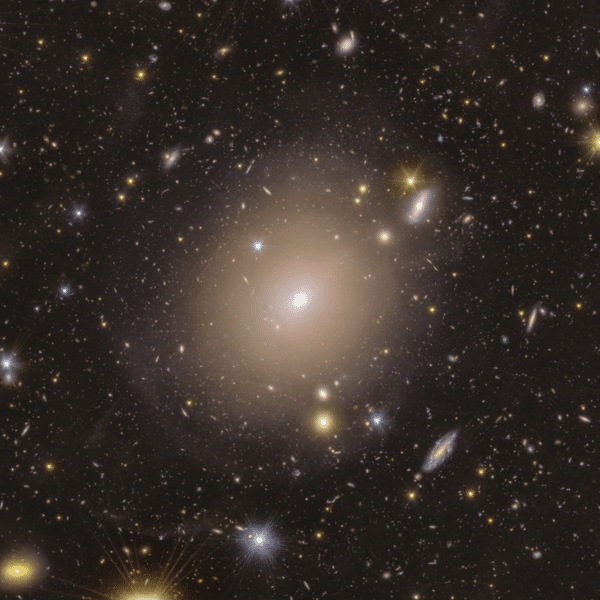
Ring of light around NGC 6505, Credit: Wikimedia/European Space Agency
The event has occurred in the cosmic backyard of Earth, in galaxy NGC 6505, which is only 590 million light-years away from the Earth. The mass of this galaxy bent the light coming from a more distant galaxy into a ring through gravitational lensing. Euclid’s high-resolution instruments have captured this luminous ring of light around the galaxy for the first time. The ring has been formed out of light coming from a galaxy that is 4.42 billion light years away. This galaxy has no name yet and has not been observed before.
Albert Einstein predicted the presence of gravitational lensing in his theory of general relativity. According to him, light bends around objects in space, and the larger the object, the greater its chance of warping light and space-time fabric itself. Galaxies or clusters of galaxies have a substantial gravitational lensing effect, allowing hidden light from distant galaxies to be visible. The Einstein rings are rich knowledge hubs for astronomers, as they can help us learn about the universe’s expansion, detect the effects of dark energy and dark matter, and dig deeper into the background source whose light is being bent by dark matter between us and the source.
NGC 6505 was discovered in 1884 and has been known to man for decades. Yet the ring has just been discovered, which shows Euclid’s potential for finding new things even in the most recognizable areas of the universe. Euclid’s exploration through the universe will also be a glimpse into cosmic history, which should reveal more information about the role of gravity, dark energy, and dark matter. Euclid is expected to find 100,000 strong lenses and map a third of the sky. Euclid will revolutionize the field of astronomy with new data that we never had before.
Copyright @smorescience. All rights reserved. Do not copy, cite, publish, or distribute this content without permission.
Join 20,000+ parents and educators
To get the FREE science newsletter in your inbox!
SUBSCRIBE TO OUR NEWSLETTER
.......... ..........
Subscribe to our mailing list to get updates to your email inbox.