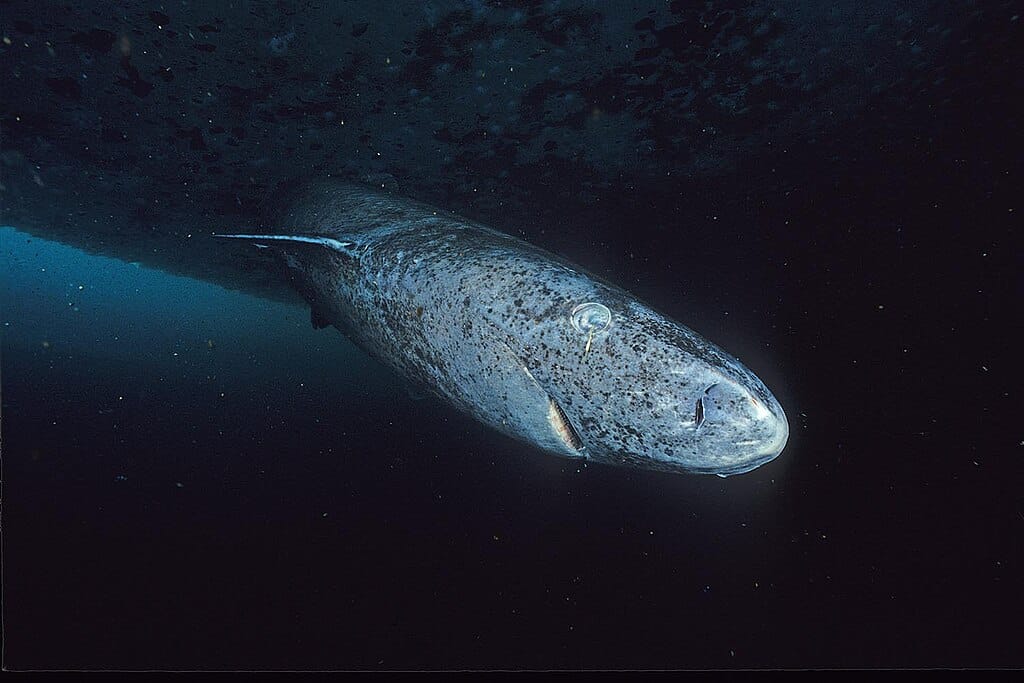
Sharks have been popularized as apex predators and torchbearers of chaos in movies. However, one shark species has kept most of its secrets up its sleeves–the sluggish yet slippery Greenland shark. They live in the frigid waters of the North Atlantic and Arctic oceans, the only species to do so all year round. Their longevity makes them attractive to scientists, as researchers have estimated that Greenland sharks can live up to four hundred years to around half a millennium—the longest-living vertebrate ever discovered. To date, scientists don’t have much of a clue as to why they can survive for such a mammoth number of years. An international team of scientists has now mapped 92 percent of their genome, and they provide us with a clue to dig deeper into the lengthy lives of these long-lived sharks. In turn, we can use that same information to extend the lifespan of humans.
What do the genetic studies unveil?
Dr. Steve Hoffman, the senior author of this new study on Greenland sharks, says genomic studies unravel mutations accumulated in the sharks, leading to their long lives. The primary finding from the genome assembly is its unusually large size, which is twice that of a human and bigger than any other shark species. One of the general traits that come with a long genome is the ability to repair DNA. For example, the longest-living rodent, the naked mole rat, displays a large genome. The same can be said about some species of tortoises.
The other factor that provides these sharks with long lives is the presence of jumping genes. Jumping genes move from one part of the genome to another by duplication and subsequent insertion. This can lead to mutations, which may or may not be beneficial, sometimes even causing cancer. In the case of Greenland sharks, though, the genes that repair DNA act as jumping genes, spreading across the whole genome and eventually slowing down the aging process by repairing DNA much more effectively. The authors suggest that DNA repair genes in the species eventually evolved the ability to multiply, further contributing to DNA repair and longevity.
How can the human lifespan be prolonged?
Humans have artificially increased the lifespans of flies and mice with the help of genetic manipulations. However, replicating the same results in humans is a far-fetched idea. According to Dr. Vera Gorbunova, the lead author of a study that transferred genes taken from naked mole rats into mice to increase their lifespans, we need to find a genomic mechanism that adapts to our body, and that can be achieved by further studying the genes of animals that are prowesses in longevity.
The path that can be taken looks like this: Researchers can design a drug that targets a human gene and makes it more like that of a Greenland shark, improving the DNA repair mechanism in humans and subsequently delaying aging.
Copyright @smorescience. All rights reserved. Do not copy, cite, publish, or distribute this content without permission.
SUBSCRIBE TO OUR NEWSLETTER
.......... ..........Subscribe to our mailing list to get updates to your email inbox.
Monthly Newsletter