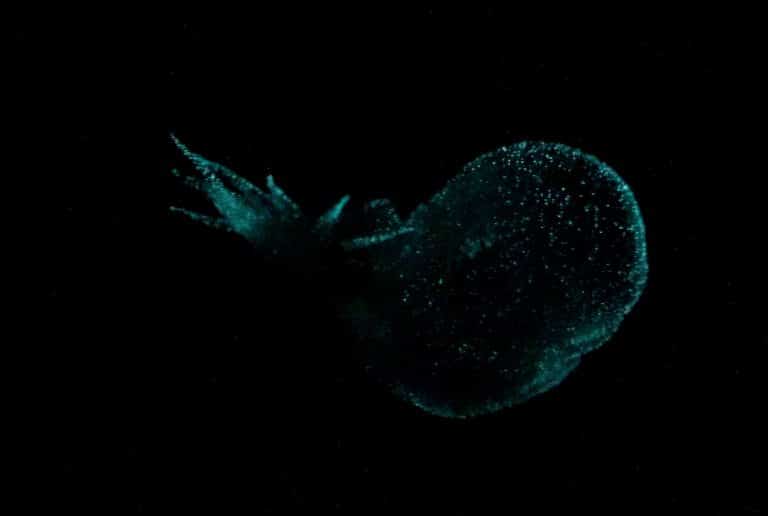
Researchers have discovered a shining marvel of the ocean, Bathydevius caudactylus, aka. the mystery mollusk. This bioluminescent sea slug, found drifting through the sea’s midnight zone, has incredible adaptations including a vibrant defense mechanism and a large gelatinous hood for capturing food. Its discovery has brought our attention to some of the largest and least explored underwater habitats on planet Earth.
MBARI researchers have discovered a remarkable new species of nudibranch from the depths of the ocean named Bathydevius caudactylus. Credits: https://www.mbari.org/
Nudibranchs, a group of shell-less marine molluscs, are usually located in shallow coastal waters or on the sea surface. In contrast, mystery mollusks are at the frontiers of their own family as they are found in the deep sea columns in extremely dark habitats.
Scientists from the MBARI (Monterey Bay Aquarium Research Institute) first came across this extraordinary sea slug in 2000, during a remotely operated vehicle (ROV) dive near Monterey Bay. MBARI’s researchers have used the state-of-the-art ROV technology to investigate extreme depths of the ocean. In 2008, they managed to collect a live specimen for detailed study, analyzing its anatomy, physiology and genetics. They investigated more than 150 sightings over 20 years before officially publishing the discovery on November 12, 2024 in the journal Deep-Sea Research Part I.
This creature has many astonishing and extraordinary features:
Bioluminescence: it projects bright glowing light to intimidate predators.
Hood-like trap: it has a hood-like structure, similar to a Venus flytrap, that enables it to capture its prey.
Camouflage: it has a transparent body which helps it to blend easily with the dark surroundings.
Rhythmic body: it uses its paddle-like tail and rhythmic body movements to swim through the sea.
Researchers at MBARI used an advanced underwater low-light camera system to capture footage of the biolumniscent, mystery mollusk, in its natural habitat. Credits: https://www.mbari.org/
This study sheds light on the evolution and diversity of deep-sea organisms who thrive in the midnight zone of the sea. MBARI’s Senior Scientist, Steven Haddock, said, “What is exciting to me about the mystery mollusk is that it exemplifies how much we are learning as we spend more time in the deep sea, particularly below 2,000 meters. For there to be a relatively large, unique, and glowing animal that is in a previously unknown family really underscores the importance of using new technology to catalog this vast environment. The more we learn about deep-sea communities, the better we will be at ocean decision-making and stewardship.”
The discovery of Bathydevius caudactylus opens the path for further exploration of deep-sea habitats that might lead to more potential groundbreaking discoveries. With the advancement in technology, it has now become more convenient for researchers to deepen their connections with the hidden realms of our planet Earth.