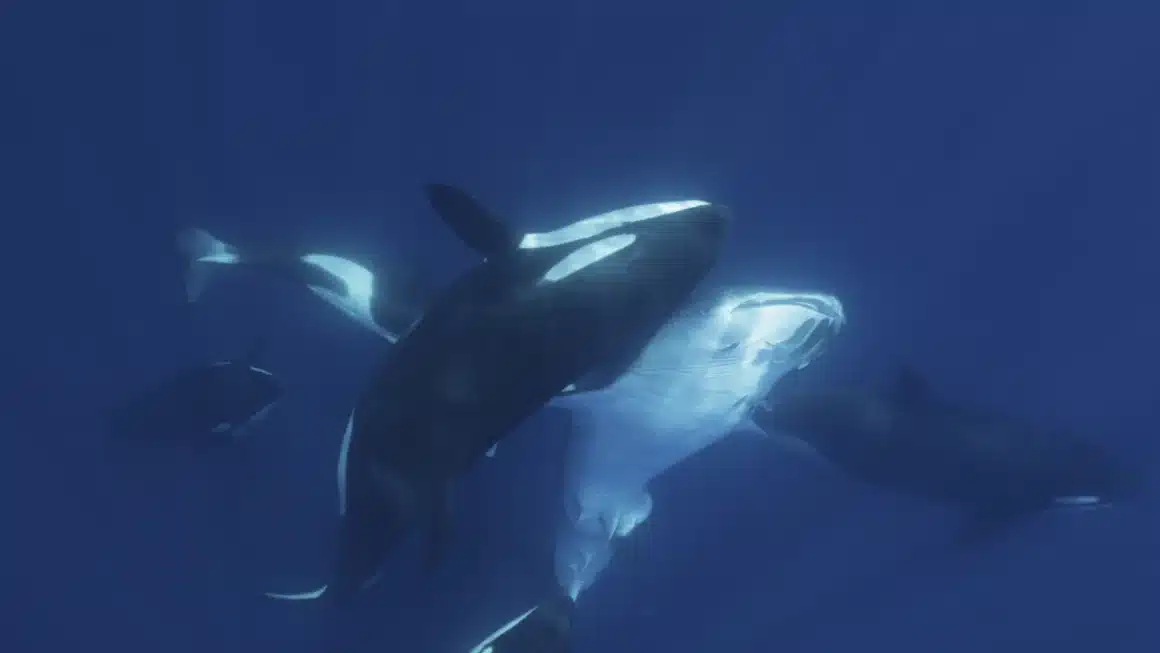
Marine biologists have documented an extraordinary hunting strategy where pods of killer whales systematically attack and overpower whale sharks, the ocean’s largest fish species. The groundbreaking research reveals how these highly intelligent predators work together to defeat creatures nearly three times their length, despite the whale sharks’ ability to dive to extreme depths to escape.
Sharks, the largest fish in the world, measuring up to 18 meters (60 feet) in length, actually have little self-defense to offer. They have tiny teeth and a brain that’s only as large as an egg. Compared to body size, they have the smallest brains among any animal. They are slower when compared to other sharks. The only method of defense used by whale sharks is flailing or diving down by 2000 meters or more.
Orca pods in the Pacific Ocean off the coast of Mexico have been recorded to pull off their hunt fest in four separate instances. Marine scientists have documented their hunting strategy against whale sharks for the first time.
Orcas are the apex predators of the sea. They prey on various marine fish and mammals, like dolphins, and have also been documented feeding on cephalopods, like squid. Notably, orcas near Cape Town, South Africa, have been reported attacking and killing great white sharks, driving most sharks away from the coastal regions around Cape Town.
The showdown: Orcas vs Whale shark
To subdue the whale shark, the orcas devise an intricate plan.
- The orcas hit the whale shark at high speed at first
- Then, they flip the whale shark, exposing its belly on the upper surface. One orca hits the shark on the belly or the ventral side, while another hits the head. This prevents the whale shark from diving down to escape.
- Lastly, the orcas bite the whale shark’s abdomen and allow its blood to flow out before feasting on the internal organs of the fish.
These actions put the whale shark in a state of extreme fear, leading to temporary paralysis called ‘tonic immobility’. Researchers believe that the orcas target the sharks’ fatty livers.
However, despite being hunted by orca pods, the population of whale sharks in the Gulf of California region has not been threatened.
Copyright @smorescience. All rights reserved. Do not copy, cite, publish, or distribute this content without permission.
SUBSCRIBE TO OUR NEWSLETTER
.......... ..........Subscribe to our mailing list to get updates to your email inbox.
Monthly Newsletter