Archaeologists have uncovered a remarkable find in northwest Saudi Arabia. The remnants of a fortified settlement date back 4,000 years, revealing a transition from nomadic to urban lifestyles.
The research led by French archaeologist Guillaume Charloux unveiled Al-Natah, an ancient town hidden in the walled Oasis of Khaybar, a fertile green area surrounded by deserts in the northwest Arabian Peninsula. The town was concealed by a 14.5-kilometer-long wall that protected the residential area. According to a preliminary survey, the study disclosed that a fortified 2.6-hectare town was built around 2400 BC and lasted until 1500 BC and possibly 1300 BC, along with possible interruptions.
It is believed that this town might have housed around 500 people. However, the settlement was abandoned after a thousand years of existence. “No one knows why,” Charloux said. The houses were connected by small streets. Archaeologists believe that northwest Arabia was inhabited by nomadic groups involved in long-distance trading activities.
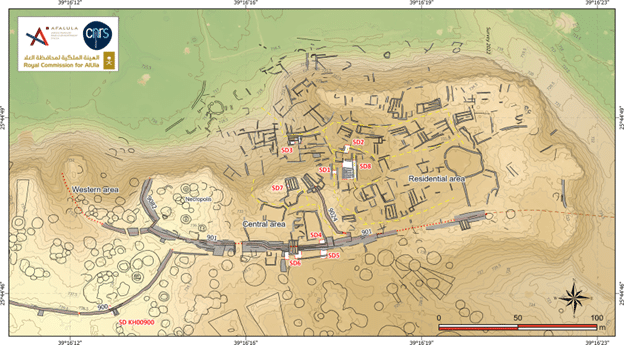
Map of the al-Natah site, with the plan of the architectural features identified on the surface (black lines), reconstructions (grey lines) and layout of the rampart (dashed red line). (Charloux et al., PLOS ONE, 2024).
Researchers explained that black volcanic basalt rocks protected al-Natah’s walls, which preserved the town from illegal excavations. They found the foundations strong enough to support structures one to two stories high. The initial finding revealed a 2.6-hectare town with 50 houses on a hill, surrounded by a protective wall. Excavations also exposed tombs containing metal weapons like axes and daggers, signifying a relatively advanced society. Despite all the sophistication, Al-Natah was still smaller than the cities in Mesopotamia or Egypt during that period.
Researchers who discovered Al-Natah described the process as “slow urbanization” that explained the transformation from a nomadic life to a settled village life. But in these vast expanses of desert, it appears there was “another path towards urbanization” than such city-states, one “more modest, much slower, and quite specific to the northwest of Arabia”, Charloux said.
Preliminary research revealed insights into understanding al-Natah’s history and the evolution of life in the Arabian Peninsula. It also shed light on different paths towards settlement in an arid desert patch. Charloux and his team will have to explore the site more to provide details of the town’s everyday life, governance, and social structure.
The study was published by Charloux and his team in the journal Plos One.
Copyright @smorescience. All rights reserved. Do not copy, cite, publish, or distribute this content without permission.
Join 20,000+ parents and educators
To get the FREE science newsletter in your inbox!
SUBSCRIBE TO OUR NEWSLETTER
.......... ..........
Subscribe to our mailing list to get updates to your email inbox.