A 99-million-year-old firefly preserved in amber has provided new signs of the evolution of bioluminescence in insects, highlighting how these glowing insects developed their luminous characteristics millions of years ago.
The newly discovered firefly was trapped in amber 99 million years ago. (Cai et al., Proc R Soc Lond B Biol Sci, 2024)
Fireflies, with around 2,500 known species worldwide, are famous for their bioluminescent abilities. Bioluminescence is the natural production of light by some living organisms through a chemical reaction in the body. Animals, including fireflies, deep-sea jellyfish, certain worms and even microscopic organisms including fungi and bacteria exhibit bioluminescence. These shining insects have glowing abdomens used for various purposes, but scientists still do not understand how this ability evolved. A team led by paleontologist Chenyang Cai from the Chinese Academy of Sciences recently found a fossilized firefly in Myanmar amber, offering some new insights.
The newly identified firefly, Flammarionella hehaikuni, lived during the Mesozoic era when Dinosaurs were also present on Earth and they already had bioluminescent abilities. This concludes that the ancestors of today’s fireflies had evolved their glowing traits well before the modern era. The fossil, found in Myanmar amber, is the second Mesozoic firefly ever found with its lantern intact, showing that bioluminescence in insects was both completely functional and diversified by this period.
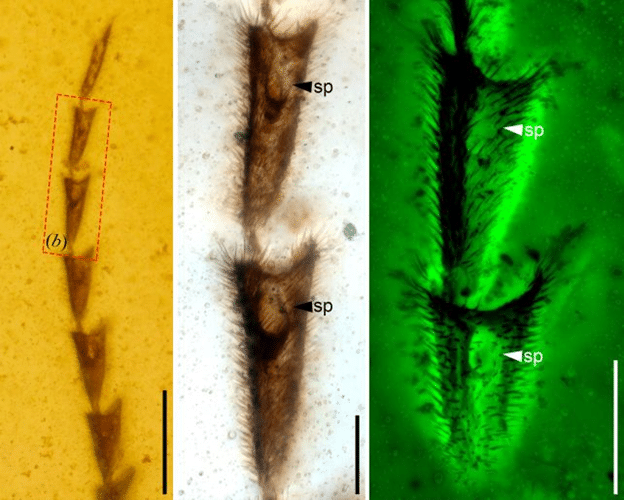
Details of the antenna of Flammarionella hehaikuni. The arrows point to the indentations. (Cai et al., Proc R Soc Lond B Biol Sci, 2024)
The specimen, discovered in Myanmar’s Kachin State, was studied based on its physical traits. The researchers found that the fossil is a female member of the Luciolinae subfamily, a group of fireflies known for their twinkling lights. What makes this finding fascinating is that the lantern structure in this fossil is distinct from other amber-preserved fireflies, implicating diverse evolutionary paths for bioluminescence in early fireflies.
Bioluminescence in fireflies likely evolved for various reasons, including attracting their partners and intimidating predators with toxic lucibufagin compounds. However, recent scientific arguments suggest that bioluminescence in fireflies developed before the appearance of lucibufagins, which leads to questions about the initial advantages of this glowing ability in insects. The distinctive features of Flammarionella, such as hair-covered antennae, may also shed light on how these insects communicated and identified mates millions of years ago.
“As the fossil record expands in the future,” the researchers write in their paper, “we anticipate further revelations that will broaden our knowledge of when, how and why bioluminescence evolved in these fascinating animals during the Mesozoic era.”
Further analysis of other Mesozoic bioluminescent insects will be crucial in understanding how this characteristic developed in fireflies. The research team aims to continue exploring similar fossils, hoping to reveal more examples of ancient fireflies and their evolutionary background.
This fossilized firefly gives us more information about glowing creatures and highlights how diverse and complex life was during the Mesozoic era. Future discoveries might offer even clearer insights into how fireflies and other glowing insects have evolved this special glowing trait.