Today’s life on Earth is complex, but it was not always the same. About 575 million years ago single-celled organisms evolved into comparatively complex life forms. One of the creatures from that period, the Ediacaran period, was recently found in South Australia, showcasing the development of early multicellular life.
Researchers have unearthed fossils of an animal named Quaestio simpsonorum in the South Australia outback. What makes this discovery special is that Quaestio could move around on its own, something very few creatures could do at that time. This fossil has complex features which makes it stand out as one of the most detailed organisms from this era. Although Quaestio simpsonorum has a flattened, blob-shaped simple structure it still represents one of Earth’s earliest complex animals.
A partnership between US Scientists and paleontologists from the South Australian Museum has led us to Quaestio simpsonorum. The researchers confirmed that Quaestio was considered an animal as it is multicellular, can move, has body symmetry and shares characteristics with modern animals.
The team has found a dozen of these fossils along with other trace fossils – the preserved imprints of their blobby bodies in the solidified mat of microscopic algae and bacteria.
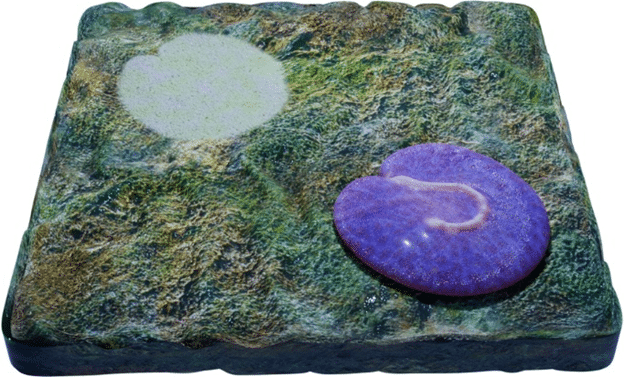
The discovery shows that these animals were capable of moving independently, as the slight shifts in their fossil imprints suggest. This movement infers that Quaestio was probably one of the first organisms capable of independent motion. The organism has a unique question-mark-shaped appearance, for which it was named, highlighting bilateral symmetry, a body structure seen in modern animals, including humans.
The fossils were found in Nilpena Ediacara National Park, a region famous for harboring some of Earth’s oldest fossils. Scientists identified this fossil based on its distinct asymmetrical twist, which sets it apart from the other fossils of that time.
The discovery of Quaestio gives insight into the evolution of complex organisms and initial animal traits like asymmetry and movement. Understanding how these creatures survived and evolved sheds light on how organisms adapt and develop traits to allow life on Earth to thrive.
An artist's impression of Quaestio simpsonorum's body in the foreground and the impression left in the organic mat behind. Note the mottled purple texture of the organism is a stylistic interpretation, not based on fossil evidence. (Walker Weyland/Evans et al., Evolution & Development, 2024)
“One of the most exciting moments… was when we flipped over a rock, brushed it off, and spotted what was a trace fossil behind a Quaestio specimen – a clear sign that the organism was motile; it could move,” Harvard University evolutionary biologist Ian Hughes said.
As more fossils are found from Ediacaran biota, scientists hope to uncover the secrets of early life on Earth. Nilpena Ediacara National Park is under consideration for UNESCO World Heritage Site status, which would protect its crucial records of life’s early history.
The discovery of Quaestio simpsonorum opens a new chapter in our understanding of life’s early evolution.