Archaeology teaches us about human history and culture with evidence from the past. A team from the University of Córdoba, led by Professor José Rafael Ruiz Arrebola, and the City of Carmona, discovered liquid from a funerary urn as the world’s oldest wine. Researchers published a paper on this in the Journal of Archaeological Science: Reports.
A house in Carmona, an ancient Roman city in the Baetic region of Southern Spain, unearthed a collective tomb of a family of six in 2019. The access to the chamber led to a well-preserved vault decorated with voussoir stones and geometric motif paintings. Archaeologists found eight carved niches, with two of them being empty. Six ash urns contained remains and other objects from offerings of burial rituals. The names engraved on the outer gypsum layer were of a female – Senicio and male – Hispanae.
(a), (b) Funeral chamber. (c) Urn in niche 8. (d) Lead case containing the urn. (e) Reddish liquid contained in the urn. Credit: sciencedirect.com
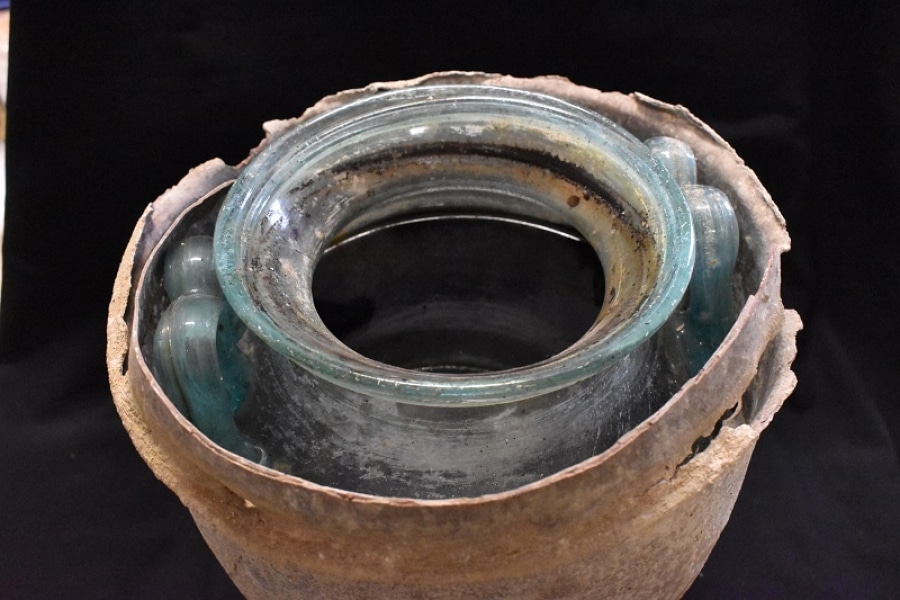
Out of the six, a glass urn belonging to the male appeared in excellent condition. The urn with an M-shaped handle sat inside an ovoid lead case with a flat lid that bulged in the middle. Inside the urn was a reddish liquid. “At first we were very surprised that liquid was preserved in one of the funerary urns,” explains the City of Carmona’s municipal archaeologist Juan Manuel Román.
Juan Manuel Roman; Credits: https://www.uco.es
Ancient people prevented wine decay during preparation by adding various chemical additives. They used gypsum, sodium chloride, and large amounts of sugars for taste. This being the base, scientists conducted a series of chemical analysis in the liquid from the urn. To claim a wine as ancient, it must contain specific biomarkers, including polyphenols. Polyphenol presence depends on the grapes, environment, and the winemaking process. In 1867, archaeologists discovered the “Speyer wine bottle,” a 1700-year-old wine in liquid state preserved in the Historische Museum der Pfalz, found in a tomb in Germany. Chemical analysis has never confirmed its polyphenol biomarkers.
Researchers employed inductively coupled plasma mass spectrometry and high-performance liquid chromatography-mass spectrometry techniques to analyse the polyphenol biomarkers in the liquid. They compared the urn liquid with current Fino wines from Montilla-Moriles, Jerez, and Sanlúcar. These wines likely come from the same Roman region. Scientists studied its pH, absence of organic matter, mineral salts, and ethanol composition. Researchers also studied other specific chemical traces from the stored glass and the buried bones.
The comparison results confirmed the reddish liquid and Fino wines have seven common polyphenol biomarkers, indicating it to be a degraded wine with time. Low ethanol concentration and absence of syringic acid polyphenol responsible for red pigment in the reddish liquid confirmed it to be white wine. With this discovery, and chemical analysis the reddish liquid is found to be the world’s oldest wine tracing back 2000 years.
The excavation uncovered other materials including a ceramic jar and bowl, a glass mosaic plate, a gold ring, and solidified remains of perfume composed of patchouli.It was also discovered that female bone remains in the urn had burnt pieces of ivory sheets. This ancient tomb’s remarkable preservation permitted the examination of liquids, bones, and trousseau.
Copyright @smorescience. All rights reserved. Do not copy, cite, publish, or distribute this content without permission.
Join 20,000+ parents and educators
To get the FREE science newsletter in your inbox!
SUBSCRIBE TO OUR NEWSLETTER
.......... ..........
Subscribe to our mailing list to get updates to your email inbox.