How did dinosaurs transform into the birds we see today has been a question many have wondered . Paleontologists at the University College Cork in Ireland have made a fascinating discovery about theropods- a group of two-legged carnivorous dinosaurs that includes the famous T-Rex. These creatures acquired feathers, flight, and other birdlike features in just 10 million years, an instant in the evolutionary timeline.
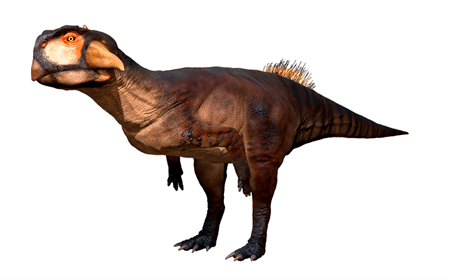
The researchers worked on a specimen of Psittacosaurus, a feathered dinosaur that lived in the early Cretaceous period, around135-120 million years. Dinosaurs started to evolve into birds during this period. What was truly intriguing is that in the specimen of Psittacosaurus, the researchers found zonal development of skin tissue— a zone of feathered skin and one of reptile-like, scaly skin.
The patches of skin were invisible to the naked eye but visible under UV light. Further analysis was done using X-ray and infrared studies, which revealed details about preserved cellular structures.
The surprising fact is that the skin is chemically composed of silica, which is glass. Although found in other animals, no fossils of vertebrates with this kind of preservation have been discovered. Dr. Yang predicts that more fossils with preserved soft tissue will be discovered.
Despite years of groundbreaking research, no clear answer exists regarding how the scaly skin evolved to have feathers. This is mainly because different fossils of feathers have been discovered, but fossil skin is rare to come by.
Artist’s representation of Psittacosaurus
This discovery suggests that dinosaurs may have evolved birdlike skin under the feather-covered areas, while the rest of the body had scaly skin. The zonal development of skin also allows the dinosaur to retain essential skin functions, like protection against abrasion, parasite attacks, and dehydration. This can be considered the first generation of dinosaurs that survived with feathers and passed on the genes for feathers to the next generation.
Copyright @smorescience. All rights reserved. Do not copy, cite, publish, or distribute this content without permission.
Join 20,000+ parents and educators
To get the FREE science newsletter in your inbox!
SUBSCRIBE TO OUR NEWSLETTER
.......... ..........
Subscribe to our mailing list to get updates to your email inbox.