Far out in the tranquil waters of the Pacific Ocean, a chain of islands floats, a world teeming with life like nowhere else on Earth. These are the Galapagos Islands, an enchanted place with a host of unique creatures. But, out of this array of fascinating inhabitants, one creature stands out in size and longevity – the mighty Galapagos tortoise. These shelled titans are not just the largest tortoises globally, but they also boast incredibly long lives, surpassing even the oldest humans on Earth!
The tortoise’s place: Understanding their role in the Galapagos
In the Galapagos Islands, tortoises are far more than mere residents. They play a vital role in maintaining the health and balance of their ecosystems. Imagine them as the landscape artists of these islands. As they wander, feasting on the plants, they help control the vegetation , thus shaping the terrain and habitats of countless other species. And let’s not forget their droppings, which might seem unpleasant but serve as an excellent natural fertilizer. This contribution helps in the flourishing of local flora, emphasizing that even the humblest actions can make a big difference!
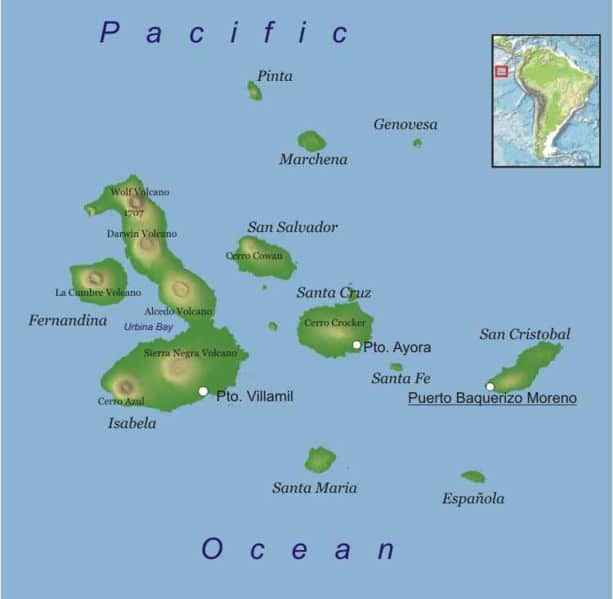
Map of Galapagos Islands. Credit: Wikimedia/Daniel Feher
Unveiling variety: Different species of Galapagos tortoises
One of the most interesting aspects of these tortoises is that there isn’t just one kind. The islands host several species of Galapagos tortoises, each uniquely adapted to the specific conditions of the island they inhabit. Some species have large, domed shells, almost like a soldier’s shield. Others bear a distinctive saddle-shaped shell that curves upwards in the front, a beneficial adaptation that enables them to stretch their necks higher to reach tall vegetation. These varied appearances reflect the amazing adaptability of life.
Living long and prospering: The lifespan of Galapagos tortoises
Get ready to have your mind blown: some Galapagos tortoises have been known to live for more than 100 years! Yes, you read that right. Galapagos tortoises are among the longest-living vertebrateson our planet. Their exceptional longevity is attributed to a mix of factors, including their slow metabolismand the ideal conditions of their island homes. If we consider their lifespan, these gentle beasts are indeed living, breathing history, their lives spanning multiple human generations!
Threats and conservation: Safeguarding the future of Galapagos tortoises
However, these awe-inspiring creatures face significant challenges. Their numbers were drastically reduced when sailors and pirates hunted them for food and oil in the past centuries. Today, invasive species pose a substantial risk as they destroy nests and devour the tortoises’ eggs. Fortunately, efforts are being made to protect these magnificent creatures and ensure their survival. Various conservation groups are tirelessly working to preserve the tortoises’ habitats, eradicate harmful invasive species, and spread awareness about the crucial role these tortoises play in the Galapagos ecosystem.
The symbol of the Galapagos
In conclusion, the Galapagos tortoise is an embodiment of the power and perseverance of nature. These colossal tortoises, roaming the lush landscapes of the Galapagos Islands, are a testament to life’s ability to adapt and thrive in even the most unique corners of our planet. With their domed or saddle-shaped shells, slow pace, and tranquil demeanor, they are more than just inhabitants of these islands; they are the very symbol of the Galapagos. It is our shared responsibility to ensure that the Galapagos tortoises, these extraordinary ambassadors of evolution, continue to flourish in their island homes for centuries to come.
Glossary
Ecosystem: A community of interacting organisms and their physical environment.
Vegetation: Plants considered collectively, especially those found in a particular area or habitat.
Flora: The plants of a particular region, habitat, or geological period.
Vertebrates: Animals that have a backbone or spinal column, including mammals, birds, and reptiles.
Metabolism: The chemical processes occurring within a living cell or organism that are necessary for the maintenance of life.
Invasive species: Plants, animals, or pathogens that are non-native (or alien) to an ecosystem and cause harm.