Nestled in the arid landscape of Arizona lies a geological marvel that captures the imagination of thousands each year – Antelope Canyon. Known for its undulating walls and light beams that seem to dance through the dust-laden air, this canyon’s formation story is as captivating as its views. In this article, we’ll embark on a journey to understand the forces and events that shaped Antelope Canyon, transforming it into the breathtaking natural wonder we see today.
The geological canvas: Navajo sandstone
At the heart of Antelope Canyon’s story is the Navajo Sandstone . Formed from the compacted sands of ancient deserts, this sandstone dates back to the Jurassic Period , around 190 million years ago. Over millennia, these dunes solidified into the rock, setting the stage for the canyon’s formation. The uniformity and softness of Navajo Sandstone made it particularly susceptible to the forces of erosion , which played a pivotal role in sculpting Antelope Canyon.
“Carved from the red sandstone for millennia by seasonal flood rains and wind, the canyons are narrow passageways that lead several hundred feet away from the mouth.”
The primary architect of Antelope Canyon is water. Despite its arid climate, this region is prone to sudden and violent flash floods . When rain falls over the canyon, it rushes into the narrow passageways, carrying with it sand and debris. This natural sandblasting process erodes the sandstone walls, gradually carving out the canyon’s sinuous shapes and smooth, flowing contours.
While water plays the lead role, wind is a vital supporting actor in this geological drama. The process of wind erosion, or aeolian processes , contributes to the canyon’s formation by whisking away loose sand and sediment. This action helps smooth and polish the canyon walls, giving them their characteristic sheen. The intricate patterns etched into the rock surfaces bear testimony to the relentless yet delicate touch of the wind.
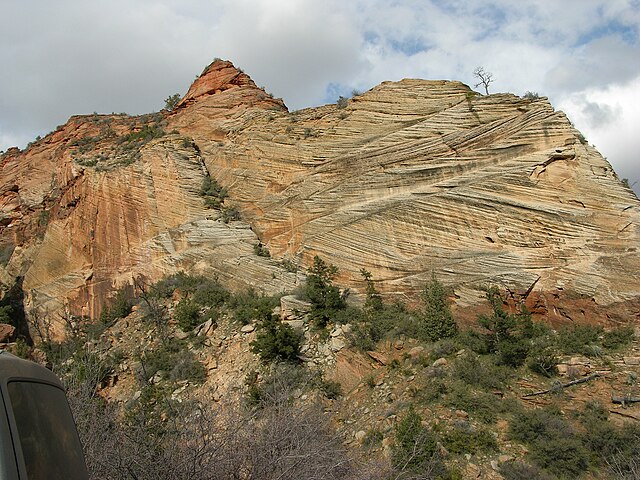
Cross-bedding Of Sandstone Near Mt Carmel Road Zion Canyon Utah, Credit; Wikimedia/Dr. Igor Smolyar, NOAA/NESDIS/NODC
The science of slot canyons
Antelope Canyon is a type of slot canyon characterized by its narrow, deep corridors. These canyons form in regions where a combination of firm bedrock and periodic, high-energy flood events occur. The narrowness of slot canyons is due to the limited width of the fissures through which water initially starts to flow. Over time, these fissures deepen and widen by erosion, but their characteristic narrowness remains.
The regional geology plays a crucial role in the canyon’s formation. The Colorado Plateau , where Antelope Canyon is located, has undergone uplift , a process where the earth’s crust rises. This uplift increases the gradient of streams and rivers, accelerating erosion. Therefore, the uplift of the Colorado Plateau was a significant factor contributing to the rapid and intense erosional processes that formed Antelope Canyon.
Antelope Canyon is not just a geological wonder but also a site of cultural significance. For the Navajo people, the canyon holds spiritual importance and is intertwined with their history and folklore. The Navajo name for Upper Antelope Canyon, ‘Tse’ bighanilini’, means ‘the place where water runs through rocks’ – an apt description of its formation process.
Here is a video explaining how slot canyons like Antelope Canyons are formed.
The formation of Antelope Canyon is a dynamic process. As climatic conditions change, so too do the patterns of rainfall and flooding that continue to shape the canyon. With the increasing intensity of global climate phenomena, the future could see alterations in the frequency and intensity of the flash floods that sculpt this natural masterpiece.
What is the best time to visit the Antelope Canyon?
Antelope canyons are famous for sunlight beaming into the canyon, which can be seen from 11 am to 1 pm from March to October, suggests the Navajo Tourism Department. For hiking, one can visit the Lower Antelope Canyon. If one wants to have fewer tourists around, they can visit during the winter months.
The growing popularity of Antelope Canyon as a tourist destination brings challenges in conservation. Balancing the need for public access with the preservation of its delicate ecosystem is a task requiring careful management and sustainable tourism practices. Continued study and monitoring of the canyon are crucial for understanding how human activities might impact its future.
Glossary
Navajo Sandstone: A type of sandstone that primarily comprises the cliffs, canyons, and domes in parts of the Western United States, formed from the compacted sands of ancient deserts.
Jurassic Period: A period of the Mesozoic Era, about 201 to 145 million years ago, known for the rise of dinosaurs.
Erosion: The geological process where materials are worn away and transported by natural forces like water or wind.
Flash Floods: Rapid flooding of a geographical area caused by heavy rain, often with little warning.
Aeolian Processes: Geological changes caused by the wind, including erosion, transport, and sediment deposition.
Slot Canyon: A narrow canyon formed by the erosive power of water rushing through rock.
Uplift: The geological process of the earth’s crust rising due to tectonic forces.
Colorado Plateau: A large plateau in the Western United States known for its unique topographical and geological features.