Table of Contents
Butterflies are insects well-known for the beautiful and colorful patterns on their wings. Scientists believe that butterflies arose around 65 million to 135 million years ago in the period known as “The Age of Flowering Plants.” Today, there are around 17,500 species of butterflies in the world. About 750 species of butterflies are found in the United States alone.
Here is a list of a few of the different types of butterfly species that may be spotted around us! How many of these have you spotted?

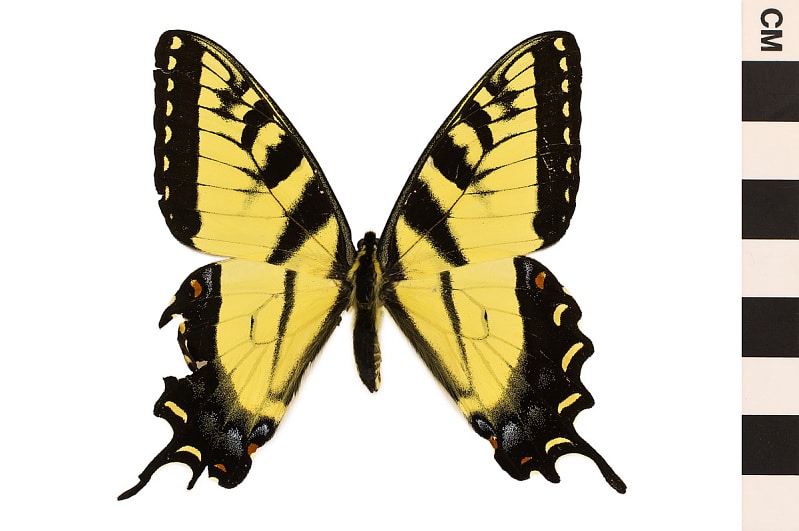
1. Appalachian Tiger Swallowtail
The Appalachian Tiger Swallowtail is similar in appearance to another species of butterfly known as the Eastern Tiger Swallowtail. However, the Appalachian Tiger Swallowtail is slightly larger, having a wing span of 8.6–11.5 cm (3.4–4.5 inches). This species has forewings which are slightly angular, and with narrow vertical black stripes. The hindwings of males are triangular. Females have both yellow or black colored hues, and both have tail-like projections at the end of the hindwings. This species is mostly found in the Southern Appalachian Mountains, ranging from Pennsylvania to Georgia and westward to northeast Alabama.

2. Blue Morpho Butterfly
The Blue Morpho is a species known for its beautiful, bright blue wings with a black edge. This species is one of the largest butterfly species in the world, with wings spanning 12.7–20.32 cm (5–8 inches). This butterfly species has tiny scales on its wings which reflect light, giving it a glowing blue shade. Thus, a Blue Morpho in flight seems to appear and disappear. The underside of the morpho’s wings have a dull brown color with many eyespots . These eyespots act as camouflage to hide the Blue Morpho from predators, such as birds and insects, when its wings are closed.

Curious about the people who study these butterflies? Click here to read how do scientists study butterflies
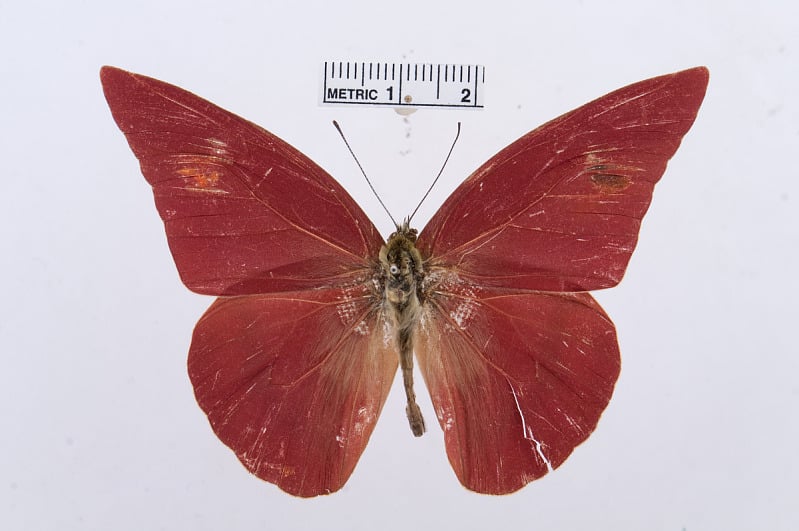
3. Eastern Orange Albatross
The Eastern Orange Albatross, known by scientists as Appias zarinda, is a species belonging to the Pieridae family of butterflies. Mostly, it is found on the Sulawesi and the Maluku Islands of Indonesia. Although this species is mostly orange in color, there are many related species and subspecies of this butterfly. For example, the Orange Albatross is a related butterfly species found from northern India to the Sunda Islands, the Philippines, Sulawesi, and eastwards.

4. Goliath Birdwing Butterfly
The Goliath Birdwing Butterfly is the second largest butterfly species in the world; the largest butterfly species being Queen Alexandra’s Birdwing. The Goliath Birdwing species has a wingspan of 28 cm (11 inches) on average. The forewings are bright green in color with a central black band running diagonally towards the upper outer corner, and an outer black border. The hindwings are yellow in color with green dots, black borders, and dark veins running across them. Although not poisonous to humans, this species is poisonous to its predators . It is found only in New Guinea.

5. Green-banded Swallowtail
The Green-banded Swallowtail is also called the Narrow-banded Blue Swallowtail or African Blue-banded Swallowtail. This species belongs to the butterfly family Papilionoidea. The green-blue color of the band varies with the light. Like many other “swallowtail” species of butterflies, this butterfly does not have “tails.” The pattern of the coloring on the wings of the males and females varies. This species is native to Africa and southern Arabia.

6. Leafwing Butterfly
The Leafwing Butterfly (Agrias narcissus) is a common name for many species belonging to the Nymphalidae family of butterflies. These species have a pattern of very bright red, orange, shimmering blue, and yellow colors on the black or bluish background of their wings. The undersides of the wings are patterned. The wingspan of these butterflies ranges from 7–12 cm (2.7–4.7 inches). They have a broad thorax and short wide abdomen , making fast flight possible.

7. Monarch Butterfly
The Monarch Butterfly is known by scientists as Danaus plexippus, which is the Greek term for “sleepy transformation.” This name comes from the phenomenon of hibernation that is seen in this species, along with metamorphosis . An adult monarch butterfly has two pairs of beautiful orange-red wings with black veins and white spots along the edges. The males also have black dots along the veins of their wings and are slightly bigger than the females. Milkweed is the only plant on which monarchs will lay their eggs and is the only source of food for their baby caterpillars .

Watch a video of the monarch butterfly emerging from its chrysalis.
Curious about how far monarch’s migrate? Download this animal migrations poster to find out!
8. Red Tip Butterfly
The Red Tip, known by scientists as Colotis antevippe, is a butterfly species also belonging to the Pieridae family of butterflies. This species has wings which are 4–4.5 cm (1.57–1.77 inches) in size. As per its name, this butterfly, and other related species, have pure white uppersides with yellow, orange, or red tips on the forewings. Mostly, this species is found in the continent of Africa, scattered from Gambia to Ethiopia and south to Angola, Namibia, Mozambique, and South Africa. Adult butterflies of this species may be spotted all year long.

9. Rippon’s Birdwing
The Rippon’s Birdwing species originates from the Indonesian Islands of the Moluccas and Sulawesi. Although this endemic species is not threatened, it is still a protected species. The wingspan of this species ranges from 18–20 cm (7–7.8 inches). Although males are mostly black in color, grey colors and golden spots may be seen on the hindwings. Female adult butterflies are larger in size and are mostly dark brown in color. Currently, the species is found throughout the Australasia and Indomalayan regions.

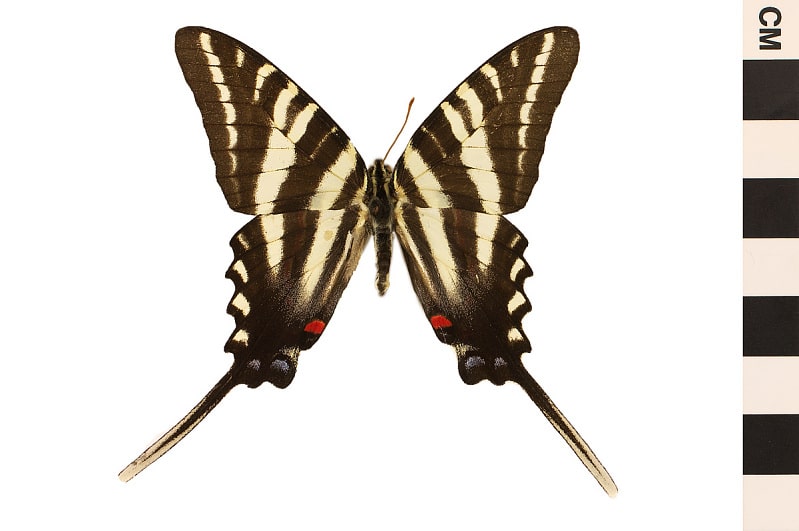
10. Zebra Swallowtail
The Zebra Swallowtail is another member of the Papilionidae butterfly family. This butterfly species gets its name from the black stripes on pale whitish-green background on the upper surface of its forewings. The hindwings have very long tails. Usually, the wingspan of this species ranges from 2.5–4 inches (6.4 –10.4 cm). In order to mate, the adult males fly into woods near swamps and rivers to find females. Females lay individual green eggs on the lower leaves of host plant. Caterpillars live and feed on the underside of these leaves, then pupate and hibernate there.

Glossary
Hindwings: The pair of wings at the back of the two pairs of wings present in butterflies
Eyespots: Round eye-like markings on the wings of butterflies
Camouflage: To hide or disguise from predators
Subspecies: A group within a species which is usually geographically isolated
Predators: Animals or organisms which prey on, hunt, or kill other animals or organisms
Thorax: The part of the insect body between the head and the abdomen
Abdomen: The last or rear part of the insect body
Hibernate: A way of surviving winter through an inactive, sleep-like state
Metamorphosis: The phenomenon seen in insects where development occurs through an immature form to a distinctly different adult form
Milkweed: A plant which produces a milky sap; attracts Monarch Butterflies
Caterpillar: The elongated wormlike young stage (or larva) of a butterfly
Endemic: Occurring specifically in a region; native of or restricted to A way of surviving winter through an inactive, sleep-like state
Protected: In reference to a species, it is forbidden by law to harm or destroy
Pupate: The process of a larva becoming a pupa
Flesch Kincaid Grade Level: 7.6
Flesch Kincaid Reading Ease: 61.8
References
“Appalachian Tiger Swallowtail Papilio appalachiensis (Pavulaan & Wright, 2002).” Butterflies and Moths of North America, 29 Apr. 2022, https://www.butterfliesandmoths.org/species/Papilio-appalachiensis.
“Appias zarinda.” INaturalist Canada, https://inaturalist.ca/taxa/781856-Appias-zarinda.
“Blue Morpho Butterfly.” Rainforest Alliance, 9 July 2021, https://www.rainforest-alliance.org/species/blue-morpho-butterfly/.
“Butterflies.” Smithsonian Institution, Smithsonian Institution, https://www.si.edu/spotlight/buginfo/butterfly.
“Green-Banded Swallowtail.” INaturalist, Garden Route Botanical Garden Butterflies, https://www.inaturalist.org/guide_taxa/903904.
Hoskins, Adrian. “Butterflies of Africa – Colotis antevippe.” Learn About Butterflies, http://www.learnaboutbutterflies.com/Africa-Colotisantevippe.html.
“Monarch Butterfly.” WWF, World Wildlife Fund, https://www.worldwildlife.org/species/monarch-butterfly.
“Narrow Green-Banded Swallowtail Butterfly Papilio Nireus.” Narrow Green-Banded Swallowtail Butterfly, https://www.animal.photos/butterfly/sw-nbb.htm.
“Orange Albatross (Appias nero).” INaturalist, https://www.inaturalist.org/taxa/196826-Appias-nero.
“Red Tip (Colotis antevippe).” INaturalist, https://www.inaturalist.org/taxa/68483-Colotis-antevippe.
“Rippon’s Birdwing (Troides hypolitus).” INaturalist United Kingdom, https://uk.inaturalist.org/taxa/311257-Troides-hypolitus.
Vaughn, Toby. “Goliath Birdwing Butterfly: Identification, Facts, & Pictures.” Butterfly Identification, 19 Dec. 2022, https://www.butterflyidentification.com/goliath-birdwing.htm.
“Zebra Swallowtail Neographium marcellus (Cramer, 1777).” Zebra Swallowtail Neographium Marcellus (Cramer, 1777) | Butterflies and Moths of North America, 27 Mar. 2023, https://www.butterfliesandmoths.org/species/neographium-marcellus.
Contributors
Copyright @smorescience. All rights reserved. Do not copy, cite, publish, or distribute this content without permission.
SUBSCRIBE TO OUR NEWSLETTER
.......... ..........Subscribe to our mailing list to get updates to your email inbox.
Monthly Newsletter