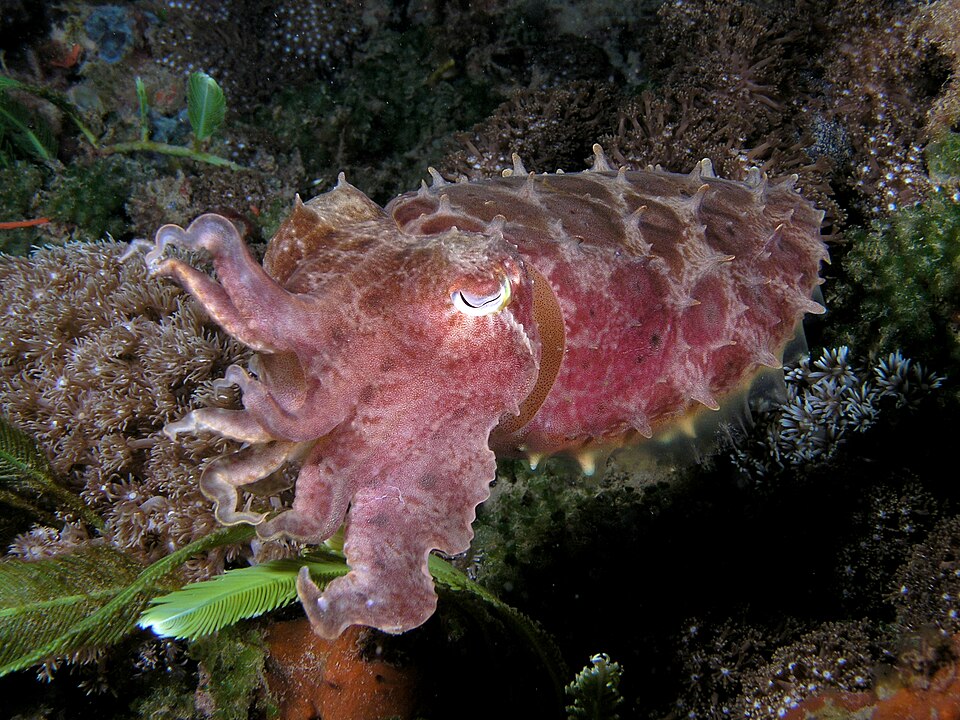
It took six years of working under a microscope in the dark with tiny manipulators for Tessa Montague, a Columbia University neuroscientist, to engineer glowing cuttlefish. This is the first time anyone has succeeded in adding a new gene to a cephalopod— a group of animals that includes mostly octopuses, squids, and cuttlefish. The pioneering work has been posted as a preprint on bioRxiv.
Why Engineer a Glowing Cuttlefish?
While mice, fruit flies, and zebrafish became the “model organisms” of molecular biology research, cephalopods were pivotal to biological discoveries in the 1950s. In fact, Alan Hodgkin and Andrew Huxley discovered how neurons transmit signals by studying giant axons in squids, earning a Nobel Prize for their work. In many ways, octopuses and cuttlefish have an intelligence analogous to some mammals—they can be trained and taught restraint. More research on breeding, genomes, and reproduction in the former group made them the preferred choice for researchers over cephalopods.
However, cuttlefish have one striking feature that makes them a prominent choice for neurobiology— camouflage. They can blend in perfectly by copying patterns they perceive in their surroundings onto their skin using a combination of pigmented and reflective cells arranged in layers. Montague says that cuttlefish can reveal what they see to the researchers. If the gene-editing process can prompt its neurons to fluoresce as they fire, she will be able to track how the creature changes color in the blink of an eye.
How Difficult was the Process?
Injecting gene-editing tools into a fertilized egg involved deft movements. After peeling a dozen layers of antimicrobial jelly, scientists used a special pair of pincers to squeeze the egg with just enough force. The embryo is lens-shaped and almost invisible. Montague had to design a needle with the right angle to inject gene-editing tools. She says that they might have experienced every type of failure possible. Keeping the baby cuttlefish alive once they hatch was another challenge.
Montague injected over 4,000 embryos over six years before reaching a milestone: seven cuttlefish that glow red under fluorescent light. Every cell in their body has a gene to encode a synthetic fluorescent protein, including their eggs and sperm. Researchers hope these transgenic animals will pass the added gene down to their babies. Although CRISPR and other tools have been used to delete genes in cephalopods, Montague is the first person to add a gene to a cephalopod. Her dream of creating neurons that fluoresce when active still lies ahead, but cephalopod researchers are quite stoked about the advance.
The first checkpoint was a male cuttlefish that had glowing sperm cells. He was small and afraid of the females in his tank, but soon made a connection. Finally, when Montague found a clutch of eggs, she turned on the fluorescent microscope. The eggs were glowing. She recalls the moment as one of the best in her life. She refined the process, replacing CRISPR with transposons, or “jumping genes,” which are small “cassettes” of DNA that insert themselves randomly across the genome. To do this, she had to sequence the cuttlefish genome, another first in cephalopod research. She detected the genomic regions likely to participate in gene expression and copied those sequences into the cassette.
Cephalopod Neurobiology is an Asset in Computing
Cephalopod research is highly regulated because of their capacity for thinking and intelligence, which puts them in the same category as vertebrates for research purposes. Studies are believed to become easier if researchers create and share model cephalopods. Montague is one such researcher, seeking insight into their nervous system, which has a central brain and a peripheral nervous system with possible local memory that may help the arms act autonomously when the surrounding environment changes.
For example, the nervous system of a colossal squid (Mesonychoteuthis hamiltoni) has gained attention as an Internet of Things framework— a network of physical objects embedded with sensors, software, and connectivity to collect and exchange data without human assistance, such as a smart home. The bio-inspired framework, SQUID-COMM, emulates the signaling and nervous system of the colossal squid for real-time aquaculture monitoring. Researchers have tested the decentralized communication system in commercial fish farms in Norway, Egypt, Thailand, and Greece.
Engineering a new cuttlefish whose neurons flash when fired is the next major hurdle for Montague. Designing a new cephalopod, she says, “requires this deep passion and commitment that only someone who’s basing their whole career on this is willing to do.” Six years of working with a microscope and tiny equipment in a dark laboratory have damaged her wrist and eyes, but that has not tarnished her passion for using cuttlefish as a model organism to study neurons.
Copyright @smorescience. All rights reserved. Do not copy, cite, publish, or distribute this content without permission.
SUBSCRIBE TO OUR NEWSLETTER
.......... ..........Subscribe to our mailing list to get updates to your email inbox.
Monthly Newsletter