Beavers are fascinating creatures known for their dam-building skills, and their love for the water. A large, primarily nocturnal , semiquatic rodent, beavers are native to North America and Europe and are famous for their ability to fell trees and construct intricate lodges and dams.
Beavers have adapted over millions of years to live in various freshwater habitats. These habitats include rivers, streams, ponds, and lakes. Beavers feel most at home near water. If you see a dam in a small stream or a series of log-built structures in a lake, chances are, beavers are nearby!
Beaver, Credit: Wikimedia/Cszmurlo
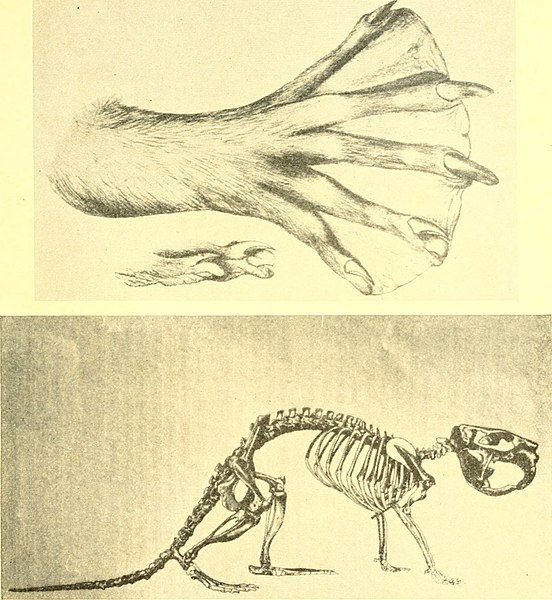
Anatomy of a beaver
A beaver is a magnificent work of biological engineering . Its anatomy is fine-tuned for life around and in water. From webbed hind feet that make swimming a breeze to a paddle-shaped tail used for balance and signaling danger, each feature plays a role.
Among these features, the beaver’s lungs are particularly noteworthy. These lungs are larger and have a greater capacity than those of many other rodents . This allows them to hold their breath for long periods. But does that mean they can breathe underwater? Let’s delve into that mystery next.
Illustration of a beaver anatomy, Credit: Wikimedia/Fæ
How long can beaver stay underwater?
How long a beaver can stay submerged might astound you. On average, beavers can hold their breath for up to 15 minutes! During this time, they can dive, swim, and work on their dams or lodges without needing to surface for air. This ability comes in handy when they need to escape from predators or when they’re doing construction work underwater.
However, this doesn’t mean they can stay underwater indefinitely. They must eventually resurface to breathe. This necessity brings us to our main question – Can beavers breathe underwater?
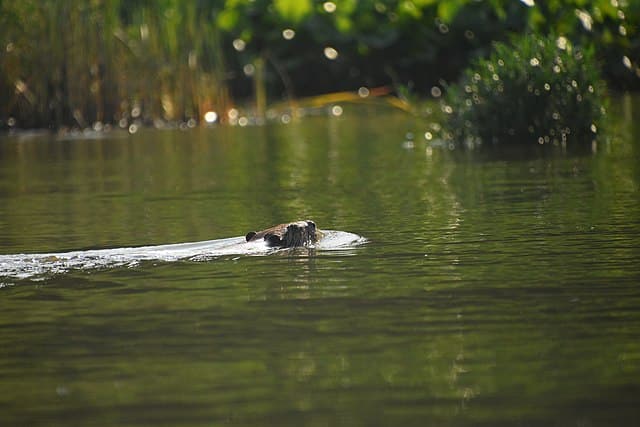
Beaver swimming in the water, Credit: Wikimedia/Amaury Laporte
Can beavers breathe underwater?
While beavers are excellent swimmers and divers, they cannot breathe underwater. When a beaver dives, it closes its nostrils and ears to keep water out. While submerged, a beaver gets its oxygen not from the water, but from the air it has stored in its lungs.
This is why even though a beaver might appear to be underwater for quite a while, it will eventually resurface. Once it breaks the surface, it can take a deep breath, refilling its lungs with air. Then, it’s ready for another dive!
Their blood has a component called myoglobin, and it is more potent in transporting oxygen to different organs of a beaver. It is a protein that is globular in shape. This helps them to hold their breath underwater for longer.
Fun facts about beaver abilities
Aside from their unique aquatic adaptations, beavers have some pretty impressive skills and traits. For instance, their teeth continuously grow throughout their lives. This helps them gnaw through tough tree trunks without wearing their teeth down.
Beavers also have a remarkable sense of smell, which they use to communicate and find food. But one of the most amazing things about beavers is their ability to change landscapes. By building dams, they can transform a small stream into a large pond, creating a new habitat for themselves and other wildlife!
So, while beavers can’t technically breathe underwater, their other adaptations make them some of the most fascinating creatures in the animal kingdom. Next time you see a beaver lodge or dam, take a moment to appreciate the amazing abilities of these industrious rodents.
Glossary
Nocturnal: Active during the night.
Semiquatic: Adapted for living or spending a significant amount of time in water, but not entirely aquatic.
Rodents: A member of the mammalian order Rodentia, characterized by a pair of continuously growing incisors in both its upper and lower jaws. Rodents use these teeth to gnaw on various materials, which helps keep the length of their teeth manageable. This group includes numerous species, such as rats, mice, squirrels, beavers, hamsters, guinea pigs, and more. They vary greatly in size and inhabit diverse habitats across the world.
Biological engineering: The application of concepts and methods of biology to solve real-world problems related to life sciences or the application thereof.