Remember how Harry Potter grew gills and was able to stay underwater for a long time after consuming gillyweed in Goblet of Fire. Although the magical world of Hogwarts provides herbs with perks, humans haven’t had the privilege of such magic herbs. Diving deep into the heart of the sea with just one breath is our take, and for freedivers, it’s a thrilling journey. Freediving is an age-old practice where divers explore underwater realms without the aid of breathing apparatus. They are guided only by their courage, the capacity of their lungs, and their unyielding love for the ocean.
The mindset of a freediver
Beneath the surface, freedivers enter a world where time seems to slow. Here, they are guests in the grand theater of marine life, surrounded by a ballet of fishes and corals. It requires not just physical strength, but a calm and focused mind to perform this deep-sea dance.
Categories of freediving records
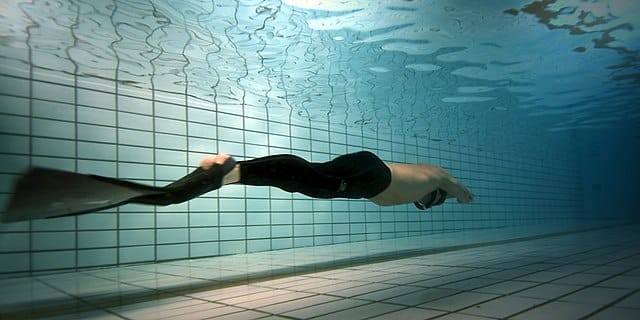
In the realm of freediving, records are broken and made in different categories. There are constant weight dives where divers descend and ascend using their fins, and free immersion dives where the diver pulls themselves along a rope. Static apnea tests how long a diver can hold their breath underwater while remaining stationary
A freediver using a monofin, which is often used in constant weight freediving, Credit: Wikimedia/ jayhem
The process of validation
For a record to be valid, strict protocols must be adhered to. Professional organizations, like the International Association for the Development of Apnea (AIDA ), oversee and verify the authenticity of these records. An official record demands extraordinary skill, strength, and resilience.
A brief history of freediving records
Over the years, freediving has evolved significantly. Early divers dove to collect sponges or pearls, with rudimentary equipment and limited knowledge of safety measures. But today, the sport has grown into a global spectacle with athletes pushing the boundaries of human potential.
Famous record holders
Many daring individuals have written their names in the annals of freediving history. Bob Croft, the ‘Father of American Freediving,’ revolutionized the sport by reaching 64 meters in the 1960s. Later, Umberto Pelizzari hit the headlines, setting numerous records in the 1990s.
Breaking the freediving world record
Breaking a world record in freediving requires intense preparation. Training regimes include rigorous swimming workouts, breath-holding exercises, and yoga for enhancing flexibility and calming the mind.
Mental and physical challenges
Pushing the human body to its limit is a colossal task. Freedivers face extreme pressure changes, hypoxia , and chilling water temperatures, not to mention the mental challenge of maintaining focus and composure in the face of danger.
The current freediving world record
The current record holder for the deepest dive is Alexey Molchanov. This fearless Russian diver is a remarkable athlete whose love for the ocean is evident in his dedication to the sport.
The dive that made history
In November 2020, Alexey Molchanov dove an incredible 130 meters on a single breath, setting the world record for the deepest Constant Weight dive. This monumental achievement is a testament to the human spirit and a benchmark for future generations of freedivers.
In the world of freediving, it’s about exploring human limits and fostering a deeper connection with the ocean. Breaking records might seem synonymous to conquering depths, but it is only the tip of the iceberg. Freediving reminds us that we are but humble guests in the magnificent underwater kingdom. The waters have always challenged us, as proved by the mere fact that we know space in greater detail than the oceans.
Alexey Molchanov: the current record holder for the deepest dive, Credit: Wikimedia/Divot
Glossary
Freediving: Also known as apnea diving or breath-hold diving, it’s a form of underwater diving that relies on the diver’s ability to hold their breath until resurfacing rather than using breathing apparatus like scuba gear.
Constant Weight Diving: This is a category of freediving where the diver descends and ascends using only their fins or a monofin. They do not use a line to pull themselves down or up and the weight they carry cannot be discarded.
Free Immersion Diving: In this category of freediving, divers descend and ascend by pulling themselves along a vertical guide rope. No fins or propulsion devices are used in this type of diving.
Static Apnea: This is a discipline of freediving where the diver holds their breath for as long as possible while staying motionless in the water, usually floating on the surface or standing on the pool bottom.
Hypoxia: This is a condition in which the body or a region of the body is deprived of adequate oxygen supply at the tissue level. It can be a risk for freedivers who push the limits of their breath-hold capacity.
AIDA: The International Association for the Development of Apnea, an organization that sets the standards for freediving education and competitions, and verifies freediving records.