The world of felines is an interesting one, filled with quirks and unique features that set these magnificent creatures apart. If you’ve ever shared your home with a cat, or even if you’ve had the chance to interact with one, you would have noticed their curious, and often perplexing, traits. Among them, one that stands out the most, and often becomes a topic of intrigue, is the peculiar texture of a cat’s tongue. Unlike the smooth, flat surface of a human’s tongue, a cat’s tongue feels like sandpaper. But have you ever wondered, why is a cat’s tongue so rough?
The anatomy of a cat's tongue
The unusual texture of a cat’s tongue doesn’t just exist for the sake of being different; it’s a part of the feline’s complex anatomy and physiology. Unlike our tongues, the surface of a cat’s tongue is populated with tiny, hook-shaped formations known as papillae . These papillae are composed of keratin , the same tough protein that our hair and nails are made from.
But these aren’t just any ordinary hooks; they are directed towards the cat’s throat, and this design gives the feline’s tongue its distinct roughness. If you take a closer look, which might be a challenge unless your cat is exceptionally patient, you’ll see that these papillae are not evenly distributed but are denser towards the middle and the back of the tongue.
close-up of a cat's tongue, showing the unique texture and structure, Credit: Wikimedia/madprime
The functional benefits of a rough tongue
Now, you might ask, why would a cat need a rough tongue? What purpose does it serve? Interestingly, the unique texture of a cat’s tongue is highly functional. It plays a significant role in two primary aspects of a cat’s life: grooming and eating.
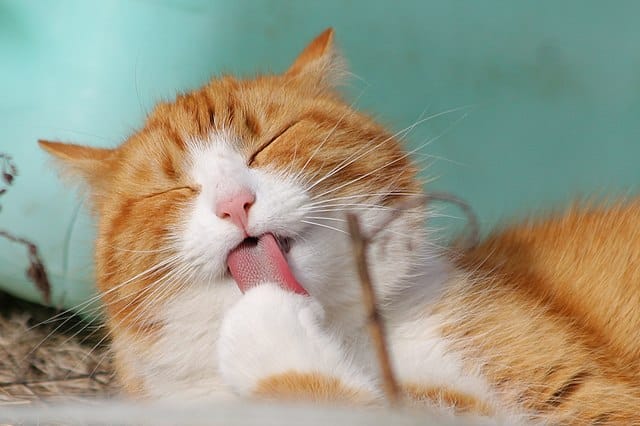
A cat’s grooming routine is an integral part of its day. They’re known for their cleanliness and spend a considerable amount of time grooming themselves. When a cat grooms itself, its tongue works like a natural comb. The tiny hooks comb through the fur, removing any loose hair, dust, or dirt that might be clinging onto their coat. Moreover, they also help to spread the natural oils secreted by the cat’s skin uniformly across their fur, keeping it healthy, shiny, and well-moisturized.
The other key function of the rough tongue comes into play during mealtimes. Cats are carnivores by nature, and their tongue is designed to support their meat-eating habits. The rough, hook-like papillae help to tear and scrape meat off the bones, ensuring that not a single bit of their meal goes to waste.
A cat grooming itself, Credit: Wikimedia/TeamK (Karin Laurila)
How a cat's tongue enhances its survival
The rough texture of a cat’s tongue isn’t just about grooming and eating; it also plays a vital role in their survival. For instance, cats don’t consume water the same way we do. They don’t scoop water into their mouths, but instead, they lap it up with the tip of their tongues. The unique surface of their tongue allows them to draw up a column of water, which is then swiftly pulled into their mouths.
Moreover, the design of the tongue provides them with a predatory advantage . The hooks face backwards, and when a cat catches its prey, they work as natural barbs that make it challenging for the prey to escape.
Interesting facts about cat tongues
While it’s known that all cats have rough tongues, it’s intriguing to note that not all rough tongues are the same. The size of a cat does influence the roughness of its tongue. For example, a lion, which is a member of the feline family, has a tongue so rough it could potentially lick the paint off a wall! This extreme roughness is due to the larger and more pronounced papillae on their tongues.
Cats also display some unique behaviors related to their tongues. Ever noticed how a cat might suddenly stop in its tracks and start grooming itself, especially after a surprising event or loud noise? This action is known as “ displacement grooming ,” a behavior cats use to comfort and calm themselves when they’re startled or stressed.
So, the next time you’re feeling the sandpaper-like lick of a cat, remember that it’s more than just a strange sensation. It’s a fascinating piece of feline design, an adaptation that serves multiple essential functions, from maintaining cleanliness to aiding in their survival. A cat’s tongue, just like every other aspect of this captivating creature, is a testament to the wonders of nature’s designs.
Glossary
Papillae – Tiny, hook-shaped formations on the surface of a cat’s tongue. These are made up of keratin and give the tongue its rough texture.
Keratin – A type of protein that makes up hair, nails, and the outer layer of skin in humans and animals.
Carnivores – Animals that primarily eat meat.
Predatory advantage – An adaptation or characteristic that improves an animal’s ability to catch and kill its prey.
Displacement grooming – A behavior in which a cat grooms itself to soothe or calm down after being startled or stressed.
Barbs – Sharp, pointy objects. In the context of this article, it refers to the backward-facing papillae on a cat’s tongue that help in holding onto prey.
Adaptation – A change in an organism’s body or behavior that helps it to survive in its environment.