If you’re tuning in from the southern hemisphere, chances are you’re suffering through an uncharacteristically warmer spring or a straight-up brutally hot summer right now. Apart from the regular rigamarole of drinking anything you get your hands on and desperately trying to stay indoors any time before the evenings, you might also be hunting around for the best antiperspirants and deodorants because you’ll be sweating more than usual.
Everyone sweats everywhere, it’s not just a matter of running hot! Credit; pexels.com/Ketut Subiyanto
But do you only sweat when you’re running hot? Let’s find out!
What is sweat?
Simplified down to the absolute basics, sweat is just a solution. It’s mostly made up of water but also has a few solutes like sodium, potassium, calcium, and chloride in it. These solutes are what give sweat its characteristic stinky odor. As warm-blooded creatures, sweating is a tiny part of a larger mechanism known as thermoregulation.
Elements like sodium and potassium are present as solutes in sweat, Credit; Wikimedia/Nefronus
What is thermoregulation?
Think about it; our body is a complex biological system made up of hundreds of thousands of tiny biological machines: cells. Naturally, like any other machine that has ever worked, work produces heat. It’s a matter of thermodynamics . We can’t keep this extra heat stored in our bodies. We need to get rid of it. We discard that heat in many different ways, like either panting or sweating.
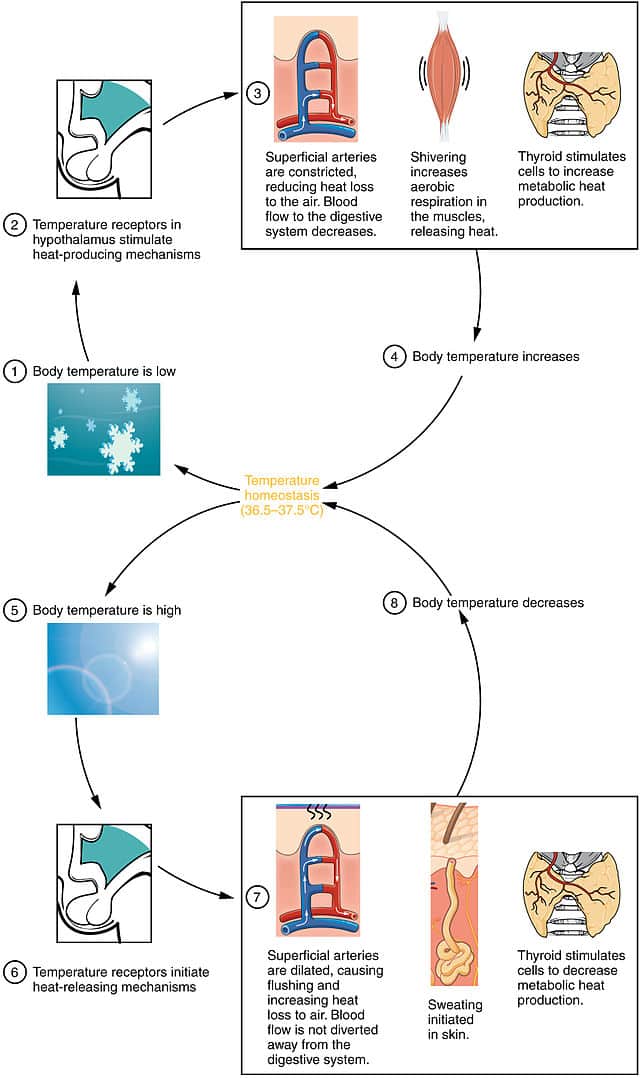
An illustration of thermoregulation in different environmental conditions, Credit; Wikimedia/OpenStax College
Do we only sweat when it’s hot, then?
Not necessarily. When we talk about heat and temperature, we’re talking about our internal body temperature as opposed to our external or surrounding temperature. Although we associate sweat with hot temperatures and the rigors of summer, it’s actually more of an all-around-the-year type of deal. It’s a pretty common physiological reaction of the body and doesn’t actually require heat or high temperatures as a trigger.
An illustration of the thermoregulation feedback loop, Credit: Wikimedia/OpenStax College
Other than metabolism, what else can trigger or cause sweating?
There’s no denying that sweat is a by-product of our metabolic activities. Every cell in your body is pretty much a nifty little engine that is running throughout the day. Each cell takes in food, pumps out energy, and, depending on the type of cell, does a few other things as well, be it filtering impurities from blood or transmitting messages across the length of the body. However, sweat, or rather sweating, is also part of many other physiological pathways than just thermoregulation. For instance, have you heard of the “spicy sweats” or the “panic sweats”?
Anxiety, stress, and panic can all cause excessive sweating, Credit: pexels.com/Nathan Cowley
How many times, while chowing down on a bucket of spicy wings, have you broken out in a bout of excessive sweating? This is because when we eat spicy foods (like a bucket of wings), a chemical known as capsaicin interacts with our nervous system, or more specifically, the endings of our sensory nerves, like those on our tongues. These nerves then transmit signals to the brain to indicate an apparent increase in our internal body temperature. But, guess what? This signal is untrue! Our body temperature doesn’t actually change or increase when we ingest spicy foods, rather, capsaicin just tricks us into thinking that it does. Similarly, when it comes to the “panic sweats,” it’s a matter of fight-or-flight.
Fight-or-flight
When things go haywire, different organ systems of our body are sometimes forced to jump into collective action. Fight-or-flight is a coordinated response mediated by the nervous and endocrinal systems of our bodies when we encounter external or internal stressors.
For example, let’s consider a dangerous scenario, such as running down the fire escape of a burning building. In times like these, your body doesn’t want you to focus on less urgent activities, like digestion and cell division. Instead, once your body has identified a threat, your nervous system jumps into action. Your brain will trigger the adrenal glands to release two substances, norepinephrine and epinephrine. They’re both a kind of adrenaline .
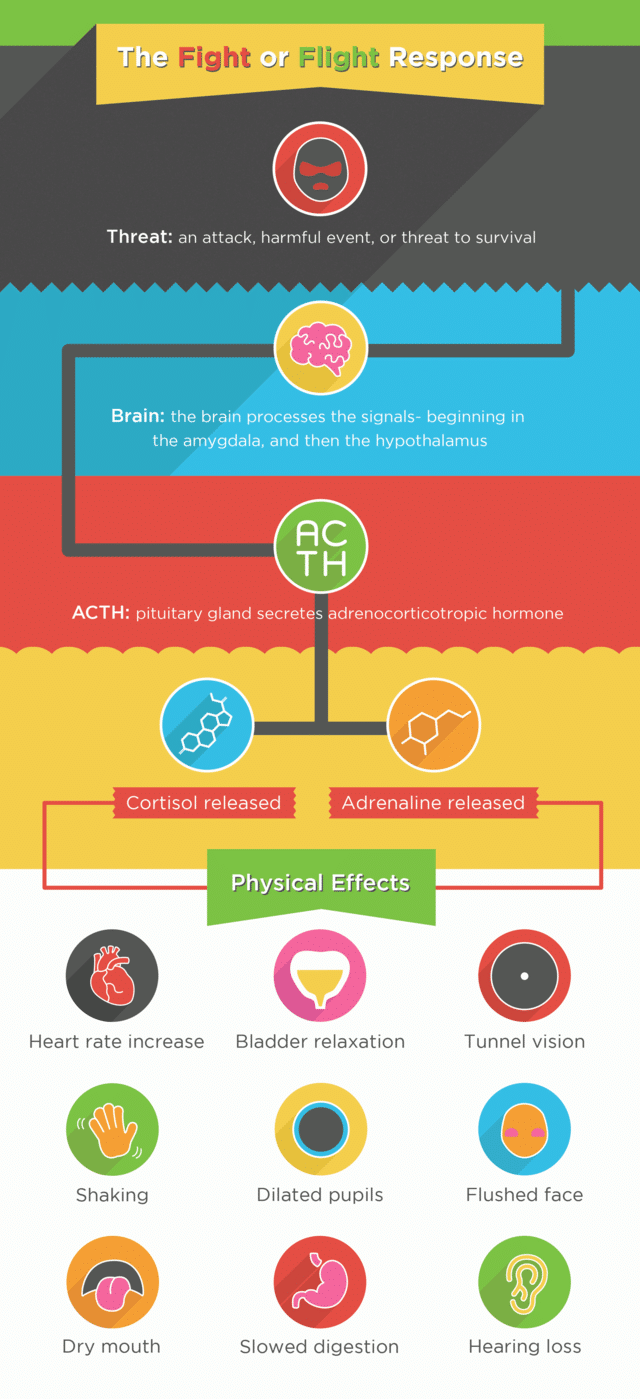
The infographic illustrates how the fight-or-flight response works, Credit: Wikimedia/Jvnkfood
Your pupils will rapidly dilate , your blood pressure will elevate, your heart rate will spike, and your sweat production will also intensify or increase. This increase in sweating, or hyperhidrosis , doesn’t just happen to cool down your body; you’re also sweating as a response to potential danger. Finally, sweating also compensates as a form of waste removal during time of fight-or-flight. Toxic chemicals like ammonia and urea build up during times of increased metabolic activity, so sweat is a nifty little solution that the body comes up with to get rid of waste without diverting resources to the renal system.
Emotions
You might have noticed that when you’re stressed about taking an important exam, or if you have a big presentation to give in front of your class, you may sweat through your shirt then as well. This is because feelings or emotions also elicit the flight or fight response.
Conclusion
Not everyone sweats for the same reasons. In summertime, you might break into a sweat simply because you’re out in the sun. Yet you can also break into a sweat if you’re engaged in a particularly arduous workout session in the middle of winter. So, the temperature that matters when it comes to sweat is your internal body temperature as opposed to the external or surrounding temperature and weather.
Sweat is one of the most common physiological responses that the body employs, Credit; pexels.com/CottonBro Studio
Apart from thermoregulation, physiological processes such as fight-or-flight, as well as behavioral tendencies such as an affinity towards spicy foods, can all lead to sweating.
Readability: 60.7
Flesch Kincaid Grade Level: 8
Glossary
Thermodynamics: A physical science discipline that deals with energy and systems.
Metabolism: The sum total of all the activities and processes that take place in your body.
Capsaicin: a chemical found in spicy peppers that causes a sensation like burning.
Glands: Tissues or organs that can synthesize and release specific types of substances.
Adrenaline: A special type of biochemical made in the adrenal glands that better equips us to deal with any impending dangers in our immediate surroundings (or any perceived internal stress like anxiety.)