Tornadoes conjure both awe and fear as they cut unpredictable paths of destruction across landscapes. These rapid swirling winds, extending down from cumulonimbus clouds, have intrigued scientists for decades, seeking to unpack the atmospheric ingredients that generate such concentrated vortices. In this article, we look to answer the question of why and how tornadoes happen by exploring the complex interaction of variables like wind shear , air temperature, pressure systems, and humidity that collide to spawn tornadoes under certain conditions.
How tornadoes are born
For a tornado to form, certain ingredients need to come together in the sky. First, you need warm humid air near the ground and drier air above. This creates instability, like a layer cake ready to topple over.
Next, you need wind shear. This means the wind blows one way at ground level but a different way up higher. Wind shear causes the air to start spinning horizontally.
Finally, updrafts lift the rotating air upright. Updrafts are columns of rising air, kind of like an invisible elevator. When the humid, unstable air and spinning winds get lifted vertically, it sets the stage for tornado birth.
Thunderstorms can create tornadoes because they contain lots of energy, wind shear, and strong updrafts. A funnel cloud starts extending toward the ground if the spinning motion tilts upright within a thunderstorm.
The most powerful tornadoes come from “ supercell ” thunderstorms. These are huge rotating storm systems with intense, sustained updrafts. Their spinning motion and lift nurture tornadoes like an incubator. Tornadoes are birthed when the swirling winds touch the ground. Tracking supercells helps predict where tornadoes may strike.
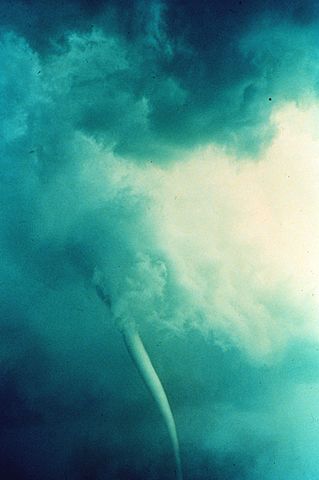
Tornado at Beginning of Life, Credit; Wikimedia/Saperaud
The f-scale: Measuring tornado intensity
How do meteorologists make sense of the wide variability in tornado intensity and destruction? This critical challenge was tackled in 1971 by Dr. Tetsuya Theodore Fujita, a pioneering severe storms researcher from the University of Chicago. Fujita devised an empirical scale that classified tornadoes based on the severity of inflicted damage, from minor to catastrophic. This became known globally as the Fujita Scale , or F-Scale.
The F-Scale consists of six categories from F0 to F5, representing estimated wind speeds from 40 mph up to over 300 mph. An F0 tornado may damage chimneys, tree branches, and street signs with its modest wind gusts hardly stronger than a stiff breeze. Meanwhile, the winds inside an exceptionally rare F5 tornado exceed 300 mph, enough to cleanly sweep homes off their foundations, hurl automobiles hundreds of yards, and deform skyscraper-grade steel beams.
To determine a tornado’s F-Scale rating, meteorologists carry out ground surveys evaluating the wreckage left behind. Correlating damage levels to estimated wind velocities provides standardization to compare storm potency over time. However, factors like construction materials and quality introduce some variability. Two tornadoes with identical wind speeds may inflict disparate damage based on what structures lie in their path.
Nonetheless, the simplicity and adaptability of the Fujita Scale established it as the keystone for assessing tornado strength for over three decades. It continues as a crucial reference point even as more sophisticated measurement methodologies emerge, though scientists today apply updated Enhanced Fujita Scale ratings when examining the most extreme storms.
Tornadoes don’t strike randomly across the United States. There are hotspots notorious for twisting funnel clouds. The central Plains is one such tornado breeding ground, nicknamed “Tornado Alley.”
What makes Tornado Alley prone to storms? Two key factors collide here. First, wind blowing from the Rocky Mountains to the east clashes with humid air from the Gulf of Mexico. This collision creates the spinning winds that tornadoes need.
Second, Tornado Alley’s flat landscape allows storms to rage with few barriers. When supercell thunderstorms build here, any tornadoes can travel far distances rather than hitting hill or mountains.
Another high risk tornado zone is “Dixie Alley” in the southeastern states. But Dixie Alley forms fewer yet more powerful tornadoes than Tornado Alley. That’s because tropical air and more varied terrain intensifies the storms that do arise.
By understanding different regions’ geography and climate, scientists can better predict seasons and areas tornadoes will strike most. Tornadoes gravitate to hotspots lending fuel to their formation and room to roam.
What to do during a tornado
If a tornado is headed your way, seek shelter right away. Get to the lowest floor of a sturdy building if possible. Inner rooms like bathrooms or closets are best for shelter. Stay away from windows and outer walls in a tornado. If you’re outside, lie flat in a ditch and shield your head. Never try to outrun a tornado in a car—stop and get underground.
Advanced technologies help warn people faster when tornadoes form. Doppler radar tracks storms closely to see signs they are making tornadoes. Scientists also use specialty drones and computer models to study how tornadoes start inside thunderstorms. Tracking storms better helps forecasters get warnings out earlier and save lives. While tornadoes can be unpredictable, modern science tools are unlocking their secrets more every year.
Glossary
Tornado: A rapidly rotating column of air that extends from a thunderstorm to the ground, often visible as a funnel cloud.
Wind Shear: A difference in wind speed and direction over a relatively short distance in the atmosphere, contributing to the development of tornadoes.
Supercell: A highly organized type of thunderstorm with a deep, persistently rotating updraft. Supercells are often responsible for significant tornadoes.
Fujita Scale (F-Scale): A scale for rating tornado intensity, based primarily on the damage tornadoes inflict on human-built structures and vegetation.
Doppler Radar: A radar system used to detect the location, movement, and intensity of weather systems, particularly useful in identifying severe weather such as tornadoes.