It is an animal so tough that scientists thought that it might survive on the moon. Israeli lunar lander Beresheet was carrying water bears, or tardigrades, to the moon. Unfortunately, the lander crashed. Although that’s over a hundred million dollars turned into a moondust, scientists speculated that the tardigrades might have lived on. Recent studies support otherwise, but we don’t find scientists rooting for a millimeter-long critter every day. What makes tardigrades special, and where can they live?
Tardigrade under a microscope. Note how they have an almost transparent body, Credit: Wikimedia/ Peter von Bagh
Where do tardigrades live?
Tardigrades, also known as water bears, are small chubby invertebrates. They are akin to insects and velvet worms . They have four pairs of legs with four to eight claws each. They slurp in fluids from plant and animal cells. But water bears are one of the toughest organisms to ever exist. They survive on mountain peaks and in the deepest trenches of the oceans. From the Amazon to the Antarctic, water bears live in every possible habitat.
However, they need water around their body to respire and prevent desiccation. As a result, tardigrades are primarily aquatic . For instance, you can find these critters in a film of water on plants. Similarly, any trace of water in soil and leaf litter is a perfect home for water bears. Surprisingly, they can also survive in sand dunes. Water bears live on mosses and lichens and in water bodies with vegetation. You may even find some in your backyard, probably chilling on a bed of moss! More on that later.
Where can tardigrades survive?
It is easier to cross out the options where water bears can’t survive.
• Firstly, they can survive in temperatures as low as −328 °F (−200 °C) and as high as 304 °F (151 °C)
• Secondly, they can survive in the absence of water and oxygen. In fact, they can survive for some time in a vacuum . However, scientists still classify them as aquatic.
• Thirdly, they can survive exposure to X-rays a thousand times greater than the lethal dose for humans
• Lastly, they can survive in very high pressure—almost six times the pressure in the deepest ocean trenches, which is eight tons per square inch.
Can tardigrades live in space?
As if all the harsh places on Earth weren’t enough, water bears make a spacewalk seem like a cakewalk. Scientists left water bears in containers to float at a height of 167 miles (almost 270 km) for 10 days. After they plummeted back to earth, most of them were fine.
How do water bears survive such harsh conditions?
Water bears have their own take on hibernation . Their metabolism comes to a reversible stop. This is known as cryptobiosis, which is an ‘almost dead’ state of an organism. Tardigrades make it through dry conditions by curling up into a little ball called a tun. Firstly, tun formation reduces metabolism, and secondly, water bears can revive from tun conditions. Water bears synthesize and metabolize a sugar named trehalose. These sugars enter into cells to replace lost water during a tun state. As a result, the metabolic rate lowers to almost 0.01 % of the normal rate.
Tardigrades have been revived from samples that are over a century old. It takes a few hours for tardigrades to come out of this slumber, depending on their state of tun.
A. Normal state B. Tun state. A tardigrade curled into a ball is quite resilient and can survive almost everywhere, Credit: Wikimedia/Ricardo Cardoso Neves
How to find tardigrades?
Science isn’t a read-only subject. Sometimes, you need to get your hands dirty. In this case, get hands-on and hunt for water bears around your own home.
1. Collect moss or lichen and place it in a shallow dish. Water bears find mosses cozy enough to be called home.
2. Soak the clump in water for a day.
3. Squeeze out the water from the moss or lichen into another dish.
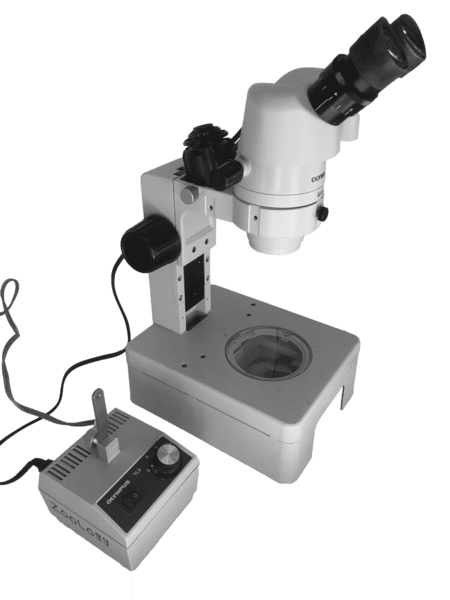
4. This is where you need to ask your science teacher for some help. Put some of the squeezed water on a slide and ask your teacher to help you focus under a dissecting microscope.
A dissecting microscope can help you find tardigrades. And you can collect a few of them from your backyard, Credit: Wikimedia/Sarah Greenwood
Reading ease: 67.3
Grade: 7.1
Glossary
Velvet worms: A type of worm-like invertebrate with waterproof, velvety skin
Aquatic: describes an animal that mostly lives in water
Vacuum: Space devoid of air
Hibernation: A state of sleep that reduces hunger and energy usage
Metabolize: The breakdown of food material to produce energy
I am pursuing my bachelor's in microbiology from Scottish Church College, Kolkata and the lab at my college is as close as my home is to me. My interest lies in molecular biology and cell signalling, and I want to be a professor when I grow up. I believe that what we see around has a fantastic science story in it. In my free time, I love to watch soccer. Writing for Smore Science gives me the chance to explore my take on explaining the science around me in ways that everyone can grasp.