Where do platypuses live?

Table of Contents

A lot of us have grown up watching Phineas and Ferb. And one of the most interesting characters in the show is, without a doubt, Perry the Platypus. Sadly, most platypuses do not double as secret agents. But they are still fascinating. So, let’s explore their habitats.

Land and water: Best of both worlds!

Platypuses are semi-aquatic , meaning that they can survive both on land and in water. Best of both worlds! They prefer freshwater rivers, ponds, and wetlands. Adaptations like a streamlined body  and waterproof fur equip them with the ability to thrive in water. They can survive in both slow-moving rivers and rapid streams. They also occupy man-made dams and ponds but prefer natural environments.

Platypus in Water
Platypus in Water. Credit: Wikimedia Commons/Brisbane City Council

Platypuses occupy water bodies to forage for food like insects and worms. But they spend abundant time on land, too. When not looking for food, they tend to dwell in burrows . The platypus makes the burrows close to water bodies, above the water level. They may also occupy fissures or cracks in rocks. Areas with more plants and trees attract the platypus. The presence of trees, grasses, and shrubs increases the availability of fauna . This fauna can act as food for the platypus. The presence of trees and plants protects the platypus from predators.

Types of platypus burrows

When on land, platypuses can make two types of burrows. These are nesting burrows and camping burrows. A nesting burrow is built to shelter a mother and her offspring. It is often the place where females lay their eggs. A camping burrow is occupied by males and females that aren’t pregnant or aren’t caring for any young ones. Nesting burrows are usually longer than camping burrows to provide ample space for the mother and her young ones.

A Platypus in a Burrow. Credit: Wikimedia Commons/ The History Trust of South Australian, South Australian Government

Country of origin

Platypuses are found only in Australia. Areas like Tasmania, Queensland, certain parts of Victoria, and New South Wales show a wide distribution. Western Australia has no recorded incidences of the platypus.


Platypuses can survive in warm regions like Queensland and also in snowy, freezing regions of Tasmania.

A hint of salt

Platypuses usually inhabit freshwater systems. It is their natural habitat. Saltwater systems like oceans or beaches are not the places to look for a platypus. Hence, it came as a pleasant yet confusing surprise when a platypus was found on the beach of Kangaroo Island. The researchers observed no ill effects on the health of the platypus. This discovery also suggests that platypus can tolerate a wide range of salinity  variations, from freshwater to saltwater.


Some reports indicate platypus in brackish  areas, but this was the first time anyone had observed a platypus in an altogether saltwater environment. Brackish areas are the locations where the river meets the sea. Even scientists who had been studying platypuses and their habitat for years were surprised. Platypuses remain one of those animals we know little about.

Threats to habitat

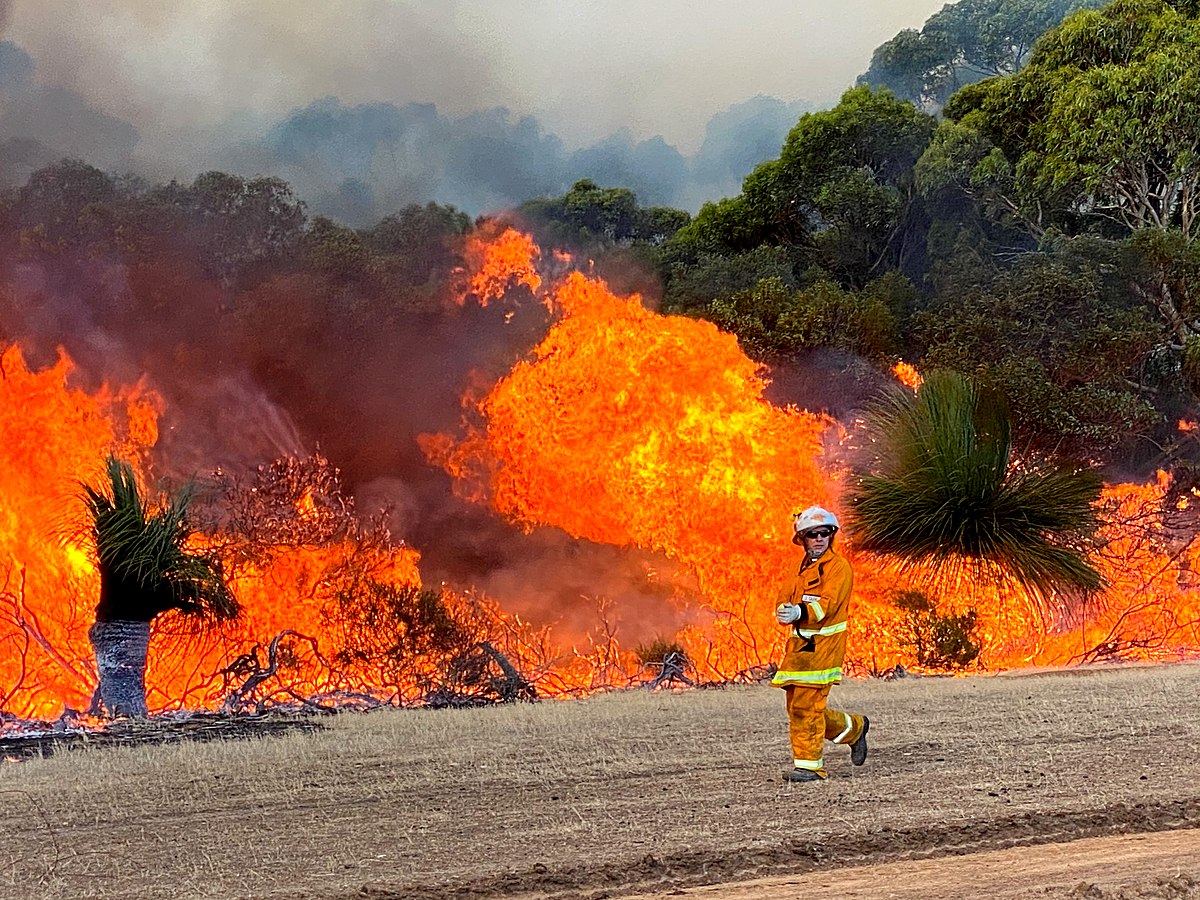
The IUCN has labeled the platypus as “Near Threatened.” Their rare occurrence and our lack of knowledge have made it difficult to have an exact count of their population. Degradation of water quality, building dams, and clearing vegetation have impacted their habitats. Recent bushfires  in Australia in 2019 and 2020 also caused a decline in their population. It is important to have stringent control over human activities to protect these animals.

A bushfire in Australia
A bushfire in Australia. Credit: Wikimedia Commons/New Matilda

FLESCH KINCAID READING EASE: 60.2


FLESCH KINCAID GRADE LEVEL: 7.4

Glossary

Platypus: Unique mammal with a duck-like bill.


Semi-aquatic: Living partially on land and partially in water.


Freshwater: Water systems having less salt concentration, like rivers and ponds.


Streamlined body: An adaptation that enables swimming and survival in water, involving being long and smooth rather than round and bumpy.


Burrow: A cavity or tunnel in the ground, usually dug by an animal.


Fauna: Animals in a region.


Salinity: The concentration of salt in the water.


Brackish: Water systems that are partially salty, less salty than saltwater systems but more salty than freshwater systems.


IUCN: International Union for Conservation of Nature; a union aimed to protect nature.


Bushfires: Wildfires that spread rapidly.

For paragraph 1: Land and water: Best of both worlds!

  1. Serena, M., Thomas, J. P., Williams, G., & Officer, R. C. E. (1998). Use of stream and river habitats by the platypus, Ornithorhynchus anatinus, in an urban fringe environment. Australian Journal of Zoology, 46(3), 267. https://doi.org/10.1071/zo98034
  2. Serena, M., Worley, M., Swinnerton, M. I., & Williams, G. (2001). Effect of food availability and habitat on the distribution of platypus (Ornithorhynchus anatinus) foraging activity. Australian Journal of Zoology, 49(3), 263. https://doi.org/10.1071/zo00089
  3. Milione, M., & Harding, E. K. (2009). Habitat use by platypus (Ornithorhynchus anatinus) in a modified Australian Wet Tropics catchment, north-eastern Queensland. Australian Mammalogy, 31(1), 35. https://doi.org/10.1071/am08110

For paragraph 2: Types of burrows

  1. Thomas, J. P., Handasyde, K. A., Parrott, M. L., & Temple-Smith, P. (2017). The platypus nest: burrow structure and nesting behaviour in captivity. Australian Journal of Zoology, 65(6), 347. https://doi.org/10.1071/zo18007
  2. Otley, H., Munks, S., & Hindell, M. A. (2000). Activity patterns, movements and burrows of platypuses (Ornithorhynchus anatinus) in a sub-alpine Tasmanian lake. Australian Journal of Zoology. https://doi.org/10.1071/zo99010

For paragraph 3: Country of origin

  1. Van Dyck, S., & Strahan, R. E. (2008). The mammals of Australia. https://ci.nii.ac.jp/ncid/BB01371111
  2. Linternmans, M. (1998). The Status and Distribution of The Platypus (Ornithorhynchus anatinus) In the Australian Capital Territory with Notes on Some Localised Declines. Australian Mammalogy, 20(2), 306. https://doi.org/10.1071/am98314
  3. Connolly, J., Claridge, T., Cordell, S. M., Nielsen, S., & Dutton, G. S. (2016). Distribution and characteristics of the platypus (Ornithorhynchus anatinus) in the Murrumbidgee catchment. Australian Mammalogy, 38(1), 58. https://doi.org/10.1071/am14039

For paragraph 4: Hint of salt

  1. Catchpoole, D. (2018). Saltwater platypus surprise. com. https://creation.com/saltwater-platypus-surprise

For paragraph 5: Threats to habitat

  1. Dudgeon, D., Arthington, A., Gessner, M. O., Kawabata, Z., Knowler, D., Lévêque, C., Naiman, R. J., Prieur-Richard, A., Soto, D., Stiassny, M. L. J., & Sullivan, C. A. (2006). Freshwater biodiversity: importance, threats, status and conservation challenges. Biological Reviews, 81(02), 163. https://doi.org/10.1017/s1464793105006950
  2. Bino, G., Kingsford, R. T., Archer, M., Connolly, J., Day, J., Dias, K. N., Goldney, D., Gongora, J., Grant, T. D., Griffiths, J., Hawke, T., Klamt, M., Lunney, D., Mijangos, L. a. H., Munks, S., Sherwin, W. B., Serena, M., Temple-Smith, P., Thomas, J., . . . Whittington, C. M. (2019). The platypus: evolutionary history, biology, and an uncertain future. Journal of Mammalogy, 100(2), 308–327. https://doi.org/10.1093/jmammal/gyz058

Contributors

Copyright @smorescience. All rights reserved. Do not copy, cite, publish, or distribute this content without permission.


Join 20,000+ parents and educators
To get the FREE science newsletter in your inbox!