What Do Hippos Eat?

Hippos may not be the obligate herbivores we thought they were.

Table of Contents

You might’ve encountered Fiona and Fritz, the adorable brother-and-sister hippos that entertain crowds down at the Cincinnati Zoo. The pair has captured hearts all over the world and even has a dedicated fanbase (yes, you read that right!) that eagerly follows their activities and updates on social media platforms like Facebook and Twitter.


Here’s their Facebook fan page


There’s no denying that Fiona and Fritz are absolutely adorable and stellar ambassadors of their species; yet, they might be selling us a false tale about hippos. Although hippos look cute and cuddly, out in the wild they’re downright bullies! Be it in the water or on the land, hippos have a fierce attitude. They chase after safari jeeps and speed boats with the same intensity and aggression.


They’re the second largest terrestrial mammals  on earth, and also have the unique distinction of being one of the deadliest animals in the world. For instance, a BBC article published in 2016 estimated that hippos were one of the most dangerous animals on the continent of Africa. They’re responsible for the deaths of over 500 people per year!

Hippos are one of the most dangerous animals in the world
Hippos are one of the most dangerous animals in the world, Credit: Wikimedia/Diego Delso

What do hippos eat?

What does such a dangerous animal snack on? Hint: its not what you think! Hippos are usually (we’ll get to the “usually” part in a bit) herbivores ! These majestic amphibious mammals call Africa, specifically the sub-Saharan landscape, their home. The heat of this harsh landscape forces hippos to forage for grass at night. Hippos can travel around 10 kilometers each night, looking for grass to make sure they fill their stomachs. In fact, an individual, adult hippo can eat up to 80 pounds of grass in a single night!

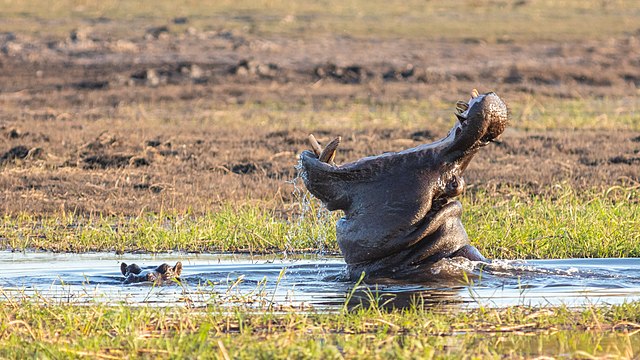
Hippos spend more time in water than they do on land, and yet, they can’t really swim!
Hippos spend more time in water than they do on land, and yet, they can’t really swim!, Credit: Wikimedia/Tim Sackton

Although they have canines  big enough to be called tusks, they don’t grow them out to eat. The canines or tusks in hippos are primarily used to fight other hippos or to scare off other predators (or literally any animal that annoys the hippo simply by broaching their territory).

Are hippos herbivores, then?

Generally, yes. Hippos will abide by a herbivorous diet, but these animals are by no means obligate herbivores. This means that, occasionally, they will eat a bit of meat. A 2015 study shed more light on this fact. The study found that hippos would occasionally choose to feed on carcasses of animals, like wildebeest and zebras.

Latest research points towards the fact that hippos may not be the gentle herbivores that we assume they are
Latest research points towards the fact that hippos may not be the gentle herbivores that we assume they are, Credit: Wikimedia/Ictuku

Conclusion

If you ever find yourself stranded on the grasslands of Africa, it’s not the lions or hyenas you should fear most, but rather, it’s the hippos! Even beyond their general temperament and territorial issues, hippos aren’t like other giant herbivores. They aren’t strict in their herbivorous diet, and if the opportunity comes up, or if resources run scarce, they can change to an omnivores  lifestyle for a bit.


If there’s one thing that will save you, in the unlikeliest and unluckiest of circumstances of coming across an angry hippo, it’s that hippos are notoriously picky eaters. They prefer eating soft and tender shoots and leaves. Generally, in their natural habitat, they’d find these types of plants growing along the banks of rivers and lakes.

Readability: 60.4


Flesch Kincaid Grade Level: 7.9

Glossary

Mammals: Warm-blooded vertebrates that have mammary, that is milk-producing, glands.


Herbivores: Animals that feed on plants.


Amphibious: The ability to survive in both aquatic and terrestrial settings.


Omnivores: Animals that feed on both plants and animals.


Canines: a pair of pointed teeth that are located between the incisors and premolars of mammals

Dudley, J. P., Hang’ombe, B. M., Leendertz, F. H., Dorward, L. J., De Castro, J., Subalusky, A. L., & Clauss, M. (2016). Carnivory in the common hippopotamus Hippopotamus amphibius : implications for the ecology and epidemiology of anthrax in African landscapes. Mammal Review, 46(3), 191–203. https://doi.org/10.1111/mam.12056


Hippopotamus | Species | WWF. (n.d.). World Wildlife Fund. https://www.worldwildlife.org/species/hippopotamus#:~:text=The%20hippopotamus%2C%20also%20known%20as,land%20animal%20after%20the%20elephant.


Hippo | San Diego Zoo Animals & Plants. (n.d.). https://animals.sandiegozoo.org/animals/hippo
Contributors

Copyright @smorescience. All rights reserved. Do not copy, cite, publish, or distribute this content without permission.


Join 20,000+ parents and educators
To get the FREE science newsletter in your inbox!