Corals are sessile living things found in the ocean. Since they don’t move, calcium carbonate can deposit on them so that they might look like rocks, but they’re not. In fact, they’re home to many small water animals. But how does a living thing that doesn’t move feed itself? Let’s find out how and what do corals eat.
Image of a coral reef, Credit:Wikimedia/Nick Hobgood
How do corals eat?
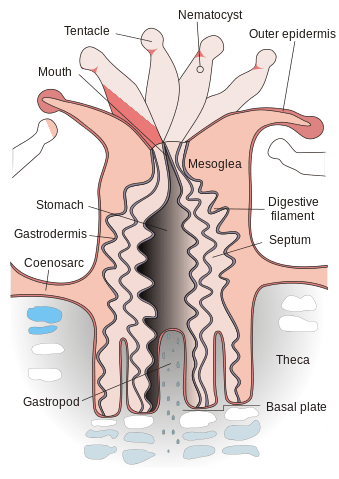
To know what corals eat, we must understand what they are made of. Corals are made up of many tiny living parts called polyps .
Each polyp works independently, as they catch any prey that veers near it. Usually, the polyps filter these zooplanktons from seawater that enter through tiny tunnels called ostia, into their central cavity, called osculum, from where excess seawater is released into the sea. These polyps have long, stinging tentacles that they expose to feed on zooplankton, tiny critters that swim freely in the sea. These polyps also contain a type of algae called zooxanthellae . This algae lives with the coral in a way that benefits both of them, a process called symbiosis.
Most of the food that corals eat comes from the sun. This happens because the algae, called zooxanthellae, that live in the coral can use sunlight to form sugars that the coral can use for energy.
Image of a coral polyp, Credit: Wikimedia/NOAA
Importance and threats
The way corals eat is very important. It helps them to live and helps the ocean’s animals and plants to stay healthy. When corals eat plankton , they help to control the number of plankton in the water, which is good for the balance of life in the ocean.
Also, when the algae do photosynthesis , they make oxygen. Oxygen is very important for all living things, including us!
But, corals are facing problems these days. Overfishing and pollution can make it hard for corals to find food. Also, the ocean is getting warmer because of climate change , and this can harm the algae. When the algae are harmed, they can’t do photosynthesis well, and this can make it hard for corals to get food.
Since they filter feed, they can absorb pollutants and contaminants in the seawater that may enter into its osculum. This can be fatal for corals, and they can even die from overexposure. We need to prevent polluting oceans to save these ecological gems of the marine world.
Corals: Marine invertebrates within the class Anthozoa of the phylum Cnidaria. They typically live in compact colonies of many identical individual polyps.
Polyps: The tiny, soft-bodied organisms that come together to form a coral.
Zooxanthellae: Microscopic algae that live within certain ocean animals like corals, in a mutually beneficial relationship.
Photosynthesis: The process used by plants, algae, and certain bacteria to harness energy from sunlight and turn it into chemical energy in the form of sugars.
Plankton: Small and microscopic organisms drifting or floating in the sea or fresh water, consisting chiefly of diatoms, protozoans, small crustaceans, and the eggs and larval stages of larger animals.
Overfishing: The removal of a species of fish from a body of water at a rate that the species cannot replenish, resulting in those species becoming underpopulated in that area.
Climate change: A long-term change in the average weather patterns that have come to define Earth’s local, regional and global climates. These changes have a broad range of observed effects that are synonymous with the term.