Table of Contents
The sweet scent of perfume is enough to fill you with confidence. But wait till you read about what perfumes are made of.
Ambergris: The poop adored by all!
When you think about the ingredients of a perfume, images of flowers, spices, resins, and fruits probably fill your mind. But in truth, some perfumes are made of components that are not so rosy. Some perfumes incorporate a very peculiar additive: whale poop! Or rather, a very special substance that whales poop out: ambergris.
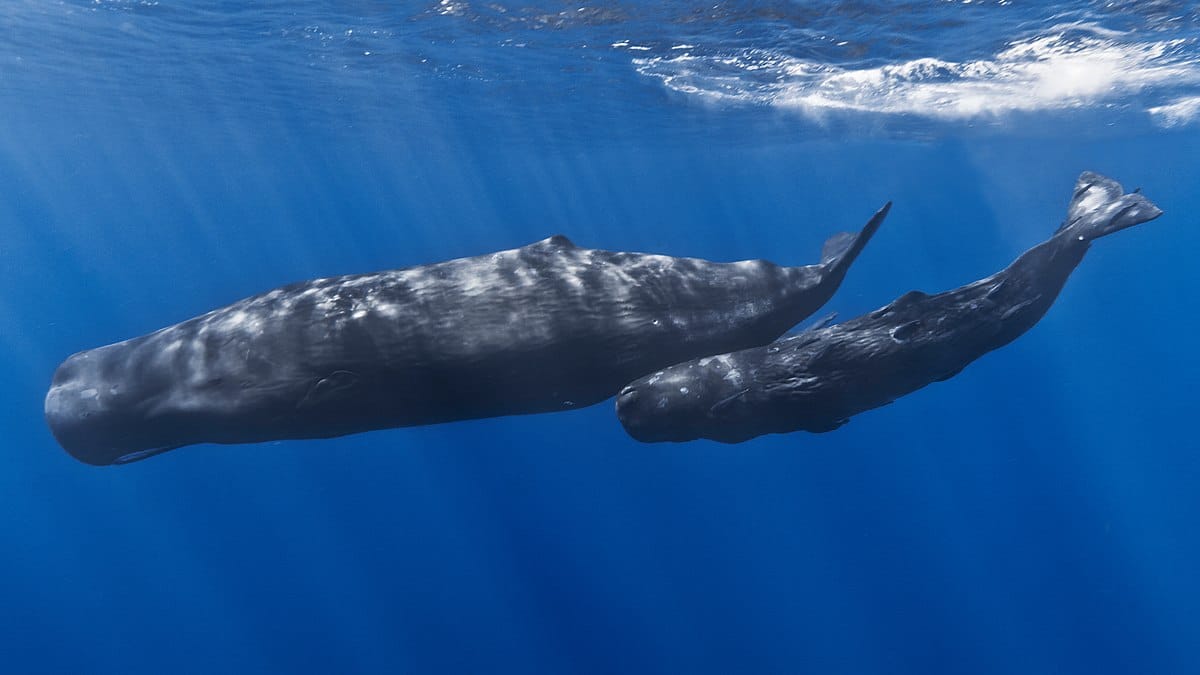
Ambergris is produced by the digestive system of the sperm whale. It is often found floating on the ocean’s surface.
When the whale ingests smaller animals, like squid , indigestible body parts like beaks are ejected out. But sometimes, the indigestible parts are not ejected. Instead, they bind together in the whale’s intestine. The whale’s intestine produces certain substances which coat the sharp parts. This gives rise to a solid mass of ambergris. It is thought that the ambergris protects the whale’s organs from being damaged by the sharp parts. Inside the intestine, the ambergris binds to other materials and keeps getting bigger and bigger. It starts gaining in mass, causing obstruction of the whale’s rectum . It is eventually expelled out as the ambergris that perfume manufacturers use in perfume making.

Initially, the ambergris has a fecal odour. But over time, in the presence of sun and oxidation caused by the salty sea water, it undergoes a color change from a dark color to a lighter, yellow shade. It acquires a musky, marine smell with hints of tobacco and wood.
History of Ambergris: Who used it and how?
Ambergris enjoyed much attention in ancient times. The Egyptians, the Arabs, and the Europeans have all used ambergris for some purpose at some point. The Europeans used it as a remedy for asthma, headaches, colds, and other diseases. The Arabs used it to give a scent to their cigarettes. In Arabian countries, ambergris was also used as an incense. It also acted as a medication to treat a range of illnesses.
For a long time, the origins and nature of ambergris remained a mystery. This was because ambergris spent a lot of time floating in the sea. It collects contaminants like fecal matter, pebbles, and sand. The presence of contaminants made it difficult to understand its features. When it arrives on land, it can resemble a variety of substances. The presence of contaminants complicates its characterization. But historical studies by Cristina Brito and theories developed by Robert Clarke proved useful. Thanks to their work, we now know a lot more about the origin and nature of ambergris.
Ambrein
Ambrein , a white, waxy material, is one of the special components of ambergris. Although it is made up of a variety of steroids, fatty acids, and terpenes, the most important ones are ambroxan and ambrinol . Perfume makers love Ambrein. Why so? Because ambrein is thought to be responsible for the poignant scent of ambergris. Due to its ability acts to stabilize the scent of perfume, it is used in perfumes to ensure that the fragrance lasts longer.
The amount of ambrein in ambergris affects how valuable it is, and manufacturers use this to decide what type of ambergris it is. If there is more ambrein, it means the ambergris is of higher quality.
Talking about quality, the perfume industry has classified ambergris depending on its potential to be used in perfumes.
Perfume worthy or not?
Ambergris is currently categorized into three classes: black, gray, and white. Black ambergris is fresh and softer in texture. It still has some left-over fecal scent. Since black ambergris is still young and hasn’t aged much, it hasn’t acquired the characteristic scent required by perfume manufacturers, making it the cheapest. White ambergris is the hardest and also the most expensive. The effect of saline water and the sun has made it perfume worthy! No wonder white ambergris is preferred by perfume manufacturers.

You might have heard that the taste and quality of wine get better with age. The scent of ambergris too, increases in quality with time.
Regarding the smell of ambergris, Robert Clarke, in his book The Origin of Ambergris, said, “Unique, illusive of precise description, the odor of ambergris has been said to suggest tobacco, the wood in old churches, sandalwood, the smell of the tide, fresh earth, and fresh seaweed in the sun. I myself am reminded of Brazil nuts.”
Is smelling good worth it?
Ambergris is often called “the floating gold” because it is costlier than actual gold. Its value as a preservative and its rarity makes it a coveted ingredient. But this has led to some unfortunate consequences for the sperm whale. It caused an increase in illegal trading and killing of sperm whales. During the 19th and 20th centuries, the killing of whales caused a decline in whale populations. Because of this, whales are now protected from trading by CITES . CITES stands for the Convention on International Trade in Endangered Species. But since ambergris is a naturally expelled product, its trade is still considered legal in many countries.
Synthetic alternatives like ambroxide have been produced that can replicate many of the properties of natural ambergris.
Ambroxide is made from a molecule called sclareol , which is a natural component of the clary sage plant. Because of the existence of synthetic alternatives to ambergris, ambergris is very rarely used these days.
Go synthetic, save the whales!
Extracting the sclareol molecule from the sage plant can be expensive because not a lot of it can be obtained. But hope is not lost. Scientists have used a cool technique called genetic engineering to make sclareol artificially!
A company called Firmenich has made significant progress in that direction. They have identified two genes that code for some important enzymes. These enzymes are important because they make ambroxide. These genes were then inserted into the genome of Escherichia coli bacteria. The bacteria were allowed to grow and reproduce in a special machine called a bioreactor. After the genes for sclareol are inserted in the DNA of E. coli, the E. coli starts producing the enzymes for sclareol. And voila! Large amounts of sclareol are produced.
Researchers at the University of British Columbia have developed another alternative. They have isolated a gene from fir trees that makes a compound called cis-abienol . Cis-abienol may not have the magic of ambergris but can act as a substitute for it. This too, had been successful.
Glossary
Ambergris: A waxy substance produced in the digestive system of whales; used in perfumes and cosmetics.
Squid: Water-dwelling invertebrate animals with tentacles; squids are a source of food for whales.
Rectum: The final part of the large intestine.
Ambrein: Responsible for the fixative action of ambergris.
Ambroxan, Ambrinol: Components of ambergris
CITES or the Convention on International Trade in Endangered Species: An agreement aimed to protect endangered species.
Ambroxide: A synthetic alternative to ambergris.
Sclareol: A compound isolated from clary sage herb.
Cis-abienol: A compound obtained from fir trees.
References
Ohloff, G. (1982). The Fragrance of Ambergris. In Elsevier eBooks (pp. 535–573). https://doi.org/10.1016/b978-0-12-685850-1.50020-6
Mori, K., & Tamura, H. (1990). Triterpenoid total synthesis, I. Synthesis of ambrein and Ambrox®. Liebigs Annalen, 1990(4), 361–368. https://doi.org/10.1002/jlac.199019900169
Clarke, R. (2006). The origin of ambergris. Latin American Journal of Aquatic Mammals, 5(1). https://doi.org/10.5597/lajam00087
Rowland, S. J., Sutton, P. C., & Knowles, T. J. (2019). The age of ambergris. Natural Product Research, 33(21), 3134–3142. https://doi.org/10.1080/14786419.2018.1523163
Dannenfeldt, K. H. (1982). Ambergris: The Search for Its Origin. Isis, 73(3), 382–397. https://doi.org/10.1086/353040
Coste-Manière, I., Zahra, J. P., & Waegell, B. (1988). Synthesis of ambergris fragrance chemicals from sclareol, involving palladium catalysed key steps. Tetrahedron Letters, 29(9), 1017–1020. https://doi.org/10.1016/0040-4039(88)85323-1
Brito, C., Jordão, V., & Pierce, G. J. (2015). Ambergris as an overlooked historical marine resource: its biology and role as a global economic commodity. Journal of the Marine Biological Association of the United Kingdom. https://doi.org/10.1017/s0025315415000910
Zhang, X., Zhu, K., Shi, H., Wang, X., Zhang, Y., Wang, F., & Li, X. (2022). Engineering Escherichia coli for effective and economic production of cis-abienol by optimizing isopentenol utilization pathway. Journal of Cleaner Production, 351, 131310. https://doi.org/10.1016/j.jclepro.2022.13131
Copyright @smorescience. All rights reserved. Do not copy, cite, publish, or distribute this content without permission.
SUBSCRIBE TO OUR NEWSLETTER
.......... ..........Subscribe to our mailing list to get updates to your email inbox.
Monthly Newsletter