Sure, you can look out the window and see what the weather will be like today… but have you ever wondered about the forecast on Jupiter? Yep, other planets have weather systems, too!
Before we venture around the solar system on the hunt for alien thunderstorms, let’s take a look at what we actually mean when we use the word “weather.” While we might think of weather as just hot or cold, or rain or shine, it turns out that it’s much more than that! We looked to the experts to find out what weather really involves.
The National Oceanic and Atmospheric Administration, which is more often simply called “NOAA,” is the organization that leads research related to weather in the United States. NOAA explains, “The term ‘weather’ describes the state of the atmosphere at a given point in time and geographic location.” So, in order to have weather, you must have an atmosphere. That is the layer, or layers, of gasses that surround large objects in space, such as planets, moons, and stars.
Now, not all celestial bodies have atmospheres. The Moon and Mercury are examples. They have exospheres, which are very thin layers of gasses around the planetary bodies; but the particles of these gasses are so spread out, they don’t impact each other.
A false color view, Credit: NASA Goddard Space Flight Center of Mercury
Basically, if you’re a celestial body and you have an exosphere but no true atmosphere, you won’t need to worry about weather too much. However, this doesn’t mean that you can’t experience extreme temperatures!The Moon’s temperatures range froma very cold minus 387 degrees Fahrenheit (-233 Celsius) to very hot 253 degreesF (123 C). Mercury can get as extremely chilly as minus 250 degrees F (-156 C) and as horrendously hot as 800 degreesF (427 C);but at least you’ll never have toweathera snowstorm on Mercury or a monsoon on the Moon!
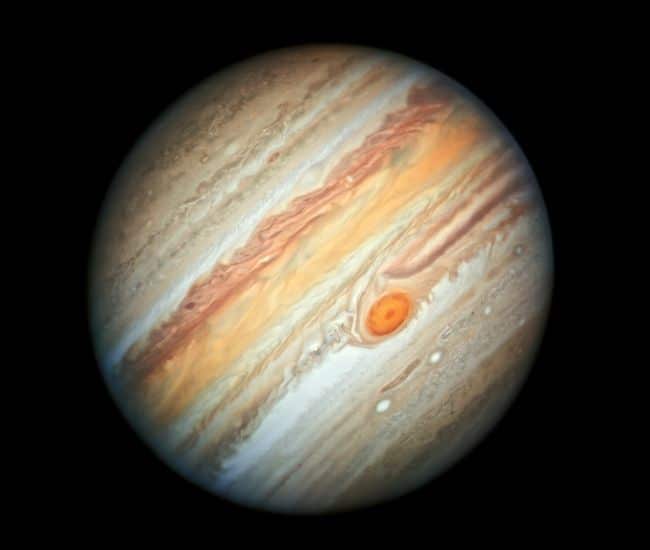
Jupiter, Credit: NASA, ESA, A. Simon (Goddard Space Flight Center), and M.H. Wong (University of California, Berkeley)
However, on Jupiter, things are quite a bit different.Jupiter is the biggest planet in the solar system,and it also has the largest atmosphere. Not only that, but it’s been home to a very large storm for a very long time. If you’ve ever looked closely at a picture of Jupiter, you’ll likely have noticed its “Great Red Spot,“ which is a storm that‘s been raging for—at least—hundreds of years.At 10,000 miles (16,000 kilometers) wide, the storm itself is almost twice as wide as planet Earth. However, scientists have observed that the storm is actually shrinking. Wouldn’t it be weird if Jupiter’s Great Red Spot fizzled out completely?
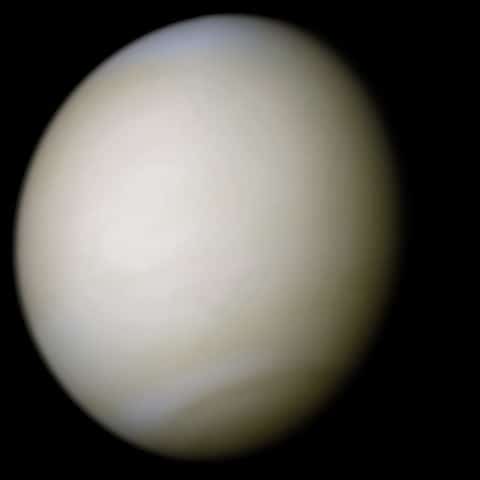
Venus in real colors, processed from clear and blue filtered Mariner 10 images Image Credit: Ricardo Nunes
Someone, switch on the AC!Because now we’re talking about Venus. With highs in the 860-degree range (460 Celsius), Venus is the hottest planet in the solar system. What’s more, it also rains nothing but sulfuric acid there, and has very nasty winds. To make a long story short, Venus is fascinating from a meteorological mindset, but not terribly friendly to life!
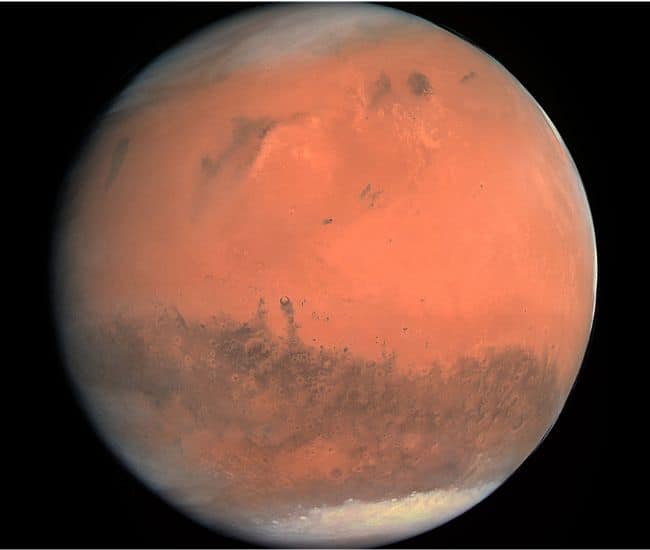
True color image of Mars taken by the OSIRIS instrument on the European Space Agency (ESA) Rosetta spacecraft during its February 2007 flyby of the planet.
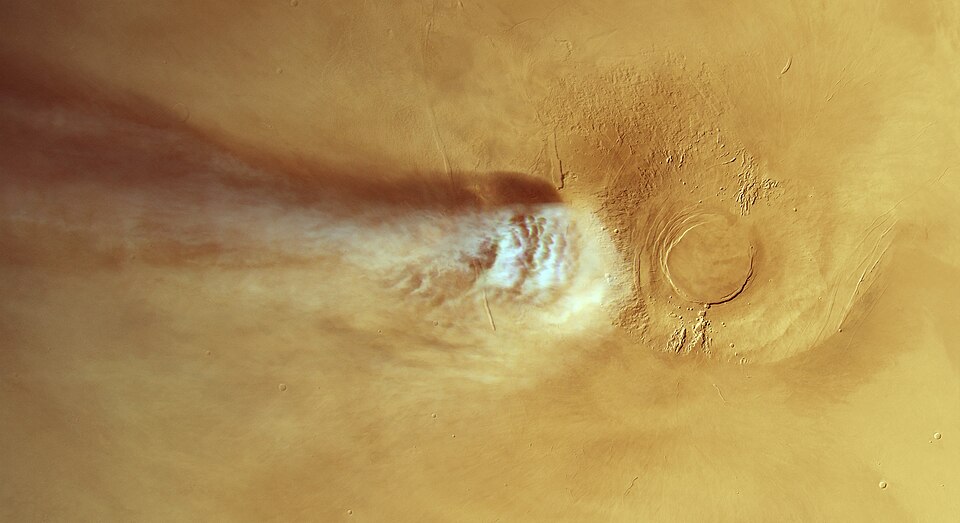
Speaking of heat, Martian weather is a hot topic, even though it’s a cold planet. Because there is much discussion about sending human explorers to Mars, in addition to the robots we’ve already landed there, it’s important to know what the forecasts on Mars can look like. We know that Mars experiences severe dust storms, but scientists also think snowstorms might be an issue. Fortunately, it appears there is no rain on Mars, so future pioneers need not pack umbrellas for their journey to the Red Planet.
While these storms are some of the wildest weather patterns in the solar system, it’s not all of them! New discoveries are made all the time, and we could talk about alien weather for eons. Plus, as we learn more about our solar system, who knows what kinds of extraterrestrial weather we will discover? One thing is for sure: the forecast is science, with a 100% chance of awesome!
While it might make sense to assume that what we’ve been discussing is called space weather, the term “space weather” actually refers to the weather patterns caused by our Sun! The Sun produces solar flares and other phenomena that can impact places all over the solar system—Earth included. Solar flares have been known to mess up things like electrical grids, GPS signals, and radio communications.