The body’s most basic functions are assessed by measuring four vital signs: body temperature, pulse rate (or heart rate), respiration rate, and blood pressure. A bystander who can measure vital signs can spot a health emergency. A quick response can buy emergency medical services time and improve survival chances. People can record vital signs at home or in a medical setting.
For example, a person can lose their life within ten minutes of a sudden cardiac arrest without intervention. The first four minutes are very crucial; each lost minute decreases the chance of survival by 7-10%. Spotting an emergency in these cases can mean the difference between life and death, especially with timely medical intervention.
A vital signs monitor in a medical setting,Credit: Wikimedia/Petty Officer 1st Class James Stenberg
What to expect: In a health emergency, you need to provide emergency services with the right details. Basic knowledge of vital signs can help you spot a health emergency as a bystander and stay vigilant about your own health. This educational blog gives you a basic understanding of vital signs.
Before we begin, a word of caution: As a bystander, always “check” for vital signs and do not attempt to “measure” them. Call 9-1-1 (or your local emergency services) as soon as possible. Prioritize life-saving actions over collecting clinical data.
What Does Body Temperature Indicate?
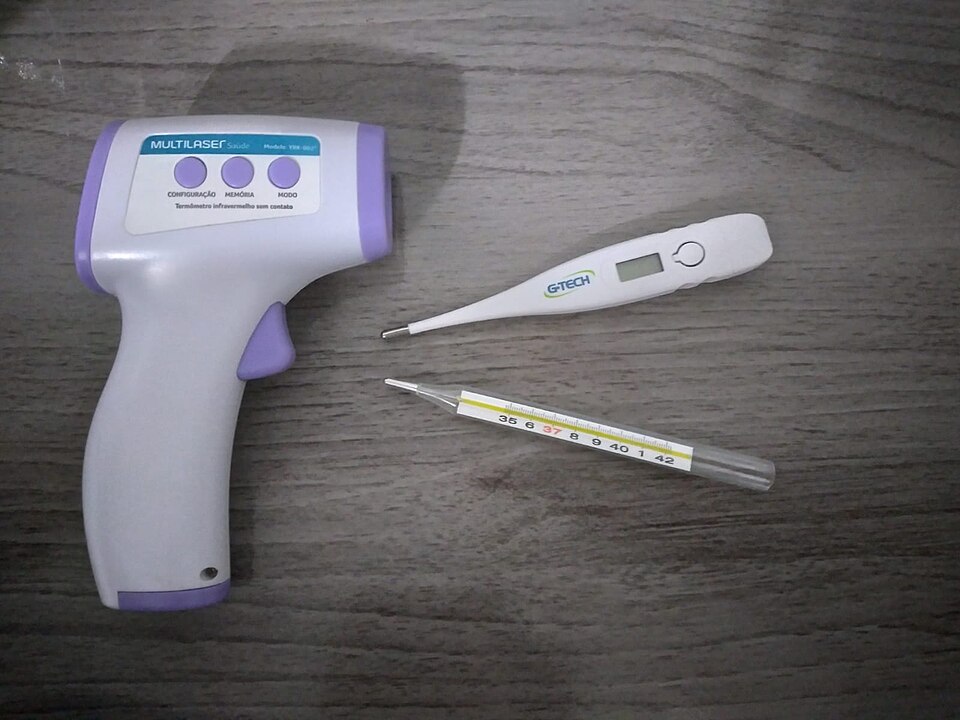
Common household thermometers (going clockwise): infrared thermometer, digital thermometer, and glass thermometer, Credit: Wikimedia/TCdeOLiveira
The body’s natural thermostat, the hypothalamus, tightly regulates a person’s body temperature. Normal body temperature is measured in degrees Fahrenheit (F) and ranges from 97.8°F(36.5°C) to 99°F (37.2°C) in a healthy adult. It can fluctuate depending on gender, recent activity, time of day, food and fluid intake, and, for women, the stage of the menstrual cycle.
A person’s body temperature is generally recorded using a thermometer and can be taken by placing the device in any of the following regions:
The mouth, or oral region, provides the standard baseline reference, usually recording 98.6°F (37°C) as normal. Using a digital thermometer instead of a mercury thermometer is safer because mercury is toxic. Consuming hot or cold foods or drinks before taking a reading can skew the result.
The rectum, or anus, is considered the gold standard for young people and registers 0.5°F to 0.7°F higher than when taken orally. A typical reading hovers around 99.5°F (37.5°C).
The ear gives a reading closer to the body’s core temperature, much like a rectal reading. A special thermometer with an infrared sensor measures temperature when you point it at the eardrum. It is fast and accurate, but a high earwax buildup can distort the reading.
A safer, non-invasive way to take temperature is to place the thermometer in the armpit. You can use either a glass or a digital thermometer, but they read 0.3°F to 0.4°F lower than mouth temperatures.
A non-contact infrared thermometer measures temperature from the forehead, across the superficial temporal artery located just 2 millimeters beneath the skin.
Spotting a Health Emergency from Body Temperature
A body temperature of about 1°F or more above 98.6°F indicates a fever, according to the American Academy of Family Physicians. Fever is rarely fatal, but cellular damage can begin when the body’s core temperature reaches 107.6°F (42 °C). At such high temperatures, dizziness, nausea, and confusion can be early signs, along with a high thermometer reading.
When body temperature falls below 95°F, itis known as hypothermia. Unlike fever, which is usually an immune response to fight an infection, hypothermia can cause metabolic collapse because of a rapid, uncontrolled drop in body temperature. Look for signs like shivering and confusion, along with a low body temperature, to spot hypothermia.
Call emergency services immediately in these cases. If the person has a high fever, try to cool them by moving them into shade and removing extra clothing. You can cool their skin with wet clothes until the first responders arrive. If the person has hypothermia, warm them with dry blankets and remove any wet clothing before emergency services arrive. Do not wait for a thermometer; act promptly.
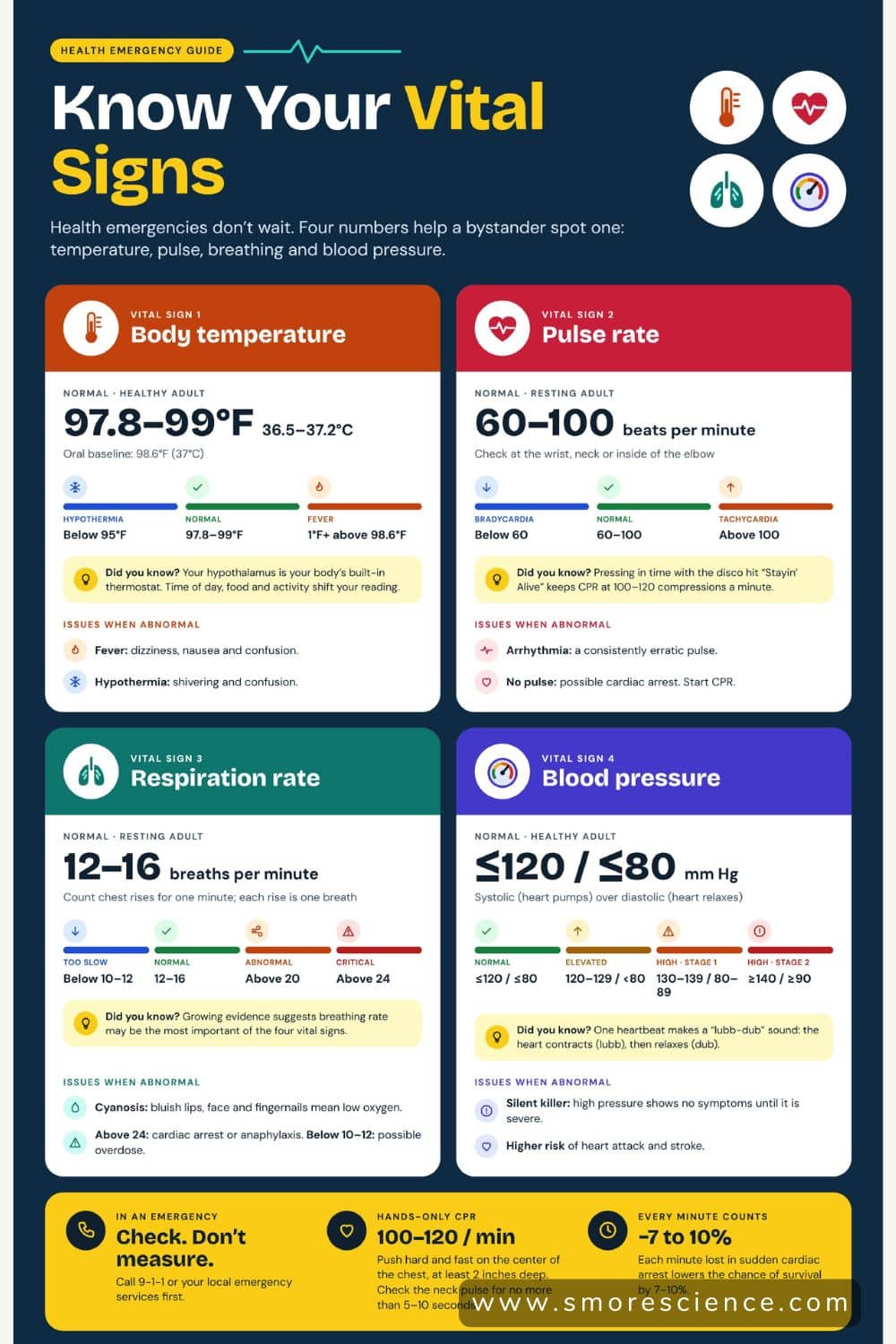
This poster is AI-generated. The blog is written by a human.
Pulse rate measures heart rate, usually counted as beats per minute (bpm). Generally, people take a pulse where an artery lies close to the skin (wrist, neck, inside of the elbow). Arteries expand and contract as the heart pushes blood through them. Taking a pulse rate not only measures how many times the heart beats in a minute, but also indicates heart rhythm and pulsestrength. Since blood flowing through arteries exerts higher pressure than blood flowing through veins, an arterial injury can cause heavy bleeding and death if not acted upon quickly.
A normal pulse for a healthy resting adult ranges from 60 to 100 beats per minute. Pulse rate fluctuates and increases during physical activity, illness, injury, and strong emotions. Females over age 12 usually have faster heart rates than males.
How to check pulse rate?
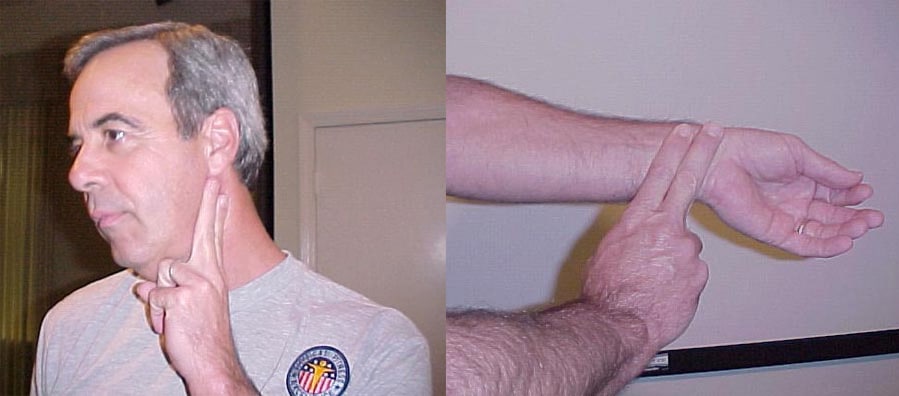
You can usually find a pulse on the side of the neck (carotid artery), on the inside of the elbow (brachial artery), and most easily at the wrist (radial artery). The following diagram shows where you can easily check for a pulse.
The neck and wrist regions are best for checking a pulse., Credit: Wikimedia/Johnteslade
Follow the steps to take a pulse reading:
With your first and second fingertips, apply firm but gentle pressure to the artery until you feel a pulse.
When the clock’s second hand is on the 12, start counting the pulse.
Count your pulse for 60 seconds (one minute), or for 15 seconds. Multiply the reading by four to calculate beats per minute in the latter method.
Concentrate on the pulse beats rather than watching the clock while counting.
Spotting a Health Emergency from Pulse Rate
Pulse rate may fluctuate with physical exertion, but a consistently erratic pulse rate is known as arrhythmia in medical terms.
Bradycardia: Pulse rate drops below 60 bpm (or below 40 bpm). Athletes naturally have a lower resting pulse rate due to cardiovascular conditioning.
Untrained or lay bystanders should not check for pulse rate during an emergency. Instead, check for a pulse only if the person is unresponsive by feeling the carotid artery on the side of the neck for no more than 5-10 seconds. If you do not find a pulse or are unsure, start hands-only CPR (cardiopulmonary resuscitation) immediately.
First, call emergency services and briefly describe the situation. Then tap the person’s shoulder, shout, “Are you okay?” and check whether they are breathing normally. If the person does not respond and is breathing unevenly, start hands-only CPR, for which you can follow these steps:
Push straight down on the center of the chest, hard and fast.
Lock your elbows and use your body weight to compress at least 2 inches deep.
Aim for 100-120 compressions per minute; as a rule of thumb, match the compression rate to the beat of the disco song “Stayin’ Alive”.
Let the chest rise completely before the next compression.
Ribs might fracture during chest compressions, but delaying CPR is precious time lost in such emergencies.
Here is a video by the American Red Cross demonstrating hands-only CPR.
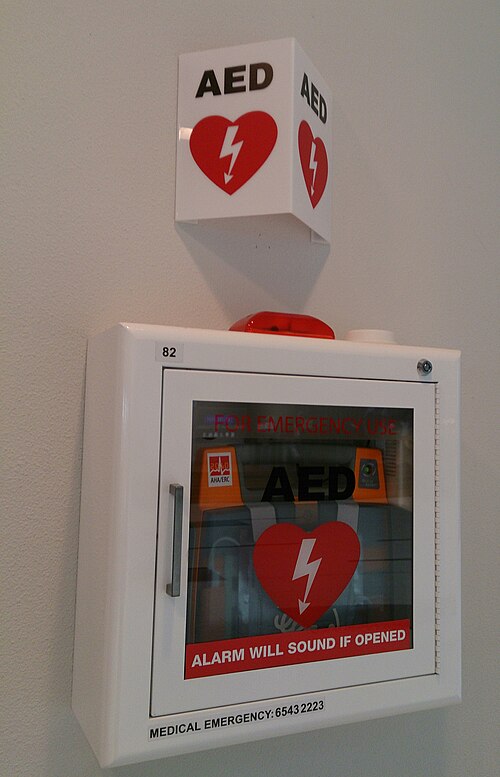
Keep doing CPR until emergency services arrive. You can also ask another bystander to get an automatic external defibrillator (AED). It delivers a safe electric pulse to help restore a normal rhythm. It is designed for bystanders without medical training and provides clear vocal and visual guidance.
These devices are usually stored in wall cabinets at access points in public and private spaces, such as entrances and front desks, marked with heart and lightning-bolt symbols.
An AED is kept inside a cabinet marked with a heart and lightning-bolt symbol, Credit: Wikimedia/ProjectManhattan
What does Respiration Rate Indicate?
Respiration rate is the number of breaths a person takes per minute at rest. Measure the rate by counting how many times the chest rises in a minute; each rise indicates one breath. Respiration rates may increase with fever, illness, or other medical conditions, and you should also check for difficulty breathing while counting.
A normal resting respiration rate for a healthy adult ranges from 12 to 16 breaths per minute. An adult’s resting respiration rate over 20-24 breaths per minute or below 10-12 breaths per minute indicates a serious health emergency.
Spotting a Health Emergency from Respiration Rate
According to the British Journal of Nursing, growing evidence suggests thatrespiration rate is the most important vital sign. An unusual respiration rate often comes with other signs of distress. Keep an eye out for:
Labored breathing,with the neck, shoulder, and stomach muscles overexertedto force air in and out.
Wheezing, gurgling, or gaspingnoises when breathing.
A bluish tint around the lips, face, and fingernails indicates low oxygen; the phenomenon is called cyanosis.
Confusion and dizziness.
If the respiration rate is above 20, it is abnormal. Anything over 24 breaths per minute indicates a critical emergency and can indicate medical deterioration (like a cardiac arrest or anaphylaxis). In either case, call emergency services immediately. Low respiration rates (10-12 breaths per minute) can be an indication of a possible drug overdose. Call emergency services as soon as possible.
What does Blood Pressure Indicate?
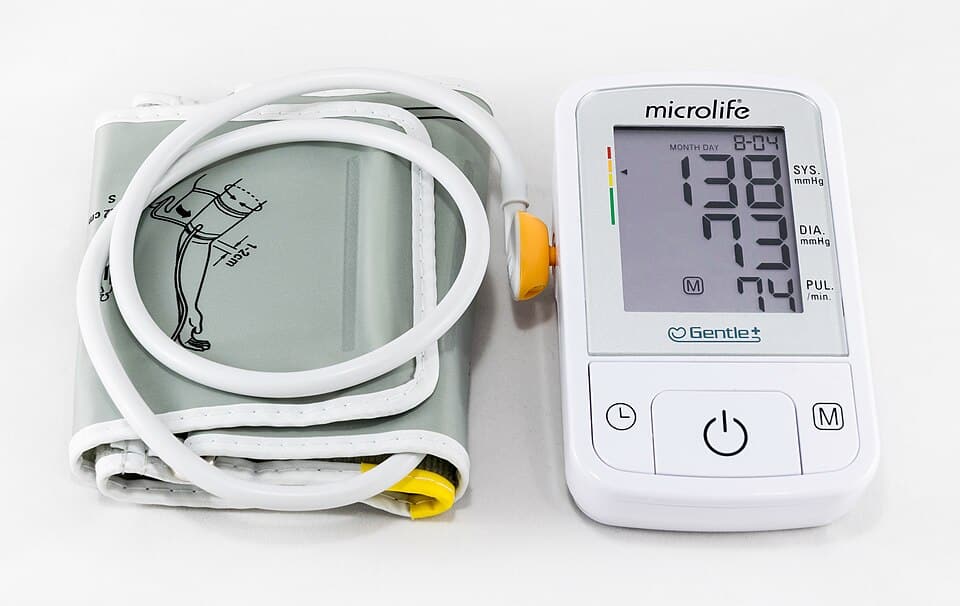
A digital sphygmomanometer can help you monitor blood pressure at home, Credit: Wikimedia/Jacek Halicki
Blood pressure is the pressure (or force) blood exerts on artery walls when the heart contracts and relaxes. Each time the heart beats (contracts), it pumps blood into the arteries, raising blood pressure. When the heart relaxes, blood pressure drops as it fills with blood for the next cardiac cycle (one heartbeat). Every contraction and relaxation phase is marked by a “lubb” and “dub” sound, respectively. One complete heartbeat makes the thumping lubb-dub sound.
Since blood flows through the heart twice in one cardiac cycle, blood pressure is recorded as two numbers. The higher number is called systolic pressure, recorded when the heart pumps blood through the body. The lower number, or diastolic pressure, indicates the pressure inside the artery when the heart relaxes and fills with blood. Both systolic and diastolic pressure are recorded in “mm Hg” (millimeters of mercury) using a device called a sphygmomanometer. The device shows pressure by how high the mercury column rises due to the pressure exerted by blood. Today, most doctors’ offices use a simple dial or a digital monitor to measure blood pressure.
Normal blood pressure for a healthy adult is below 120 systolic and below 80 diastolic, also written as 120/80 mm Hg.
Spotting a Health Emergency from Blood Pressure
Of the four vital signs, only blood pressure readings are inaccessible and require longer monitoring before a diagnosis. That said, keeping tabs on blood pressure often is a good habit. Erratic blood pressure can indicate cardiovascular decline or hypertension years in advance. Fluctuations in blood pressure readings from one doctor’s visit to the next can be seen as an early warning sign of a higher risk of heart attack and stroke.
Blood pressure is categorized as normal, elevated, or stage 1 and stage 2 high blood pressure:
Normal blood pressure is systolic below 120 and diastolic below 80 (120/80)
Elevated blood pressure is systolic of 120 to 129 and diastolic less than 80
Stage 1 high blood pressure is systolic of 130 to 139 or diastolic between 80 and 89
Stage 2 high blood pressure is when systolic is 140 or higher, or the diastolic is 90 or higher.
The American Heart Associationemphasized that hypertension (higher blood pressure than normal) is a silent killer because the symptoms do not appear until the condition becomes severe or even life-threatening.
Final Note: Staying calm and aware during a health emergency can greatly increase survival chances anywhere, including schools, universities, offices, and playgrounds. Good Samaritan laws protect people who voluntarily offer emergency help in good faith to victims from facing criminal and/or civil liability— even if accidental damage occurs (like fractured ribs while giving CPR). All 50 states of the United States of America have some form of this law.