Plastic is convenient. It doesn’t break easily and is incredibly versatile. It can make medical devices like stents, and somehow is also the same material that we use to make shopping bags and saran wraps.
Many medical implements are made of either plastic or some other kind of polymer. Credit: Wikimedia/Science History Institute
In the synthetic age of the Anthropocene , we’ve mastered the use of plastic. Actually, we’ve mastered the use of all kinds of polymers. But we’ve never mastered one facet of plastic use: disposing of it!
Think about the take-out container you just threw out yesterday. It’s probably still going to be here for the next 500 years—give or take a few years.
(You read that right—chances are, your plastic shopping bag will outlive you.)
The problem with plastic disposal isn’t that we don’t know how to do it. We do! We’ve been processing and recycling end-of-life or “old” plastics since the 1970s. The problem with plastic disposal is reliable scalability , based on factors like:
Geographical location (Country, city, neighborhood, etc)
Plastic-type
Method of application
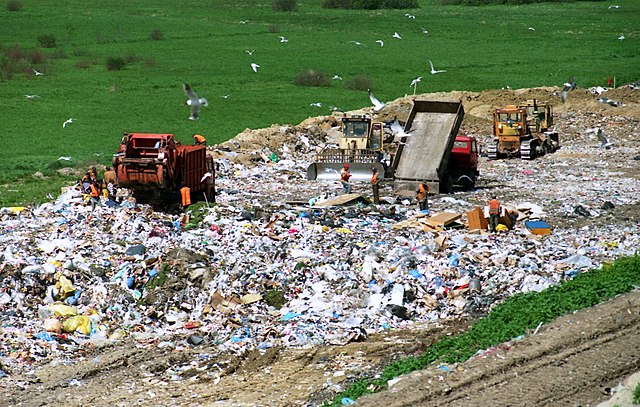
Most plastics end up in landfills like these. Credit: Wikimedia/Cezary p
Plastic waste management and processing all over the world is variable. For instance, some countries may choose to go the route of landfill management, while others may choose either incineration or some method of recycling (mechanical or chemical).
As part of an article published by the State of the Planet, the head of the Center for International Environmental Law (CIEL) revealed that plastics are among the most energy-intensive materials to produce.
Apart from variance in scalability problems, plastic also has an energy problem. From extraction of the raw materials required, to manufacture and even disposal, every single action associated with plastic is energy intensive.
In 2019, incinerated plastics alone accounted for an increase of 850 million tons of greenhouse gas emissions. This figure doesn’t even take into account the emissions caused by littered plastics in landfills and recycled plastics!
Enzymes to the Rescue!
Arguably, it makes sense to regulate single-use or disposable plastics, given their short-term use. But even with all the problems accompanying plastic use, stopping or banning all plastic use entirely is ludicrous.
Plastic has never been the problem. Management—or rather mismanagement—of plastic is the problem.
A render of an enzyme molecule. Credit: Wikimedia/NASA
Recognizing the same, researchers at the University of Texas, Austin, decided to focus on a method of plastic recycling that takes energy into account: biological solutions, specifically enzymes . Enzymes are biomolecules. They break stuff down. For example, amylase, an enzyme found both in our saliva and small intestines, breaks down carbohydrates into smaller molecules, like maltose.
Similarly, some enzymes, like PETase, can also break down plastics; particularly polyethylene terephthalate or PET. Enzymatic—or at-large biological—recycling or processing of plastics isn’t new.
(Fun fact: The earliest records for enzymatic recycling come from 1991. A 1991 paper detailed the use of lignin-degrading microorganisms to recycle or degrade plastics like polyethylene. These microorganisms were different kinds of Streptomyces.)
Similarly, PETase in particular comes from a bacterial microorganism, Ideonella sakaiensis. This bacterium, discovered in 2016, grows on PET and uses it as a carbon source. Essentially, this enzyme digests PET into simpler forms. Multiple scientists around the world work on PETase. One such group is from the Cockrell School of Engineering and College of Natural Sciences at the University Of Texas, Austin.
Comprised of an interdisciplinary team of engineers, chemists, and biologists, the team worked to introduce novel or new mutations into the bacterial enzyme.
A schematic of the types of mutations. Credit: Wikimedia/Thomas Shafee
You might be wondering, “Hey, why did they need to introduce mutations into an enzyme that can already digest plastic?”
It’s a perfectly reasonable question to ask. After all, the enzyme does already digest plastic. However, it only does so within a particular range of temperature. This isn’t because PETase is a particularly picky or finicky enzyme; every enzyme in the world has a particular range or pin-point temperature at which it performs to its peak. This is known as the optimum activity of the enzyme. The general trend that enzymes follow, when it comes to temperature, is the hotter the better. This is because at higher temperatures, the molecules involved in a reaction experience a higher probability of collision, and thus also gain from a higher or greater rate of reaction. Yet, there are problems with high temperature as well. The enzyme may change its shape, or straight-up break—there are a lot of logistical issues with trying to maintain efficiency or optimum activity at high temperatures.
In a herculean effort of interdisciplinary science, the team at UT, Austin used machine learning models that generated mutations to the PETase enzyme. The modified PETase, which the team dubbed FAST-PETase, is capable of performing efficiently at low temperatures below 50 degree Celsius!
The team even tested their newly minted enzyme with 51 different PET samples, from plastic bottles and containers to plastic fabrics and fibers. The team ran the FAST-PETase through it all to prove the functionality of the new mutated PETase.
In a UT NEWS article, Andrew Ellington, the lead for the machine learning team, had the following to say about the research teams that contributed to the creation of FAST-PETase:
“This work really demonstrates the power of bringing together different disciplines, from synthetic biology to chemical engineering to artificial intelligence.”
Readability: 64.6
Flesch Kincaid Grade Level: 8
Glossary
Anthropocene: The “Age of Man;” the geologic epoch in which human activity has been making significant change to the planet’s ecosystems. The beginning of the Anthropocene may be defined differently; from the Agricultural Revolution about 12,000 years ago to the 1960s when the first atomic bombs were tested
Scalability: The ability of a process to work at larger scales as well as smaller scales
Greenhouse gases: Gases like methane that trap heat near the earth’s surface, contributing to global warming.
Enzymes: Biomolecules that are capable of breaking down complex substances into simpler ones. They also act as accelerators or catalysts and can speed up biochemical reactions.
Mutation: Any deletion, addition, or shake-up to a portion of a genetic material
Chamas, A., Moon, H., Zheng, J., Qiu, Y., Tabassum, T., Jang, J. H., Abu-Omar, M. M., Scott, S. L., & Suh, S. (2020). Degradation Rates of Plastics in the Environment. ACS Sustainable Chemistry & Engineering, 8(9), 3494–3511. https://doi.org/10.1021/acssuschemeng.9b06635
Center for International Environmental Law. (2022, February 1). Plastic and Climate: The Hidden Costs of a Plastic Planet – Center for International Environmental Law. https://www.ciel.org/plasticandclimate/
Lee, B., Pometto, A. L., Fratzke, A. R., & Bailey, T. B. (1991). Biodegradation of Degradable Plastic Polyethylene by Phanerochaete and StreptomycesApplied and Environmental Microbiology, 57(3), 678–685. https://doi.org/10.1128/aem.57.3.678-685.1991