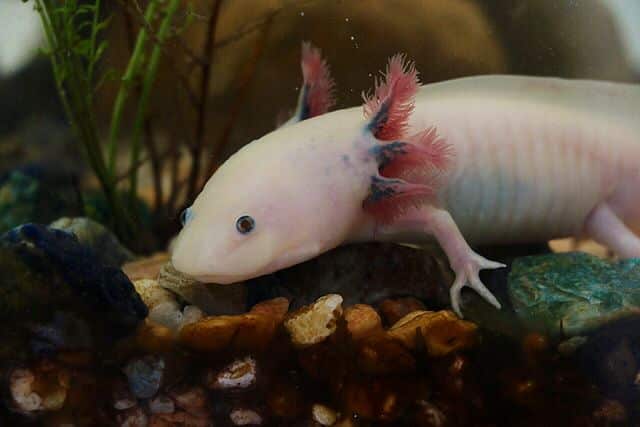
There’s a very good chance you’ve already seen an axolotl—after all, they’re pretty popular on the meme websites for their cuteness. These remarkable salamanders, represent one of nature’s most intriguing examples of neoteny – the retention of juvenile characteristics into adulthood.
Axolotls, (Ambystoma mexicanum) are salamanders that primarily live underwater. They’re only found in one country in the world: Mexico. They are naturally found only in a very small part of the country near Mexico City, the Xochimilco Lake complex. The lake complex is a labyrinth of natural wetlands and man-made waterways and canals. This ecosystem provides the perfect conditions that Axolotls need to make this lake their natural habitat.
These are the hills that surround the Xochimilco lake complex, one of the last natural habitats of the axolotls in the wild. Credit: Wikimedia/Hrdlovic
How long do axolotls live?
In their natural habitat, axolotls typically live 10-15 years, though some captive specimens have reached 20+ years under optimal conditions. Their development is marked by several fascinating characteristics:
They retain larval features throughout their adult life, including external gills and a fin-like tail
Sexual maturity is reached around 12-18 months of age
They can regenerate lost body parts, including limbs, organs, and even portions of their brain
The axolotl life cycle
Axolotls follow a very atypical amphibian lifespan. Amphibians, including frogs, are hatched from eggs, grow to juvenile intermediary forms like tadpoles, and eventually grow up into their final adult form, like frogs. That final adult form is where axolotls deviate from the general amphibian pattern of growth. Instead of growing up and growing into mature adult forms, axolotls just retain their juvenilecharacteristics.
Why do axolotls never age?
When we think of amphibians, we think of metamorphosis. We think of the general “egg to tadpole to frog” cycle. Axolotls, unlike other amphibians, forgo metamorphosis. This tendency to retain their youthful or juvenile characteristics is termed neoteny.
Neotenic characteristics of axolotls
Retain functional gills into adulthood
Maintain aquatic lifestyle throughout life
Keep fin-like tail for swimming
Never develop eyelids
What causes neoteny?
Neoteny can be induced by quite a few things. For instance, environmental factors, such as an abundance of food or the coldness of surrounding waters, have been listed as reasons responsible for inducing neoteny in the past.
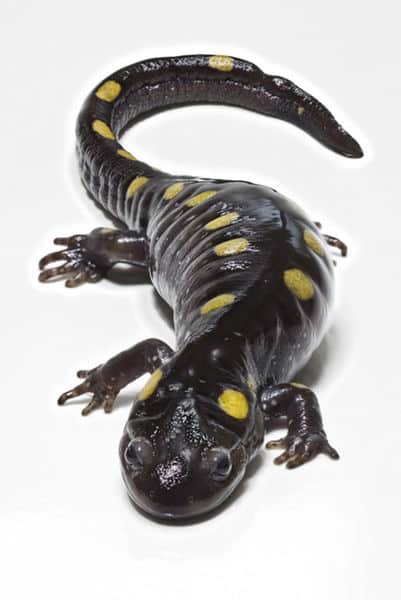
Ambystoma, the adult form of the axolotl, can be induced by administering TSH to the larval axolotl form. Credit: Wikimedia/Camazine
Today, scientists are leaning towards another theory that explains neoteny in amphibians. Many now believe that the genes that stimulate the pituitary gland to produce thyroid stimulating hormone—or TSH—are switched off in the axolotl. TSH is the primary hormone responsible for stimulating and enhancing thyroid hormone production in the animal body, so naturally, when the genes responsible for producing TSH are switched off, thyroid hormone production falls off a cliff.
Why does thyroid hormone production matter?
Thyroid hormone exercises immense control over the axolotl development process. For instance, in controlled lab settings, administration of thyroid hormone to axolotls can even induce metamorphosis into Ambystoma, the final adult form!
Axolotls possess extraordinary biological abilities that have made them valuable research subjects in regenerative medicine and developmental biology.
But the wild axolotl population has declined significantly over the recent years due to urbanization, invasive species and over-collection for the pet trade and research. Current estimates suggest fewer than 1000 remain in the wild.