In the animal kingdom, certain behaviors and habits stand out as particularly unusual, showcasing the diverse strategies animals have evolved to survive and thrive. This list will reveal the top 10 animals with the strangest habits.
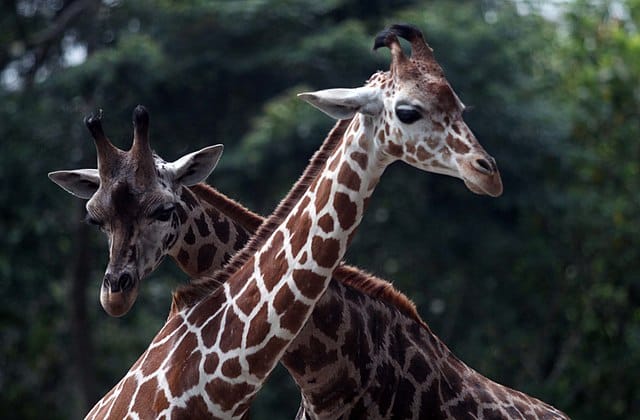
Strange Habits and Behaviors: Giraffes are renowned for their long necks, which play a critical role in their strangest behavior: necking. This ritual involves two males swinging their necks to collide with each other, a show of strength and skill meant to establish dominance. While it might appear aggressive, necking rarely results in severe injury and serves as a way for males to determine who gets mating rights without escalating to more harmful combat.
Scientific Facts: Research into giraffe behavior has illuminated the evolutionary advantage of their long necks, beyond reaching high foliage. Necking behavior is described as a form of sexual selection, where females prefer males who have proven their strength and vitality through these contests. This preference could help to drive the evolution of longer necks in males, showcasing a fascinating aspect of natural selection.
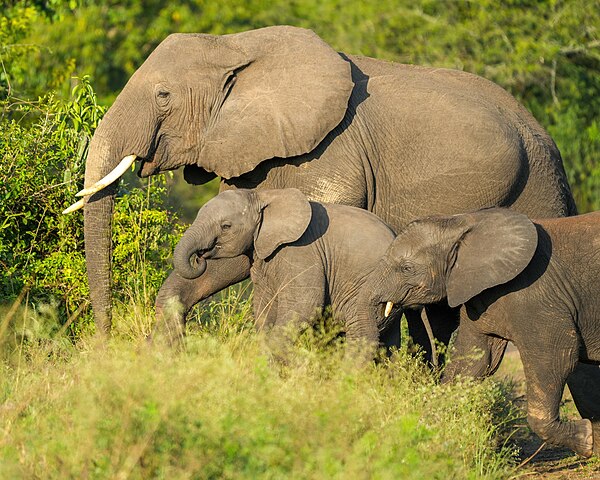
Scientific Facts: Studies on elephant behavior have provided insights into their cognitive abilities, demonstrating that their mourning practices indicate high emotional intelligence and complex social bonds. The mourning rituals suggest elephants have a concept of death and remember their deceased, showcasing their sophisticated brain structure and function.
Kangaroos (Licking Their Forearms to Cool Down)
Kangaroos, Credit: Wikimedia/Dinkun Chen
Geographic Location: Kangaroos are indigenous to Australia, thriving in diverse ecosystems, from grasslands to forests.
Strange Habits and Behaviors: Kangaroos take advantage of the cooling effect of evaporation by licking their forearms. This behavior is a vital adaptation, helping them regulate their body temperature in extreme temperatures.
Scientific Facts: Scientists have studied this behavior as an example of how animals can evolve specific physiological and behavioral traits to manage extreme environmental conditions.
Interestingly, climate changes also interfere with the kangaroo’s habitat. Bioclimatic modeling has predicted that Northern Australia could see a dramatic halving in distribution areas for four kangaroo species if average temperatures exceed 2 degrees Celsius.
7- Frogs (Freezing and Thawing with Seasons)
Frogs, Credit; Wikimedia/MichaelZahniser
Geographic Location: This strange behavior is observed in frog species found in cold climates, such as the wood frog in North America.
Strange Habits and Behaviors: Some frog species have developed the ability to freeze their bodies to improve their survival. Wood frogs can freeze up to 60% of their bodies during the long and frigid Alaskan winters. Their bodies produce a natural antifreeze compound, glucose, that prevents ice from forming inside their vital organs, allowing them to survive low temperatures. When spring starts, these animals can thaw and return to their activities.
Scientific Facts: This strange behavior by the frogs is a remarkable example of cryoprotection, or withstanding the potential harmful effects of cold. Therefore, some studies in the medical field have focused on improving the preservation of human organs for transplantation by mimicking the frogs’ natural antifreeze compounds.
6- Dolphins (Using Sponges for Hunting)
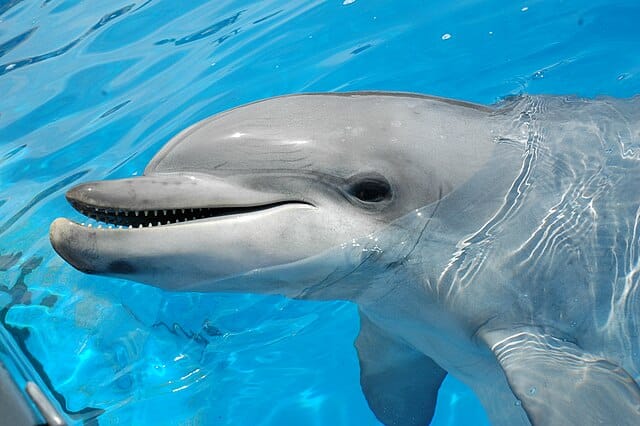
Dolphins, Credit: Wikimedia/Vince Smith
Geographic Location: The use of sponges for hunting is mainly observed in the bottlenose dolphins of Shark Bay, Western Australia.
Strange Habits and Behaviors: Dolphins can use marine sponges to hunt for food. They place a sponge on their snout to protect it while foraging on the seabed. This strange habit shields their noses from scrapes and stings and allows them to access food sources that might otherwise be out of reach. This tool-use behavior highlights dolphins’ problem-solving abilities and capacity to pass on knowledge through generations.
Scientific Facts: Scientists have documented that this strange habit is learned, with mothers teaching their offspring the technique, indicating a complex level of social learning and cultural inheritance not widely observed in the animal kingdom.
5- Crows (Using Tools and Solving Puzzles)
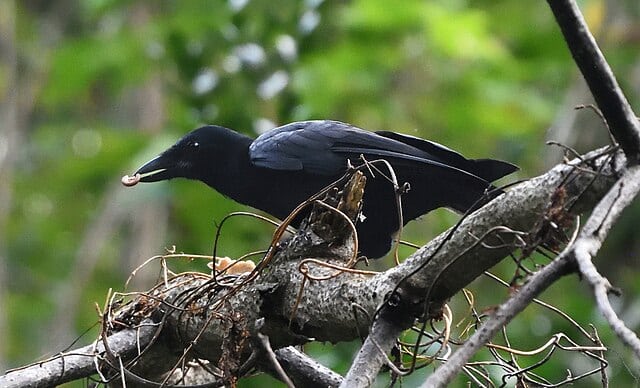
Crows, Credit: Wikimedia/Yi-Kai Tea
Geographic Location: Crows are found worldwide, with tool-use habits most notably observed in species like the New Caledonian crow.
Scientific Facts: The cognitive abilities of crows challenge our understanding of animal intelligence. Research into crow behavior provides evidence of advanced neurological capabilities, such as memory, learning, and problem-solving. Furthermore, their social intelligence, including recognizing human faces, also demonstrates their advanced cognitive abilities.
4- Octopuses (Using Tools)
Octopuses, Credit; Wikimedia/Bernard DUPONT
Geographic Location: Octopuses are found in every ocean, with tool-use behavior observed in species like the common octopus and the veined octopus.
Strange Habits and Behaviors: Octopuses have been documented using coconut shells and other objects as tools for defense and shelter. The veined octopus, for instance, carries coconut shell halves across the sea floor, assembling them into a makeshift shelter. This behavior is a fascinating display of foresight and adaptability, demonstrating their ability to use environmental resources to their advantage.
Scientific Facts: The octopus’s use of tools highlights their remarkable intelligence and cognitive flexibility. Octopuses are reported to be exploratory and attracted by novel objects, as well as being opportunistic feeders that forage large territories. Their solitary nature belies a problem-solving capability that rivals much larger and more social animals.
3- Platypuses (Electrolocation)
Platypuses, Credit: Wikimedia/
Charles J. Sharp
Geographic Location: Platypuses are native to eastern Australia and also Tasmania, inhabiting rivers and freshwater bodies.
Strange Habits and Behaviors: Platypuses possess an unusual habit among mammals since they can do electrolocation. They close their eyes, ears, and nose while foraging underwater, navigating and locating prey by detecting electric fields generated by the muscular contractions of aquatic invertebrates. Electroreception allows these animals to hunt for small shrimp, fish, and crustaceans in murky environments without using their senses of sight, hearing, or smell.
Scientific Facts: Several scientists studying electroreception have labeled this strange behavior “bill sense” since the mechanism involves using some 40,000 mucous gland electroreceptors strategically placed along the unique bill. Research into platypus electrolocation offers insights into the evolutionary development of sensory systems and the ecological niches that drive such adaptations.
2- Leafcutter ants (Farming Fungi)
Ants, Credit; Wikimedia/LadyDragonflyCC
Geographic Location: Leafcutter ants, known for their fungus-farming habits, are found in northern South America, Central America, and Northern Texas.
Strange Habits and Behaviors: Leafcutter ants can do agriculture by cultivating fungus gardens. They cut leaves and bring them back to their colonies, not to eat them, but to use them as a substrate to grow fungi, their primary food source. This mutualistic relationship benefits the ants and the fungus, and demonstrates sophisticated cooperation and social organization. The ants are sensitive to the fungi’s needs, and can detect how the fungi respond to a specific food source and change accordingly.
Scientific Facts: This strange behavior has fascinated scientists, providing insights into the complexities of ant society, including division of labor and cooperation. Research into this symbiosis has implications for understanding the development of agriculture and social structures in human societies.
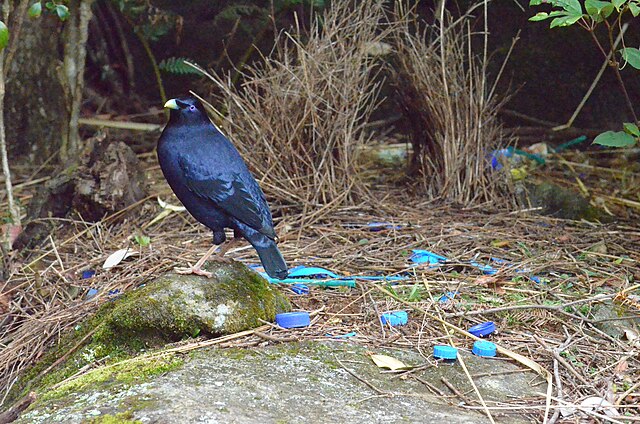
1- Bowerbirds (Nest Decoration)
Bowerbirds, Credit; Wikimedia/chujoslaw
Geographic Location: Bowerbirds are found in Australia and New Guinea, thriving in various habitats from rainforest to shrubland.
Strange Habits and Behaviors: Bowerbirds are best known for a specific peculiar behavior: the males’ habit of building and decorating elaborate structures, known as bowers, to attract females. These are not nests for raising young, but rather intricate displays adorned with colorful objects such as flowers and stones. The males meticulously arrange these items to create a visually appealing display, essential in the females’ mate selection process.
Scientific Facts: There is evidence that bowerbird cognitive abilities are well-developed and essential for success. They have large brains, which appear to have co-evolved with bower design. For example, males with better scores in cognitive tasks had higher mating success, which is a good indicator of reproductive success in this species.
Copyright @smorescience. All rights reserved. Do not copy, cite, publish, or distribute this content without permission.
Join 20,000+ parents and educators
To get the FREE science newsletter in your inbox!
SUBSCRIBE TO OUR NEWSLETTER
.......... ..........
Subscribe to our mailing list to get updates to your email inbox.