A strange, icy traveller lurking at the edge of our solar system might just be rewriting everything we thought we knew about the mysterious Planet Nine.

Astronomers using the powerful Subaru Telescope in Hawaii have spotted an unusual object orbiting far beyond Pluto. Named 2023 KQ14, this newly discovered celestial body could shake up long-held theories about the structure of our solar system, and even call into question the existence of the elusive, hypothetical Planet Nine.
The object was first spotted in 2023, and astronomers quickly realized it wasn’t just another frozen rock. After months of careful follow-up using multiple telescopes, including the Canada-France-Hawaii Telescope, scientists were able to trace 2023 KQ14’s orbit back nearly two decades. What they found was startling: this object follows a highly unusual path, one that places it in an elite class of only four known bodies called sednoids — distant, icy worlds that orbit far beyond the grasp of Neptune’s gravity.
However, what caught the scientists’ attention was that 2023 KQ14’s orbit is significantly different from those of the three other known Sednoids. And that changes everything.
For years, astronomers have speculated that something massive, maybe a hidden ninth planet, is tugging on the orbits of these sednoids, mysteriously aligning them. But now, this newcomer seems to be breaking the mold.
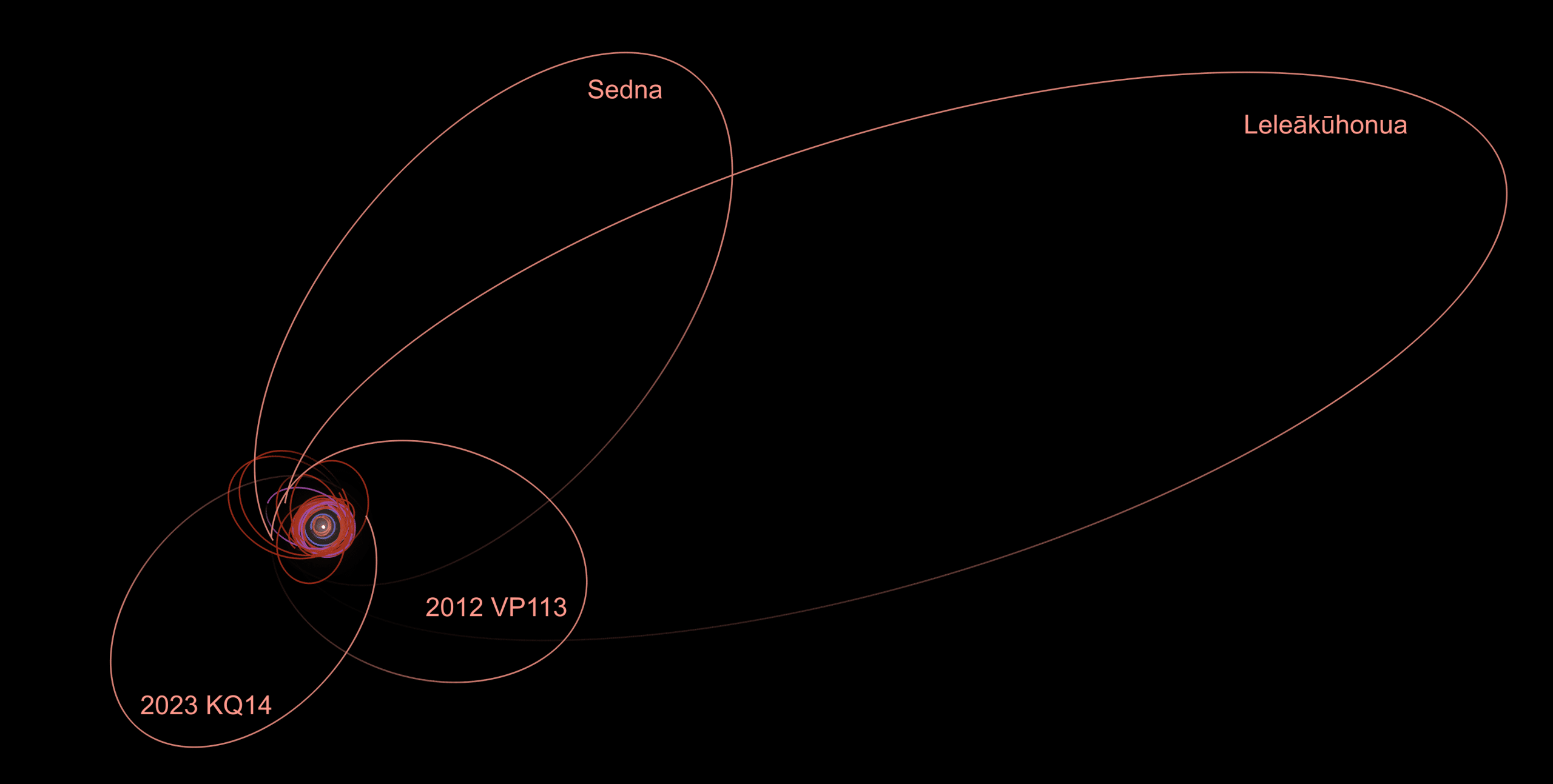
“The fact that 2023 KQ14’s current orbit does not align with those of the other three sednoids lowers the likelihood of the Planet Nine hypothesis,” says Dr. Yukun Huang of the National Astronomical Observatory of Japan, who ran simulations of the object’s orbit. “It is possible that a planet once existed in the Solar System but was later ejected, causing the unusual orbits we see today.”
So instead of pointing to a new planet, 2023 KQ14 may be a clue that something far stranger happened billions of years ago.
Researchers believe 2023 KQ14 has been travelling through space on a stable orbit for 4.5 billion years, nearly as old as the solar system itself. Back then, its orbit might have looked a lot like its sednoid siblings. So, what changed?
Dr. Fumi Yoshida from the National Astronomical Observatory of Japan explained that the discovery hints at a dramatic event in the early history of the outer solar system. She noted that the presence of objects with stretched-out orbits and large perihelion distances in this region suggests something extraordinary happened around the time 2023 KQ14 was formed.
This means the solar system may have experienced a cosmic disturbance in its early days, like a wandering planet being kicked out, or perhaps an unseen star passing nearby, that sent these frozen relics into their current orbits.
The discovery of 2023 KQ14 came from a survey called FOSSIL (Formation of the Outer Solar System: an Icy Legacy), which uses the Subaru Telescope’s wide field of view to scan the sky for faint, distant objects.
Dr. Yoshida explained that studying the orbits and characteristics of these rare, far-off objects is essential for piecing together the complete story of how our Solar System evolved. She also emphasized that, currently, the Subaru Telescope is one of the few instruments on Earth capable of making such important discoveries.
The FOSSIL team hopes this is just the beginning. With more objects like 2023 KQ14 waiting to be found, astronomers could soon uncover the full, wild history of our solar system, one icy world at a time.
So, is Planet Nine out there? Or is the truth even weirder than we imagined?
Stay tuned; space still has plenty of secrets left to reveal.
For more details, refer to this paper published in Nature Astronomy.
Copyright @smorescience. All rights reserved. Do not copy, cite, publish, or distribute this content without permission.
SUBSCRIBE TO OUR NEWSLETTER
.......... ..........Subscribe to our mailing list to get updates to your email inbox.
Monthly Newsletter