Moths vs Butterflies

Table of Contents

Moths and butterflies are both insects that belong to a group known as Lepidoptera (the Greek word “lepis” meaning scale and “pteron” meaning wing). Butterflies and moths have many things in common, such as wings covered with scales.


Moths make over 95% of the species belonging to Lepidoptera. Based on fossil records dating back to around 190 million years ago, moths were present on Earth before butterflies. Rather, moths evolved into butterflies, leading to the distinct groups – moths and butterflies.

How can you tell the difference between a moth and a butterfly? The distinguishing features of moths and butterflies are listed below.

Behavioral Activity:

Butterflies are ectotherm , using outside sources of heat to maintain their body temperatures. Thus, they are mostly active during the day, using sunlight to keep their body temperatures at around 85ºC. This temperature is required for flight. On the other hand, moths are mostly nocturnal  species, resting during the day and active at night. Although moths are also ectotherms, they maintain their body temperature by vibrating their wings.

Butterfly_Beautiful
Butterflies, like other insects including moths, contribute towards pollination. Credit: Wikimedia Commons/Rakesh Vadnala

Wings and Coloration:

Moths are usually smaller and duller in color, while butterflies are usually larger and brightly colored. While resting, moths lay their wings down horizontally, showing the tops of their wings and hiding their colored abdomen . Butterflies hold their wings vertically up over their backs, showing the dull undersides of their wings. This is to avoid being spotted by predators.


Moths have patterns on their wings in the form of swirls or zigzags to hide from predators. Butterflies also have unique patterns on their wings, but these are striking to the eye. There are exceptions in both groups of species. For example, the baron butterfly is dark brown and the cabbage white butterfly is plain white, whereas the luna moth is pastel green and the rosy maple moth is bright yellow and pink. These exceptions may also be toxic.

Wing Anatomy and Flight Pattern:

Butterflies and moths have different wing anatomy as well. Butterflies have two wings on each side of their bodies which move independently. They lack a structure called the frenulum . In moths, this structure joins the forewing to the hind wing, allowing the wings to work together.


As for the flight pattern, some species of butterflies fly at great speeds effortlessly, while others fly at slower paces. Moths have brightly colored scales on their wings which trap air and allow them to fly. However, these scales may be easily spotted by predatory birds. Thus, moths have an unpredictable, erratic pattern of flight.

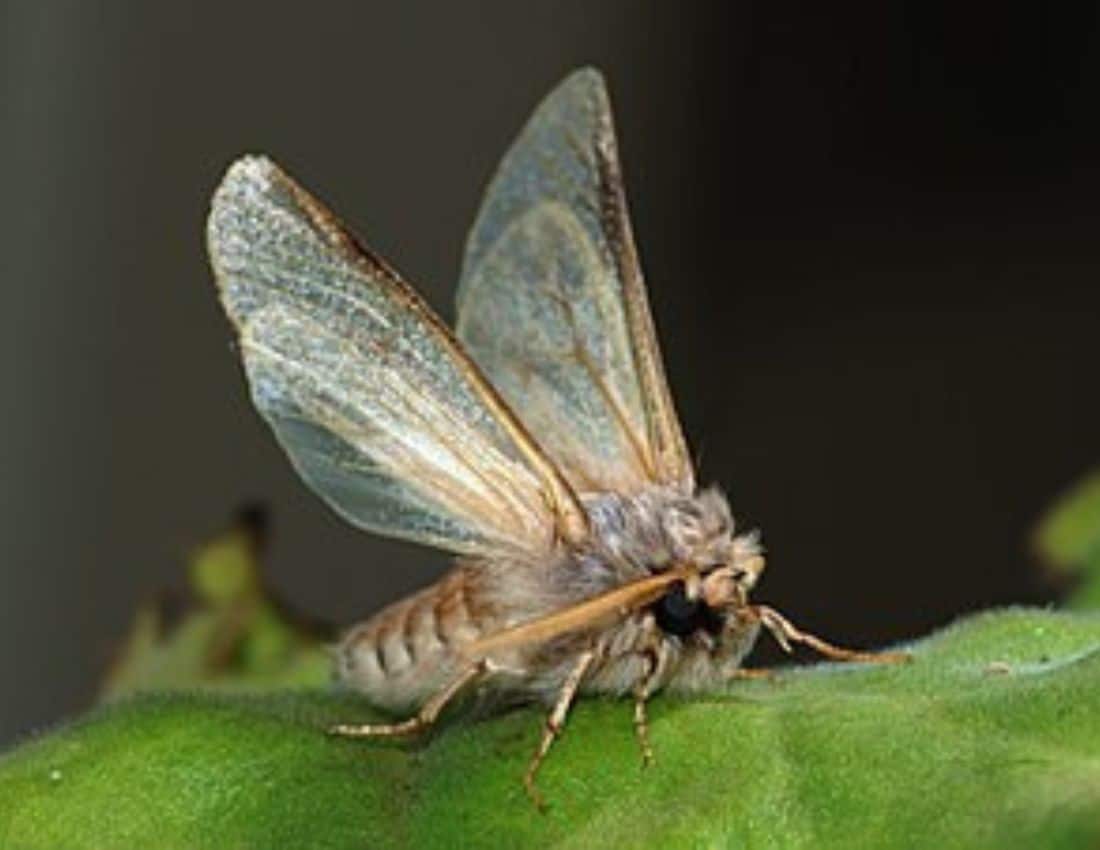
Moth
A moth species (Thaumetopoea pityocampa) resting atop a leaf. The bristles from the underside of the hind wing seen here (frenulum) join it to the forewing.Credit: Wikimedia Commons/ Joaquim Alves Gaspar

Life Cycle and Reproduction:

The adult butterfly usually lives for only two weeks. But, some species of butterflies can survive for many months and hibernate during the winter. Depending on the species, moths can also live for seven days to up to ten months. It is believed that moths do not age, but other reasons lead to their death.


Butterflies and moths are “ holometabolous ” species, showing a phenomenon known as complete metamorphosis . Distinct stages—egg, caterpillar, chrysalis (or cocoon ), and adult—are seen during complete metamorphosis. The female moth may lay a single egg or lay in batches, whereas female butterflies lay eggs in groups. Moths make cocoons wrapped in silk strings. On the other hand, the chrysalis of a butterfly is usually hard, smooth, and made of a substance known as chitin .

The different stages in the life cycle of butterflies and moths (holometabolous species) showing complete metamorphosis. Credit: Wikimedia Commons/Albert Herring

Flesch Kincaid Grade Level: 8.4


Flesch Kincaid Reading Ease: 59.6

Glossary

Lepidoptera: an order of insects that includes butterflies and moths


Ectotherm: an organism dependent on external sources of body heat


Nocturnal: active at night


Abdomen: the posterior-most part of the body of insects


Frenulum: a structure which joins the front and back wings in moths


Holometabolous: showing homometabolism or complete metamorphosis


Complete metamorphosis: metamorphosis which shows the four stages: egg, caterpillar, chrysalis (or cocoon), and adult


Chrysalis: a butterfly at the stage of development when it is covered by chitin


Cocoon: a moth at the stage of development when it is covered by a silk covering


Chitin: a hard polysaccharide substance that helps form the exoskeleton of arthropods and the cell walls of fungi

Britton, Author(s) David. “What Are the Differences between Butterflies and Moths?” The Australian Museum, https://australian.museum/learn/animals/insects/what-are-the-differences-between-butterflies-and-moths/.


“How Can You Tell the Difference between a Butterfly and a Moth?” The Library of Congress, https://www.loc.gov/everyday-mysteries/zoology/item/how-can-you-tell-the-difference-between-a-butterfly-and-a-moth/.


“Learn about Butterflies Day.” 13 Mar. 2022, https://christineelder.com/butterfly-vs-moth/.


“Moth vs Butterfly: The 8 Key Differences.” AZ Animals, 5 Oct. 2022, https://a-z-animals.com/blog/moth-vs-butterfly-the-8-key-differences/.


“The Similarities, Differences, and Environmental Niches of the Moth and Butterfly (Lepidoptera).” Crazy Plants Crazy Critters, 3 July 2019, https://crazycrittersinc.com/the-similarities-differences-and-environmental-niches-of-the-moth-and-butterfly-lepidoptera/.

Contributors

Copyright @smorescience. All rights reserved. Do not copy, cite, publish, or distribute this content without permission.


Join 20,000+ parents and educators
To get the FREE science newsletter in your inbox!