A mathematical constant so beloved that it has its own holiday. Pi (π) is the ratio between the circumference and the diameter of any circle. Known to us for around 4,000 years, we have yet to find its actual value. What adds to the allure of pi is that it is irrational, with no repeating digits and no end. Surely, finding more digits of pi is a gamification of the task itself, and also a way to stress-test supercomputers. However, computers weren’t always a thing, so let’s see how pi was calculated manually.
Pi is an irrational number with no end
In 1988, physicist Larry Shaw chose 14th March as a fun day for staff at San Francisco’s Exploratorium science museum. In 2009, the U.S. national Congress officially declared 14th March (3/14, which is similar to the first three digits of pi— 3.14) as National Pi Day. So, sit back and enjoy a slice of ‘pi’.
The Babylonian Way (c. 1700 BCE)
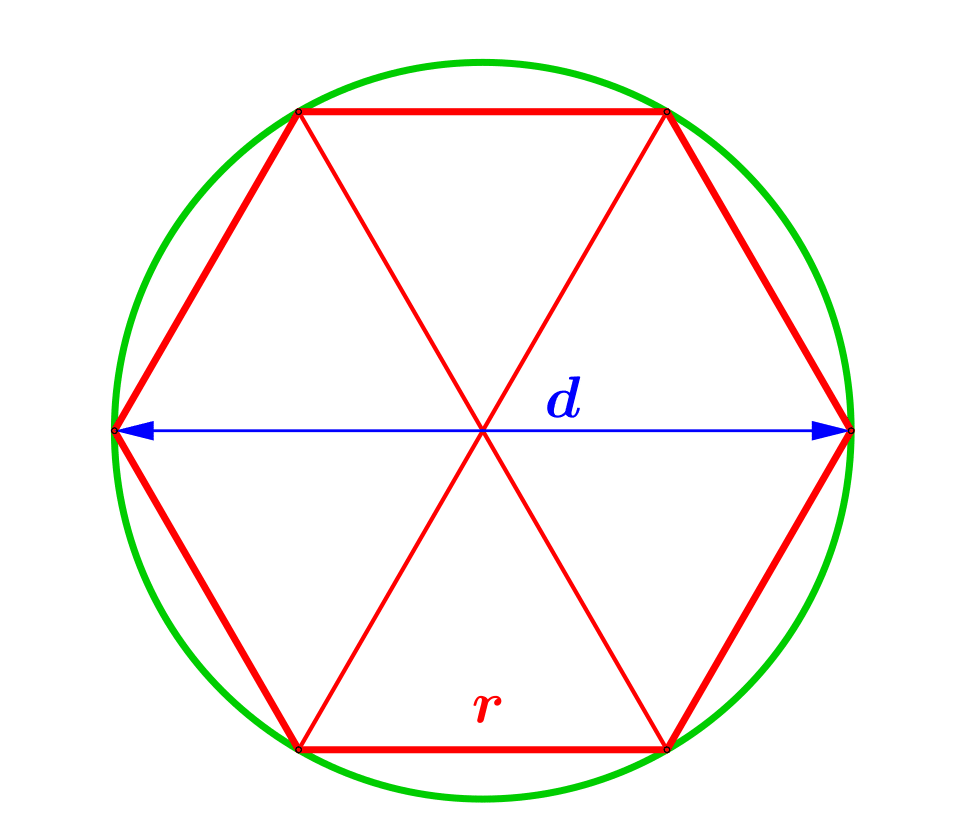
Among the many Babylonian tablets found in Susa, one shows a list of mathematical constants. The constant of interest is 24/25, which is the ratio of the perimeter of a hexagon with side length r, inscribed in a circle of radius r, to the perimeter (circumference) of the circle.
Then, they equated 24/25 to the ratio of the perimeters 6r/2πr. As the r in the numerator and denominator cancel out, we are left with pi = 25/8, or 3.125.
The ratio of the perimeter of the inscribed polygon to the perimeter of the circle is 24/25. The side length and the radius of the circle are equal, Credit: Wikimedia/Petrus3743
The Egyptian Method (c. 1650 BCE)
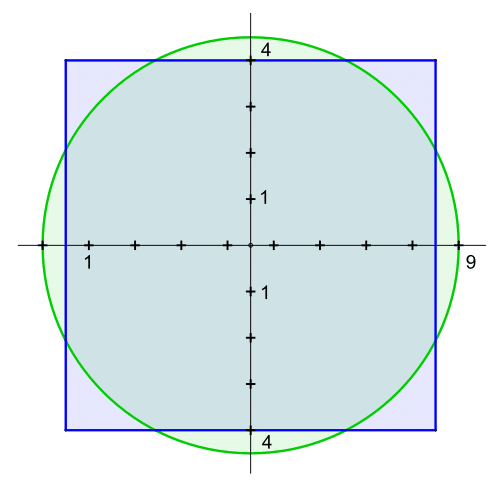
The Rhind Papyrus, found in the Egyptian city of Thebes (now named Luxor), states how ancient Egyptians approximated the value of pi. They found that the area of a square with a side of length 8 units equals the area of a circle with a diameter of 9 units or a radius of 4.5 units.
The area of the circle and square in the picture is equal, Credit: Wikimedia/Petrus3743
This means the ratio of the area of the square to that of the circle is 8/9. If we go for the formulaic version, we get:
Area of square = (side)2 = (8u)2 = 64u2
Area of circle = π × (radius)2 = π × (4.5u)2 = 20.25πu2 (radius is half of the diameter)
Since,
Area of square = Area of circle
Therefore,
64u2 = 20.25πu2
Or, π = 64u220.25πu2
Or, π = 3.1604, which is pretty close to the value of pi.
Archimedes’ Method of Exhaustion (c. 250 BCE)
Archimedes of Syracuse, a Greek mathematician, approximated the value of pi by drawing hexagons inside the circle (inscribed, with vertices touching the circle) and outside the circle (circumscribed, with sides touching the circle). Then he calculated the perimeters of the circumscribed and inscribed hexagons, and inferred that the value of pi lies between those two perimeters.
He went on to double the number of sides of the hexagons, to a 12-sided polygon, then to a 24-sided polygon, and so on up to a 96-sided polygon. As he progressed, he brought the two parameters ever closer to the circle’s circumference, thus arriving at his approximation.
Specifically, he found that pi (π) lay between 3 10/71 and 3 1/7. In the decimal notation, the lower bound (smaller value) translates to 3.1408, and the upper bound (greater value) is 3.1429. That is pretty close to the known value of pi — 3.1416 (rounded off to four decimal places).
This value will not change regardless of the diameter; hence, it doesn’t matter whether the diameter is one inch or one foot.
Archimedes’ method of exhaustion, Credit: Wikimedia/Fredrik/Leszek Krupinski
The Chinese calculation (480 AD)
Zu Chongzhi calculated pi up to seven decimal places by using a few wooden sticks called counting rods. Going further than Archimedes’ 96-sided polygon, Zu inscribed a 24,576-gon inside a circle, and performed lengthy calculations to find the ratio between the circumference and the diameter of a circle, which came at 355/113, or somewhere between 3.1415926 and 3.1415927.
Monte Carlo simulation is a probability-based method for estimating the value of pi. Let’s see how it works:
Draw a square with side length 2 units and then draw a circle inside it with radius 1 unit. The circle, if drawn correctly, should touch the edges of the square.
Cut out the square along with the circle inside it.
Now, take a pencil, close your eyes, and start to place dots on the paper. This ensures that the dots you put are at random and unbiased.
Once you’ve placed 250 dots, check the number of dots placed inside the circle, and divide it by the total number of dots (here, 250).
Repeat with 500, 750, 1000 dots.
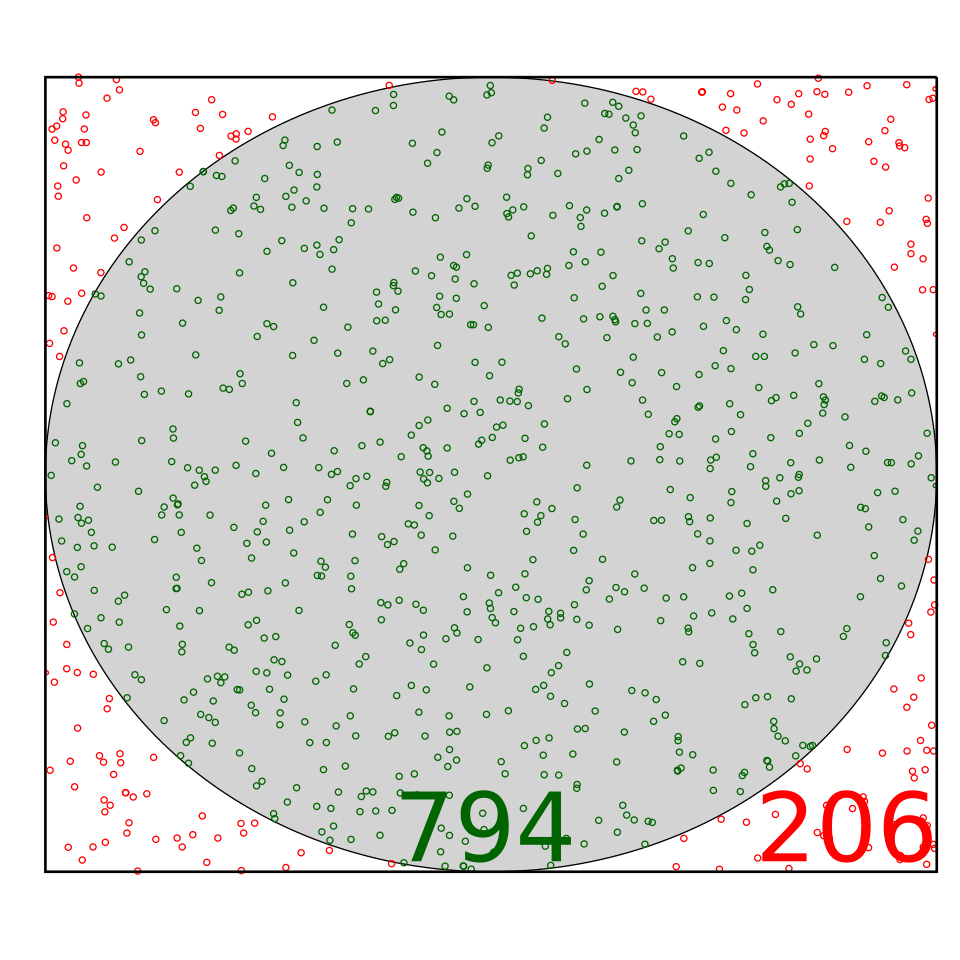
You will see that as you add more and more random dots, the ratio of the dots inside the circle to the total number of dots gets closer to the value π/4, which is the ratio between the area of the circle and the area of the square.
Monte Carlo simulation to approximate pi, Credit: Wikimedia/Thomas Steiner