Octopuses are real-life mythical beasts. Not only do they have eight arms and the ability to shoot out ink, but they also have blue blood! You might already be enthralled by octopuses but if you’re still not a fan, here’s a fun fact for you; these cool little invertebrates have nine brains. You read that right; they have more brains than they have arms!
Where are octopus's brains located?
Each arm of the octopus has one brain solely for itself. Essentially, this means that every arm of the octopus can “think” for itself. The ninth and final brain is centrally located in the head of the cephalopod, right between the eyes.
Imagine having a brain in every arm! Credit: Wikimedia/Kevstan
This brain is the locus of the whole nervous system. By allowing each arm to have its own brain, the central brain can easily delegate tasks to the brains in the tentacles and can allow itself to focus on more pertinent and complex tasks.
Do more brains equal more smarts?
What’s the point of having more than one brain if it doesn’t make you the smartest animal in the world? Octopuses do pretty well in this regard. Although they may not be the smartest animal in the world, they are indeed the smartest invertebratein the world. As a matter of fact, octopuses share almost zero neural anatomical design with other invertebrates. Essentially, an octopus has more in common with vertebratesthan invertebrates!
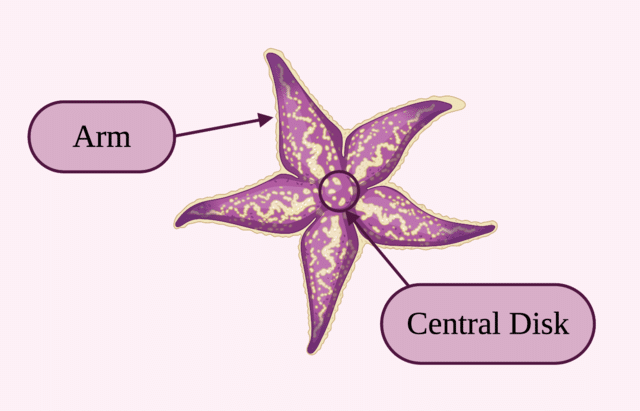
Invertebrates like sea stars have no brains! Credit: Wikimedia/HDRB
Think about it: most invertebrates don’t even have brains. Some, like echinoderms, don’t even have a ganglion. In these lower invertebrates, like sea stars, a nerve ring is the only structure that is something similar to a brain. This nerve ring is located in the center of the star, at the central disk, and branches off into five radial branches, each running into an arm.
Do other molluscs also have multiple brains?
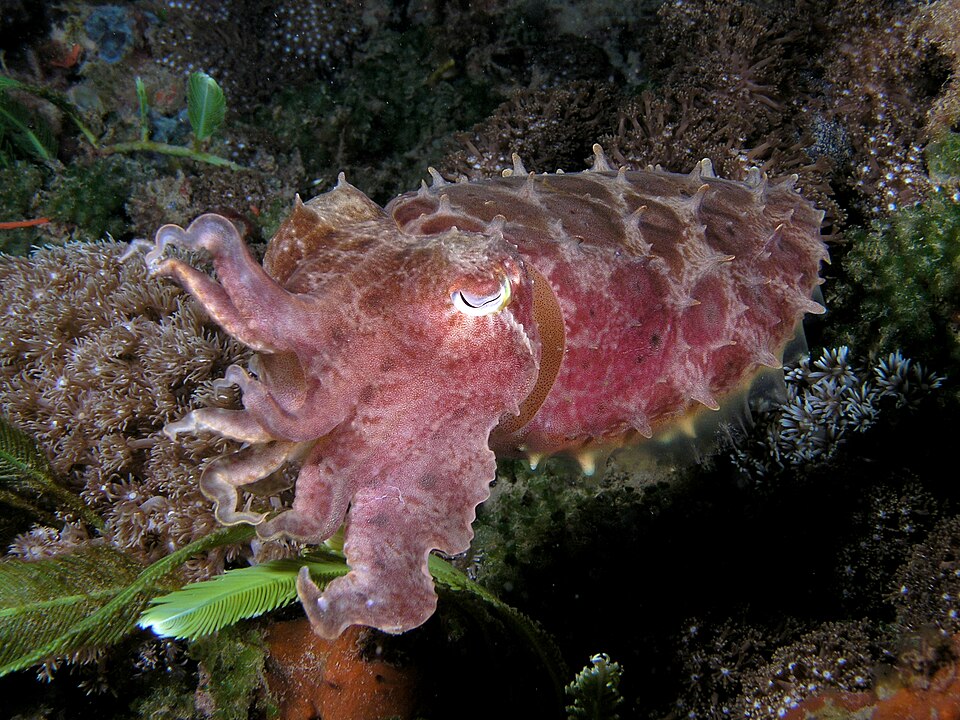
Octopuses are an exceptional group of animals. No other mollusc, except cuttlefish, even comes close in terms of the bounty of brains that octopuses harbour; yet cephalopods, in general, are a smart group of animals.
They’re well-known for their intellect, so it’s no surprise that other cephalopods like squid have complex brains as well. Unlike octopuses, squids don’t have a brain in each arm and instead have three distinct components: two optic lobes and a central ganglion. Although we now know the anatomy of a squid’s brain, it is still incredibly hard to extrapolate how smart they are.
For a deeper dive into the differences between these fascinating creatures, read our detailed comparison on octopus vs squid.
In the vast and unending realm of the open sea, squids and octopuses each carve their unique paths. Squids gracefully traverse the water column, delighting in the freedom of vertical movement, while their counterparts, the octopuses, prefer shuffling along the seafloor. Even within their natural habitats, away from the controlled confines of a laboratory, octopuses showcase their remarkable cognitive abilities. Take, for instance, the coconut octopuses, resourceful creatures that cunningly pluck shells from the seafloor, using these impromptu shelters to outsmart potential predators. This cognitive prowess is a direct consequence of their immediate environment, namely the resourceful seafloor.
Watch this video of a rare glass octopus gliding through the deep sea!
Octopuses live on the seafloor. Credit: Wikimedia/Theasereje
So, although octopuses are indeed rich in brains, that doesn’t necessarily equate to functional success in all niches. For instance, if an octopus were to suddenly decide to leave the safety of the seabed for the open seas, even with nine brains it would probably not have the same level of success as the cephalopods that evolved there.
Glossary
Invertebrate: Division of animals who do not have a backbone.
Vertebrate: Division of animals who have a backbone throughout their lives, and more importantly, a primitive notochord in the early stages of their development.
Echinoderm: A phyla of invertebrates that are characterised by their radial symmetry and a hard covering or skin.
Mollusc: A phyla of invertebrates characterized by a soft and fleshy body usually protected by a hard shell.
Cephalopod: A group of molluscs. These molluscs have arms or tentacles and generally do not have the characteristic outer shell that other members of the phyla do.