Table of Contents
At some point in your life, you might have asked your parents for a pet dog. After all, they are cuddly, cute, and loyal. Those of you who already have dogs might be wondering how time works for them. A common myth is that one human year is equal to seven dog years. Let’s find out if there’s any truth to this assumption!
Human years ≠ Dog years
The assumption that one human year is equal to seven dog years is not entirely accurate. The actual conversion rate depends on the developmental stage of the dog. The first year of a dog’s life corresponds to 15 human years. The second year is equivalent to 9 human years, and after the second year, each additional human year is equal to around 5 dog years. A pet owner who has been with a pet for 12 years would calculate the age of the dog as 15+9+(10×5) = 74. So, you might think your dog is just a teenager of 12 years, but in reality, your pooch is a retired senior citizen!
While humans become full adults during their late teens and early twenties, dogs can be called adults after only 1 or 2 years! The initial year or two involve ongoing bone development, after which a puppy is officially considered an adult.
Tick tock, epigenetic clock!
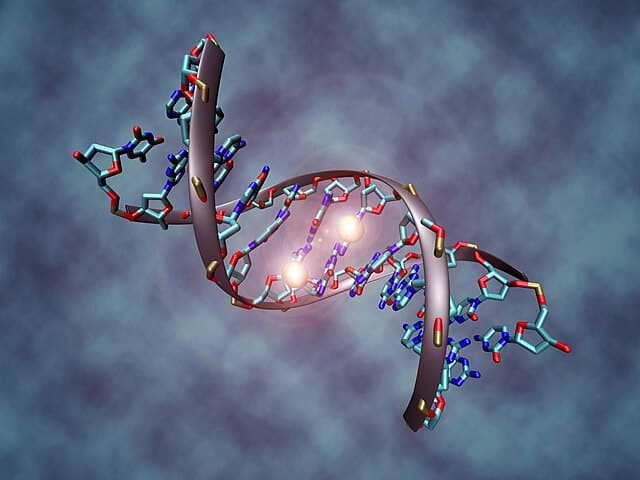
The method we used to calculate the actual age of our 12-year-old dog is a simplification of a complex mathematical formula. Before diving into the complex (but not boring!) mathematics, it is crucial to grasp the difference between chronological age and biological age . Chronological age is the amount of time we spent on earth since we were born, and biological age is the age of our body. Biological age can be lesser or higher than chronological age. Scientists in one study decided to use epigenetic clocks to gauge biological age. Think of epigenetic clocks as our body’s own stopwatch that keeps track of our biological age. Unlike real clocks, epigenetic clocks keep track of time by measuring the accumulation of methyl groups . Methyl groups are small tags that are added to your DNA. And don’t worry, they won’t affect the structure or function of DNA in any way. They are akin to vigilant security guards who monitor the activity of genes or gene expression.

Researchers at the University of California, San Diego compared the level of methyl content in Labrador Retrievers to that in humans in order to map dog age to human age. And they arrived at a complex mathematical formula:
Human equivalent age = 16 × ln (dog’s chronological age) + 31
(ln is a variable in this linear regression equation, meaning that the relationship is a curved line on a graph.)
Who would have thought that calculating a dog’s actual age would be so complicated?
Doggy years, woof woof!
While dogs seem to have no concept of time and are happy to spend their time chasing butterflies, they too undergo the aging process. The amount of time a dog gets to spend on earth depends on factors such as its size and its breed. For instance, small dogs such as Corgis, Terriers, and Chihuahuas typically live for 12–15 years, and medium-sized dogs such as Golden Retrievers, Bulldogs, and Cocker Spaniels have a lifespan ranging from 10 to 13 years. However, large-size dogs, including Great Danes and Saint Bernards, unfortunately have a shorter lifespan of only 8–10 years. Although we don’t know the entire reason behind the difference between the lifespans of small dogs and large dogs, research has given us some insights. Large dogs grow and mature at a very fast pace. When the body is growing at such a high rate, higher energy resources have to be invested to maintain growth and development. In such cases, the body doesn’t have enough energy to invest in cancer defense and cell repair. As a result, larger dogs are susceptible to cancer.
Glossary
FLESCH KINCAID READING EASE: 61.5
FLESCH KINCAID GRADE LEVEL: 9
Developmental stage: A defined time in the growth and maturation process
Chronological age: Time elapsed since birth
Biological age: The age of the body according to physiological and other biological factors
Epigenetic clock: A measure of biological age based on the number of methyl groups on DNA molecules
Methyl groups: Molecular tags that monitor and control the activity of the gene
References
Staff, A. (2023). How to calculate dog years to human years. American Kennel Club. https://www.akc.org/expert-advice/health/how-to-calculate-dog-years-to-human-years/#:~:text=15%20human%20years%20equals%20the,five%20years%20for%20a%20dog.
Duan, R., Fu, Q., Sun, Y., & Li, Q. (2022). Epigenetic clock: A promising biomarker and practical tool in aging. Ageing Research Reviews, 81, 101743. https://doi.org/10.1016/j.arr.2022.101743
Wang, T., Ma, J., Hogan, A. N., Fong, S., Licon, K., Tsui, B., Kreisberg, J. F., Adams, P. D., Carvunis, A., Bannasch, D. L., Ostrander, E. A., & Ideker, T. (2020). Quantitative translation of Dog-to-Human aging by conserved remodeling of the DNA methylome. Cell Systems, 11(2), 176-185.e6. https://doi.org/10.1016/j.cels.2020.06.006
Lovejoy, J., DVM. (2023). How long do dogs live? PetMD. https://www.petmd.com/dog/care/how-long-do-dogs-live
Yates, C. (n.d.). Are ‘dog years’ for real? An explanation of calculating canine age. The Conversation. https://theconversation.com/are-dog-years-for-real-an-explanation-of-calculating-canine-age-127655
Contributors
Copyright @smorescience. All rights reserved. Do not copy, cite, publish, or distribute this content without permission.
SUBSCRIBE TO OUR NEWSLETTER
.......... ..........Subscribe to our mailing list to get updates to your email inbox.
Monthly Newsletter