Table of Contents
Ever wondered why we can see stars that are millions of miles away? …Why we can’t see in the dark the way some animals can? The answer to these questions lies in the complexity of our visual system.
“Eyes are the windows to the soul;” the statement may be true. But the system that allows us to see the world involves more than just the eyes. The human visual system consists of the eyes and the brain. Communication between the two is the key to vision.
Parts of an Eye
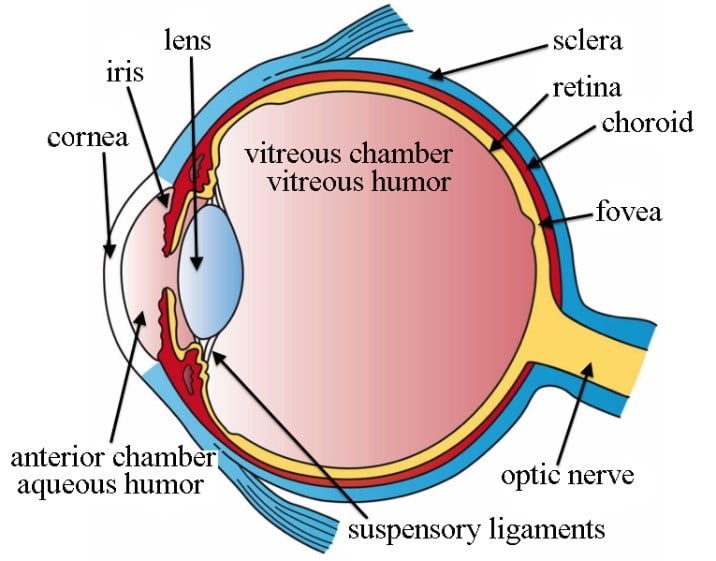
Some components of the eye that make vision possible include the cornea, pupil, iris, retina, aqueous humor, and vitreous humor.
The cornea is the curved-shaped structure that initially focuses light. The pupil is a gap in the iris that allows the light to enter your eyes. The iris is an important muscle that controls the size of the pupil, thereby regulating the amount of light that enters it. Under dark conditions, pupil size increases to allow more light to enter, whereas, under bright light, pupil size decreases to prevent excess light from entering. The iris is also responsible for the wide range of beautiful eye colors.

After passing through the pupil, the light is further finely focused by the lens. The focused light finally falls on the retina , our very own projection screen. The retina doesn’t actually contain the image we see. Rather, it receives the information of the image. How so? The retina has certain cells called photoreceptors that convert the light received by the retina into an electrical signal. This signal is then sent to the brain via a nerve called the optic nerve. The brain then does the final and most important job of converting the signal into an actual image. So, the brain acts as a translator to help us understand the world around us in a way we can understand and appreciate.
How does the eye focus?
Have you ever wondered how we can see both things that are close to us and those that are far away? It’s because our eyes have the ability of accommodation . Accommodation is the mechanism used by the eye to change its focal length, which is the distance between the lens and the retina. Focal length is important for us to be able to see both closer and farther objects. A larger focal length is needed to see objects that are at a considerable distance from us, while a lower focal length allows us to see closer objects.

Eyes have muscles called ciliary muscles . These muscles change and adjust the orientation of the lens, changing the focal length. They decrease the focal length when we want to see, for example, our darling cat sitting on our lap. If we want to see far away into the distance and watch our friend waving at us, the ciliary muscles increase the focal length to help us do that.
How far can you see?
Despite their magnificent powers, our eyes can only see up to a distance of 3 miles / 5 kilometers. Why is that so, when we can see the stars that are located millions of light-years away from us? This is because the curvature of the earth hides objects from us. If you are standing on a giant ball, you can’t see what’s happening on the side that’s diametrically opposite to you. But if you are standing on a giant wooden plank, you can see the end of the plank. The same concept applies here.
Some Vision Impairments
According to a study conducted in 2019 by Investigative Ophthalmology & Visual Science journal, more than 30% of the world’s population suffer from near-sightedness, or myopia. People with this type of vision impairment can see things close to them clearly, but objects farther from them appear blurry. To form an unblurry image, the light from the image must fall exactly on the retina. But in the case of myopic people, the light is focused in front of the retina, leading to hazy vision.
One of the major reasons children develop myopia is due to the increase in the amount of time they spend indoors. A study conducted a few years back sheds some light on one of the reasons behind this. Indoor light has high red/green contrast. Red and green are located opposite each other on the color wheel and are hence said to be high-contrast colors. This indoor light activates and impairs a cluster of photoreceptors in the retina. Improper functioning of these cells is linked to myopia.
Are we colorblind?
Our eyes contain millions of cells called photoreceptor cells. There are two types of light-sensing photoreceptor cells: rods and cones. Rods can respond to low levels of light and are responsible for night vision. Cones allow us to perceive the different variety of colors around us.
“Humans are color-blind compared to birds and many other animals,” said Mary Caswell Stoddard, a professor at Princeton University. This is because we humans have three types of photoreceptor cones in our eyes that respond to red, blue, and green light. Some birds have another set of cells in addition to these three that enables them to see colors in the ultraviolet spectrum. Birds thus can experience a plethora of colors that are hidden from the human eye.
Why can’t we see at night?
There are two reasons humans do not see in the dark as well as many animals do. Some nocturnal animals possess a higher number of rods than mammals usually do, allowing them to see better at night. Some animals also have a tissue called tapetum lucidum . This tissue reflects light to the retina for a second time, ensuring that the rods can better absorb the light. This enhances night vision.
So, now you know why your cat can lurk around in the dark without crashing into your furniture.
Glossary
Pupil: A part of the eye whose size changes in response to changes in light.
Retina: A screen-like tissue at the back of the eye that receives the image.
Accommodation: A mechanism that allows us to see close-range and far-range objects.
Focal Length: A parameter that determines how well we see close-range and far-range objects.
Ciliary Muscles: Responsible for changing shape of the lens.
Nocturnal: Animals that are most active at night.
Tapetum Lucidum: A membrane that reflects light. Responsible for night vision.
Photoreceptors: structures in an animal that respond to light
References
Sebastian, E. T. (2010). The Complexity and Origins of the Human Eye: A Brief Study on the Anatomy, Physiology, and Origin of the Eye | Semantic Scholar. https://www.semanticscholar.org/paper/The-Complexity-and-Origins-of-the-Human-Eye:-A-on-Sebastian/d8033867bd9d345c88a768c247a785a54df65f81
Burd, H. J., Judge, S., & Flavell, M. J. (1999). Mechanics of accommodation of the human eye. Vision Research, 39(9), 1591–1595. https://doi.org/10.1016/s0042-6989(98)00298-3
Cronin, T. W., & Bok, M. J. (2016). Photoreception and vision in the ultraviolet. The Journal of Experimental Biology, 219(18), 2790–2801. https://doi.org/10.1242/jeb.128769
Vee, S., Barclay, G., & Lents, N. H. (2022). The glow of the night: The tapetum lucidum as a co‐adaptation for the inverted retina. BioEssays, 44(10), 2200003. https://doi.org/10.1002/bies.202200003
Holden, B. A., Wilson, D., Jong, M., Sankaridurg, P., Fricke, T. R., Smith, E. L., & Resnikoff, S. (2015). Myopia: a growing global problem with sight-threatening complications. Community Eye Health / International Centre for Eye Health, 28(90), 35.
Mani, A., & Schwartz, G. G. (2017). Circuit Mechanisms of a Retinal Ganglion Cell with Stimulus-Dependent Response Latency and Activation Beyond Its Dendrites. Current Biology, 27(4), 471–482. https://doi.org/10.1016/j.cub.2016.12.033
Contributors
Copyright @smorescience. All rights reserved. Do not copy, cite, publish, or distribute this content without permission.
SUBSCRIBE TO OUR NEWSLETTER
.......... ..........Subscribe to our mailing list to get updates to your email inbox.
Monthly Newsletter