Table of Contents
Introduction
Refrigerators, commonly called fridges, are found at home, in stores, or any place where food, liquids, and other items need to be kept at cooler temperatures. Fridges are devices which can transfer heat from an inside space to the outer surroundings. Fridges are also insulated and can cool to temperatures below those of the surroundings.
Although fridges are common, exactly how do they work? Before understanding how modern-day fridges work, we will first learn about their history. Then, we will understand why fridges require electricity. Finally, we will see the types of modern-day fridges.
Cooling Before Refrigerators

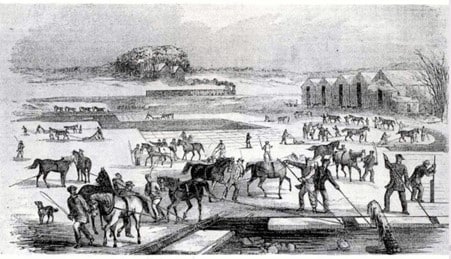
Before electricity and fridges, people stored food at colder temperatures using the resources around them. For example, food would be placed in the cold water of rivers and lakes. Otherwise, food was also stored in pits or cellars in the ground. People eventually made their own iceboxes to store food. These iceboxes were filled with ice or snow and covered with straw, seaweed, or sawdust. Such methods of keeping food cool in storage did not make use of electricity.
Iceboxes which looked like the fridges of the modern day became popular in the 19th century. Although there was still no electricity used, these boxes were made of an insulated metal or wooden cabinet with a tray or a compartment. This tray or compartment could hold large blocks of ice. At those times, the ice blocks would be regularly dropped off at each house with an icebox.
The Invention of Refrigerators

The idea for a system of cooling came from the Scottish physician, William Cullen, in 1748. Cullen saw and showed that a cooling effect was seen if a liquid was quickly made into gas. However, he did not make any use of his observation.
In 1834, the first vapor compression system was made by American engineer and physicist, Jacob Perkins. In this system, a fluid could be alternately compressed and expanded by creating a difference in pressure. This would in turn change the state of the fluid from liquid to vapor. This process was repeated in a cyclic manner. As he was the first to build such a system, Perkins is known as the Father of the Refrigerator.
Many inventors helped make fridges as we know of them today. In 1913, American physicist Fred W. Wolf made the first electric fridge. This fridge had a refrigeration unit on top of an icebox. Afterwards, William C. Durant made the first home fridge with a compressor unit. This invention led to the mass production of home fridges in 1918. Along with their use in homes, fridges were also used in industries in the 20th century.
How Do Refrigerators Work?

Fridges work by using a cyclic process called the vapor compression system. This process is also known as the refrigeration cycle. The refrigeration cycle makes use of a fluid called the refrigerant. Here, we will see this process in detail.
The cycle begins in the compressor. The compressor may be called the heart of a fridge. The refrigerant in the fridge is pulled into the compressor. The compressor applies pressure to the refrigerant vapor. Then, the vapor is pushed out at a higher temperature and pressure.
The compressor coils lead this vapor outside the refrigerator. There, the vapor exchanges heat with the air in the room. Because of the heat exchange with the air in the room, the hot gas in the condenser coils now becomes a liquid. Afterwards, the cooled liquid flows into evaporator coils inside the fridge.
The heat inside the fridge is absorbed by the refrigerant , cooling the internal temperature and contents of the fridge. The heat converts the liquid refrigerant into a vapor again. The refrigerant evaporates as a gas. This gas is pulled back to the compressor. Thus, it is ready to be compressed, and the entire cycle repeats again. The repetition of the cycle helps the fridge maintain a constant cold temperature.
Thus, the main parts of a fridge include a compressor, a condenser, an evaporator , a capillary tube, and a thermostat . Additionally, refrigerants – like propane and carbon dioxide – may be used. The use of these parts together, along with a refrigerant in the refrigeration cycle, is essentially how refrigerators work!
Why is Electricity Needed for Refrigerators?
Refrigerators make use of electricity to work against the second law of thermodynamics . According to the Second Law of Thermodynamics, heat will always spontaneously move from hotter regions to colder regions. Plus, this flow of heat (or energy) will never happen in the opposite direction without an external factor.
In fridges, heat is made to flow from colder regions to hotter regions. This flow requires the use of electricity. Thus, the inside temperature of fridges is always kept cold in comparison to the surroundings.
Types of Refrigerators

Although the basic working has remained the same, modern-day fridges show a great variety in their designs. Types of fridges include top-freezer fridges, side-by-side fridges, bottom-freezer fridges, French door fridges, counter-depth fridges, mini fridges, and more. These fridges differ in features such as energy efficiency and storage space.
Most fridges have a built-in frozen storage or freezer compartment. Like fridges, freezers also make use of a cyclic process for freezing. Based on the -in freezer or their absence, fridges may be divided into their various types. However, the principle by which it works remains more or less the same!
Flesch Kincaid Grade Level: 7.7
Flesch Kincaid Reading Ease: 62
Glossary
Insulated: protected by material to prevent the loss of heat
Iceboxes: chilled boxes for keeping something cold, especially food
Vapor Compression System: a repeating system wherein a refrigerant undergoes phase changes between gas and liquid.
Compressor: an instrument or device for compressing something
Condenser: a heat exchanger to condense gas into liquid by cooling
Refrigerant: a working fluid used in the refrigeration cycle
Evaporator: a device in which liquid turns to gas
Capillary Tube: a tube between the condenser and the evaporator.
Thermostat: an instrument that regulates temperature.
Second Law of Thermodynamics: a universal, physical law based on heat and energy interconversions
References
“How Does a Refrigerator Work?” Maytag, Maytag, 22 Mar. 2021, https://www.maytag.com/blog/kitchen/how-does-a-refrigerator-work.html.
Ozkuzey, Metin. “What Are the Different Types of Refrigerators?” Designer Appliances Blog, Designer Appliances Blog, 5 Feb. 2022, https://www.designerappliances.com/blog/refrigerator-types/.
“Refrigerator.” Refrigerator – Energy Education, https://energyeducation.ca/encyclopedia/Refrigerator.
“The Fridge – How It Works.” Danfoss, https://www.danfoss.com/en-in/about-danfoss/our-businesses/cooling/the-fridge-how-it-works/.
“The History of the Refrigerator: Ancient Origins to Today.” Whirlpool, Whirlpool, 2 June 2021, https://www.whirlpool.com/blog/kitchen/history-of-the-refrigerator.html.
Contributors
Copyright @smorescience. All rights reserved. Do not copy, cite, publish, or distribute this content without permission.
SUBSCRIBE TO OUR NEWSLETTER
.......... ..........Subscribe to our mailing list to get updates to your email inbox.
Monthly Newsletter