Table of Contents
Honey Bees – An Introduction
Honey bees are one of the most important pollinators for flowers, fruits, and vegetables. Pollinators are insects or other living creatures that transfer pollen between the male and female parts of plants. This allows plants to form seeds and fruits.
Honey bees live in groups in special structures called hives or colonies. The members of the hive are divided into three types: the queen bee, the worker bees, and male bees (or drones ). In each hive, there is a single female queen bee, around 60,000 worker bees, and a few hundred male drones. The queen bee mates with drones and lays eggs to give rise to the next generation of bees (either worker bees or drones) in the hive.
Honey bees, like their name suggests, are buzzing insects famous for making delicious honey! However, honey bees produce six extremely important products: honey, pollen, royal jelly , beeswax , propolis , and venom. Out of this list, let us take a closer look at the composition of beeswax and how it is made by honey bees!
What is Beeswax?
Although used by humans in a variety of products, beeswax is actually made by honey bees to build their hives. Beeswax is made up of around three hundred organic substances. These organic substances are compounds containing carbon, hydrogen, and oxygen. Beeswax is primarily made of esters of fatty acids (compounds made of fatty acids combined with alcohol). However, more than 200 other compounds have been found in beeswax.

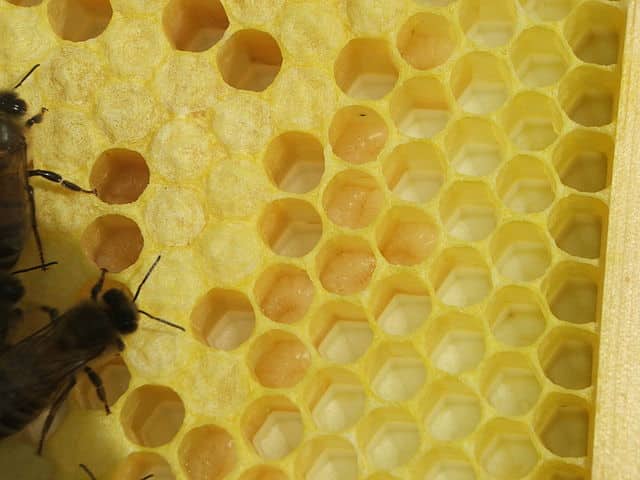
To make beeswax, bees make use of honey! In fact, honey bees use ten grams of honey in order to make a single gram of wax. Bees produce wax in the form of flakes which they store in the hive and gather in layers. Bees properly sculpt these flakes and use them to build the walls and caps of their honeycombs. Wax flakes are usually around 20 micrometers long and each weigh around 250 milligrams.
Did you know that bees are really good at math? Read more about their honeycombs and fractals found in nature
What determines the color of beeswax? Usually, the color of wax made by honey bees may be yellow, golden, or brown. Fresh beeswax is light yellow in color, mainly due to the presence of pollen, but over time it darkens to a golden yellow. Beeswax turns brown upon coming into contact with bees. The shade of the beeswax also depends on which flowers were used by the bees for making it.
Curious to know if bees eat honey ?
How Do Bees Make Wax?
In a colony of bees, the young worker bees are responsible for the production of beeswax. Worker honey bees have four pairs of special organs called wax-secreting glands beneath their abdomen . From these glands, honey bees make a liquid form of the wax, which hardens into thin scales when exposed in air.
At the most, a worker honey bee can make about eight scales of wax in twelve hours. Bees need around 1,000 such wax scales to make a single gram of beeswax for constructing their honeycomb. The shape and size of the honeycomb is constructed in such a manner that it maximizes their storage space, but decreases the amount of wax needed to build the honeycomb. As the worker bees age, the wax-secreting glands degenerate and the job of making wax is left to younger worker bees.
Flesch Kincaid Grade Level: 7.4
Flesch Kincaid Reading Ease: 70.2
Glossary
Pollinators: insects or other living creatures that transfer pollen between the male and female parts of plants
Hive: a dome-shaped or boxlike structure in which bees live
Drones: the male bees in a honey bee colony
Royal jelly: a substance fed by worker honey bees to larvae to raise as potential queen bees
Beeswax: the wax secreted by bees to make honeycombs
Propolis: a red or brown resin-like substance collected by honey bees from tree buds
Esters of fatty acids: compounds made of fatty acids combined with alcohol
Flakes: scales or flakes of wax produced by honey bees
Wax-secreting glands: special organs located beneath the abdomen in honey bees and used for making wax
Abdomen: the posterior-most body part of the honey bee
References
“10 Facts about Honey Bees!” National Geographic Kids, 17 Nov. 2022, https://www.natgeokids.com/au/discover/animals/insects/honey-bees/.
“Beeswax: How It Is Produced and What It Is Used For.” Apicoltura Laterza, 30 May 2022, https://www.apicolturalaterza.com/en/beeswax-how-it-is-produced-and-what-it-is-used-for.
Hadley, Debbie. “How Do Honey Bees Make Beeswax?” ThoughtCo, ThoughtCo, 6 Feb. 2019, https://www.thoughtco.com/how-honey-bees-make-beeswax-1968102.
Medicine, Center for Veterinary. “Helping Agriculture’s Helpful Honey Bees.” U.S. Food and Drug Administration, FDA, https://www.fda.gov/animal-veterinary/animal-health-literacy/helping-agricultures-helpful-honey-bees.
Rensvold, Jillian. “What Is Beeswax: The Building Blocks of the Hive.” Saratoga Tea & Honey Co., Saratoga Tea & Honey Co., 5 Mar. 2021, https://www.saratogateaandhoney.com/blogs/honey-education/what-is-beeswax-and-how-is-it-made.
Contributors
Copyright @smorescience. All rights reserved. Do not copy, cite, publish, or distribute this content without permission.
SUBSCRIBE TO OUR NEWSLETTER
.......... ..........Subscribe to our mailing list to get updates to your email inbox.
Monthly Newsletter