What does a typical plant need to grow? Water, nutrients, and sunlight. You might think that mushrooms grow in a similar way. However, mushrooms are fungi, not plants. Unlike plants, mushrooms do not use photosynthesis to make their own food. In fact, they grow in a different way! From the mushrooms we eat to the poisonous mushrooms in the wild, these fungi need unique conditions to grow.
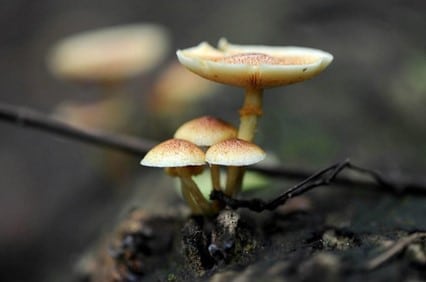
Beach Mushrooms Credit: flickr.com/vladeb
What is a fungus?
A fungus does not fit into the category of either plants or animals. While fungi are living things, they make up their own category of spore -producing organisms. Spores are tiny cells that can produce an entirely new fungus if they grow with the right support. In this way, spores from fungi are like seeds from plants. Mushrooms are just one of many different types of organisms that come from fungal spores. Other fungi that we see often include mold and yeast. Although fungi seem similar to plants, their spores grow in a different way than a plant’s seeds do.
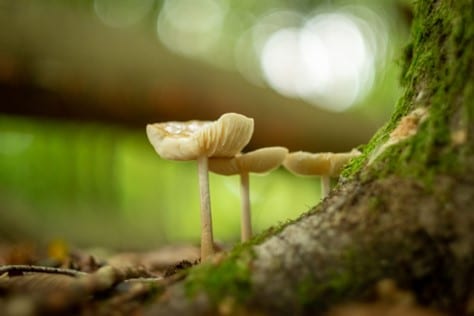
Did you ever notice that when you see mushrooms in the woods, they are often near trees and plants? This is because mushrooms grow in shady, dark areas where they can feed off of plant matter. While plants make their own food, they actually supply nutrients for mushrooms and fungal spores in the soil around them.
Mushrooms consume organic matter , or natural nutrients, from the soil around them. Have you ever heard of compost?
Compost is when waste is turned into reusable material for nature. You can compost things from your home like banana peels, egg shells, and coffee grounds. This is one small way you can contribute to helping the environment. Mushrooms and other fungi are nature’s composters. They can take nutrients from dead plants and even dead animals, recycle them, and give them back to the soil. The plants around the mushrooms can then reuse those same nutrients. It’s as if your neighbor gave you a cup of sugar, and you returned cookies to them. Mushrooms are good neighbors to the plants around them.
Mushrooms growing near the base of a tree. Credit: Word Press/Roy Tanck
Can mushrooms grow in the sunlight?
Plants and trees provide food and shade for mushrooms. Many plants need sunlight to grow, because they use sunlight to make their own food. Since mushrooms do not make their own food, they do not need sunlight to grow. A small amount of sunlight does not harm most fungi. Did you know that the part of the mushroom that grows above ground is considered the fruit of the fungus? A mushroom’s fruit can sprout above ground with the right amount of sunlight.
Mushrooms also grow best in damp conditions. This is because damp areas help spores to spread and produce more mushrooms. In the shade, water is more likely to stay in the soil around the growing spores. However, if there is too much sunlight, the area can dry up and become less friendly to mushroom growth.
How do farmers grow mushrooms?
Some mushrooms are delicious, but others are dangerous and deadly! There are over 140,000 types of mushrooms known to scientists, and only about two percent of those types, or 3,000 species, are edible. We need to grow our own mushrooms on farms to keep up with mushroom lovers across the world.
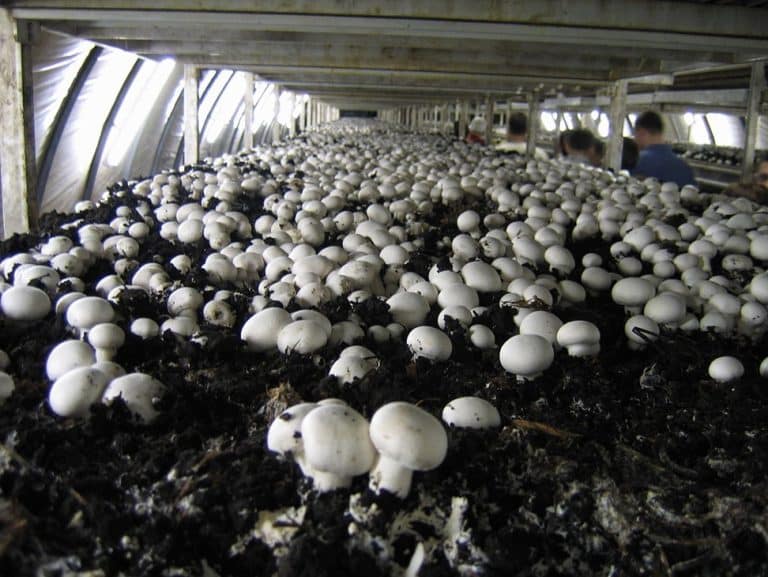
When you picture a farm, you probably see an open field full of plant growth and farming equipment. However, a mushroom farm looks much different. Instead of spreading soil that we would use to grow plants, farmers use a special substrate that contains plant and animal matter to help the mushrooms grow.
When the substrate is ready, farmers can plant mushroom spawn . Spawn is a special material that carries mushroom spores attached to the grain. Spores can only be seen with a microscope, so attaching them to grains that farmers can see is a helpful way to plant the spores in the substrate. This mixture of substrate and spawn is put onto trays and covered in a layer of casing , which is a mossy material that helps moisture stay in the substrate. These trays grow indoors, in dark areas called growing houses. The mushroom fruit is able to sprout and be harvested within just a few weeks! Because mushrooms take up little space and grow so quickly, they are a great option for farming.
Mushroom Farms. Credit: Wikimedia/Andrew Bossi
Can mushrooms grow on tree stumps?
Some edible mushrooms can be grown in a different way. For hundreds of years, mushroom farmers have used logs and tree stumps to grow mushrooms. Different types of logs even produce different flavors of mushrooms! Farmers can inject mushroom spores directly into logs and keep them in tented, damp areas where they will grow and thrive. This process takes longer, and months can pass before seeing mushroom fruit.
Logs injected with Mushroom Spores.Credit:Wikimedia/Mathew Schwartz
Growing mushrooms on trays of substrate or in logs is one of the best ways to farm food. It is environmentally friendly, space-saving, and produces large amounts of food very quickly. Mushrooms are packed with nutrients that are good for us to eat. Just be careful not to try eating wild mushrooms unless you are sure they are edible!
If you’d like to learn to grow mushrooms in your own home, you can purchase mushroom growing kits at your local grocery or nursery.
Flesch Kincaid Score: 74.7
Flesch Kincaid Reading Level: 7th grade
Glossary
Photosynthesis – the process by which plants make their own food. Fungi do not use photosynthesis
Fungus – a living organism that is not a plant or an animal and produces spores
Spore – the seed of a fungus that helps to make more fungi
Organic Matter – materials found in nature that fungi can use to grow
Compost – when waste material is recycled and reused by nature
Substrate – plant and animal material used to grow mushrooms on farms
Spawn – a grain containing mushroom spores used to seed spores on a mushroom farm
Casing – mossy material that traps moisture in the substrate so that mushrooms can grow
Tess Taggart Bub has a bachelor’s degree in biochemistry and a minor in data science from Houghton College. During her undergraduate studies, she conducted research in the areas of climate science, ecology, and muscle biology. She is currently a PhD candidate at the University of Tennessee Health Science Center studying host cellular response to viral infection. She is a strong believer that science can change the world, especially when it’s shared. In her free time, she loves communicating science, playing guitar and piano, and running. Writing for smore gives Tess the opportunity to help inspire a new generation of women in STEM.