Have you ever considered why some structures in nature are so aesthetically appealing? This is because of a particularly significant number that pops up in nature, art, and architecture – called the golden ratio. This magical number is about 1.618, usually denoted by the Greek letter phi (Φ). It is time to look at some of the most extraordinary real-life instances of the golden ratio!
What is the Golden Section?
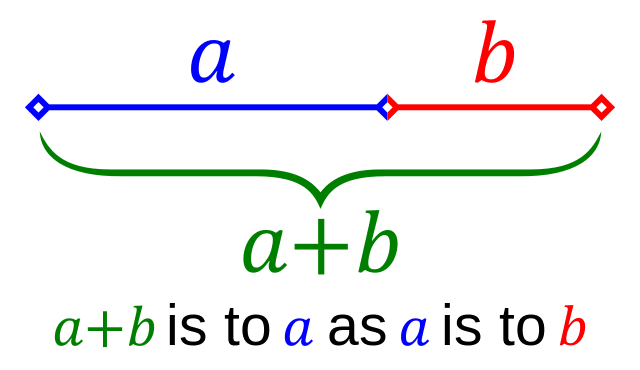
The golden ratio, Credit: Wikimedia/Stannered
The golden ratio is a mathematical ratio found in many natural objects. If you divide a line into two parts where the whole length divided by the longer part equals the longer part divided by, the shorter part, you will get the golden ratio of about 1.618.
Golden Ratio in Plants
Sunflowers
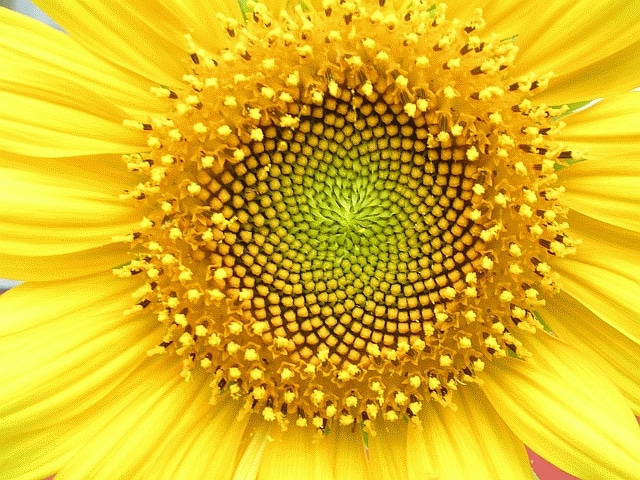
A sunflower showing the Fibonacci pattern, Credit: Wikimedia/L. Shyamal
The golden ratio is visible in the sunflower, as it is in many other plants. If you observe the sunflower more carefully, you will find that the seeds are in a circular spiral manner. The seeds in the spirals are arranged in an order that follows the Fibonacci sequence, which can be linked to the golden ratio. This enables the sunflower to accommodate as many seeds as possible in the least space.
Pinecones
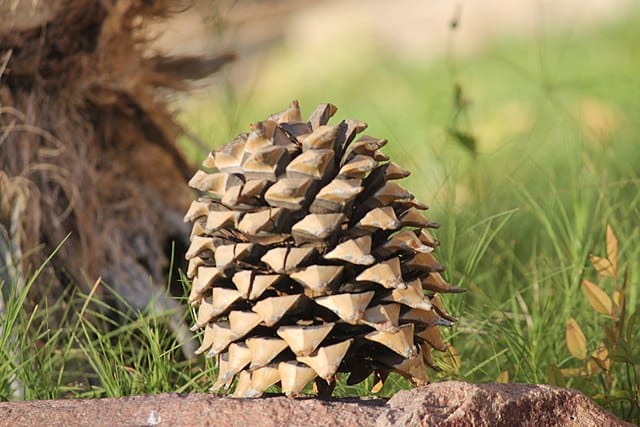
A pinecone, Credit: WIkimedia/Noah Wulf
Another instance of the golden ratio in nature is a pinecone. If you take the spirals of the scales at the surface of a pinecone and count them, many of them are Fibonacci numbers, such as 8 and 13 or 5 and 8. This is why the arrangement of the bracts enables pinecones to develop in the most optimal manner possible.
The Golden Ratio in Animals
Dolphins
A Dolphin, Credit: WIkimedia/Aude Steiner
It is important to note that dolphins are not just intelligent animals but also the epitome of the golden proportion. The physical structure of dolphins is designed with the golden ratio; hence, these animals move in water at high speeds. The eyes, fins, and tail fall at golden sections of a dolphin’s body length.
Starfish
A starfish, Credit: Wikimedia/Paul Shaffner
The body proportions of the starfish are in harmony with the golden ratio. There are many types of starfish, and they mostly have five arms; the positioning of the arms also follows the Fibonacci sequence. When you draw a star inside a circle so that all the arms of the star are touching the circle, the pattern of the lines intersecting each other will be in the golden ratio.
The Golden Ratio in Human Anatomy
The Vitruvian man by Da Vinci, Credit; Wikimedia/Beat Ruest
The Human Face
The human face is the other area where the golden ratio can be applied. Simply put, the face’s length and width are often close to one another, meaning the face is not very elongated. Also, the distance between your eyes, nose, and mouth is divisible by this magical number and is usually attributed to beauty.
The Human Body
This is evident in the human body, where there is a relationship between the body’s size and its parts’ size. For example, if one finds the distance from the top of the head to the navel and the distance from the navel to the floor, these distances are usually in the ratio of 1.618. In the same way, the length of your forearm divided by the length of your hand is roughly equal to the golden ratio.
The Golden Ratio in Spiral Galaxies
A Spiral Galaxy, Credit: Wikimedia/Hududududu
The golden ratio is seen even on a cosmic level. Spiral galaxies such as the Milky Way have spiral arms spiraled proportionately to the golden ratio. The arms of these galaxies are usually logarithmic spirals, like the shell of the nautilus, and specified by the golden section.
Why does the Golden Ratio occur in nature?
The concept of the golden ratio is evident because it is a sign of the most effective method of growth and organization. It aids animals and humans in developing sizes and dimensions that are practical and artistic.
The golden ratio is an enigmatic, mystical number that manifests in one form or another in the world around us. From the spirals of sunflowers and pinecones to the proportions of dolphins and human faces, this ratio forms the beauty and efficiency we observe in our world. The next time you walk outside, try to look for the golden ratio in the things you see around you.
Wu, L., Ji, C., Wang, S., & Lv, J. (2012, February 10). The advantages of the pentameral symmetry of the starfish. arXiv.org. https://arxiv.org/abs/1202.2219