Understanding What is the Fibonacci Sequence and Mastering Fibonacci Problems

Mathematics often reveals hidden patterns in nature—and few are as iconic as the Fibonacci sequence. First introduced through a rabbit problem by the Italian mathematician Fibonacci, this sequence of numbers shows up everywhere, from spiraling galaxies to elegant staircases. Each number in the Fibonacci sequence is the sum of the two preceding ones, creating a simple yet powerful pattern. If you’re looking to dive deeper, exploring Fibonacci sequence practice problems is a great way to see math come to life.

Ready to see this pattern in action? Check out our collection of Fibonacci sequence practice problems below and put your skills to the test!  But before that, lets explore the beauty of this relatively simple pattern, which lies in how we picture it geometrically.

For starters, the first ten terms of the Fibonacci sequence are:
0,1,1,2,3,5,8,13,21,34

• The 4th term is 2, which is (1+1), is the sum of 3rd and 2nd term.
• The 5th term is 3, which is (2+1), is the sum of 4th and 3rd term.
• The 6th term is 5, which is (3+2), is the sum of 5th and 4th term.


Fibonacci spiral
Fibonacci spiral and approximation of the golden spiral, Credit; depositphotos.com/Furian

Notice how the squares are drawn with the width being the total of the two adjacent squares. By drawing arcs along the diagonals of these squares, we end up with a nice spiral. Look closely

Spirals are abundant in nature
Spirals are abundant in nature, Credit: depositphotos.com/umjalin@gmail.com

Notice the striking similarities? And so does a winding flight of stairs, the Milky Way, and pinecones. As we go down the rabbit hole, we must acknowledge the male-female rabbit pair that made the Fibonacci sequence famous.

Fibonacci’s rabbit problem

Although named after Fibonacci, the Fibonacci sequence was not his discovery. Instead, he posed a fascinating puzzle, which led to the discovery of this pattern.

Let’s put a male and female pair of rabbits in a field. These rabbits take a month to mature, and then they give birth to a male-female pair of rabbits from the next month onwards. None of the rabbits die, and the pair of rabbits mate to produce more male-female pairs every month. We are to find the number of pairs produced in one year.

To tackle any problem, we need to simplify it.

rabbit
Original Pair

At the end of the first month, we have just a pair of rabbits.

rabbits
New Pair

It takes another month to mature, so no new baby rabbit pair exists.

rabbits
rabbit

However, at the beginning of the third month, the pair is ready to produce a pair of rabbits, so we have the original and new pair—a total of two pairs by the end of the month.

rabbits
rabbits
rabbit

The new pair takes another month to mature, while the original pair gives birth to another pair by the end of the fourth month, bringing the total to 3.

The following month, we will have:

rabbits
rabbits
rabbits
rabbit
rabbit

The pattern continues as 1,1,2,3,5,8,13,21, and so on. Well, now you know the basics, try finding out how many pairs of cute bunnies you will have by the end of the year.

You can already impress a few people with this problem up in your sleeve, but there’s always room for an upgrade. What makes this pattern a party trick are all the nifty shortcuts and geometric interpretations of the Fibonacci sequence.

Fibonacci Rabbit
Fibonacci number's illustration. Credit Wikimedia/MichaelFrey

What makes the Fibonacci sequence beautiful?

A lot of enjoyment comes from hands-on discovery in mathematics. The beauty of the Fibonacci sequence is pretty ordinary at first glance. Let’s divide a term xn with the term xn-1 to obtain a ratio (here, n represents the term we are on. For example, if n=4, we are on the fourth term of the Fibonacci sequence.

xn

xn-1

xn/xn-1

5

3

1.666666

8

5

1.6

13

8

1.625

21

13

1.615384

34

21

1.6190476

55

34

1.617647


When you consider larger terms, say 233/144, the result almost reaches a value of 1.618034. The larger the terms, the closer we get to this value. It’s called the golden ratio and is denoted by phi (φ).

You may ask, “What should I do with it?” Just ask Leonardo Di Vinci; he based his masterpiece, the Mona Lisa, on the golden ratio. Dr Julien de Silva devised a formula to find out how handsome people are based on a math equation. By mapping the facial features to see how closely they match the golden ratio, he rated George Clooney as the most handsome man in 2017.

The Fibonacci sequence is used to encrypt messages and files. Great musician Debussy gave structure to his music using the golden ratio. The Parthenon and the Pyramids were built ages before the discovery of the Fibonacci sequence. Yet, its presence is omnipresent in these beautiful structures, a point made in Nikolic’s paper, “The effect of ‘golden ratio’ on consumer behaviour.”

The golden ratio is an integral part of our universe. Let’s see a few examples of the golden ratio and Fibonacci sequence in nature:


The Milky Way: The galaxy that we call home, the Milky Way, is a spiral galaxy—the arms of a spiral galaxy direct outwards, which shouldn’t be the case. The reason for this has not been discovered, but it holds the structure of the Milky Way and other spiral galaxies.

Shells, webs, and horns, you name it: Shells of snails and marine cephalopods like nautilus have a logarithmic spiral. Some goat horns and spider webs are formed in this way, too. A part of our ear that helps in hearing is called the cochlea, and it is a spiral.

Hurricanes: If you see a satellite image of a hurricane, you might know it spirals around a central axis. Put the boxes on top, and you will find the spiral adhering to the Fibonacci pattern.

Face: The mouth and the nose are present so that the size of the tip of the nostrils is 1.6 times smaller than the distance between the eyes. The proportions of ears and eyes follow a spiral as well.

Hurricane Caterina from space shows the spiral nature, Credit: Wikimedia/NASA/Earth Observations Laboratory, Johnson Space Center

Fun things to do with the Fibonacci sequence

Fibonacci shortcut

Let’s go back to the rabbit problem. If you have worked it out, the answer would be 233 pairs of rabbits. Although you can calculate using the usual method, there is a faster way that uses the golden ratio. Let’s say we are finding the nth term of the Fibonacci sequence. The formula for that would be:

                           xn = (φn − (1−φ)n)/√5

Example: The rabbit problem runs till the 12th month, which means n=13 as the first value in the Fibonacci sequence is 0. Thus, the total number of pairs as per the formula should be:

                   x12 = (1.61803413 – (1-1.618034)13)/√5

The value comes at 233.000021, which can be rounded off to 233.

The ratio in lines

Draw a line. Divide it into two parts, one longer and one shorter. Let’s say that the longer segment is L, and the shorter one is S. Now try to put them in the equation L/S= (L+S)/L. The only segments that fall into this equation have a ratio of 1.6 between them, i.e., the golden ratio.

trippy Fibonacci spiral gif
Here’s a trippy Fibonacci spiral gif, Credit: Wikimedia/부처님

Converting distances

Using the Fibonacci sequence 0,1,1,2,3,5,8,13,21,34,55…. you can convert miles into kilometers to an approximate value and vice versa. For example:

21 miles = 34 kilometers (next number in the Fibonacci sequence)

while 34 miles = 55 kilometers (next number in the Fibonacci sequence) and so on..

If the distance isn’t a number on the Fibonacci sequence, break it into smaller parts. Each of those parts should be a number in the Fibonacci series.

For example, 18 miles will be:

13 miles + 5 miles

So, the conversion would be:

  13 miles = 21 km

+  5 miles = 8 km

  18 miles = 29 km

Fibonacci sequence practice problems

The knowledge of the Fibonacci sequence will be half as fun without a few word problems on this topic that you can solve to improve your finesse.

Problem 1:

What will be the next alphabet in the series: A, A, B, C, E, H, ___, ___

Ans: M, U

Solution: M is the 13th alphabet, and U is the 21st. If you look at these alphabets and their position in the alphabet order, it goes as 1, 1, 2, 3, 5, 8, which is the Fibonacci sequence. The two following terms will be the 13th and 21st alphabet.

Problem 2:

Calculate the value of the 13th and 14th terms of the Fibonacci sequence, given that the 10th and 11th terms are 34 and 55, respectively.

Ans: 144 and 233

Solution: Using the Fibonacci sequence formula, the 12th term is the sum of the 10th term and 11th term.

12th term = 10th term + 11th term = 34 + 55 = 89

Now, 13th term = 11th term + 12th term = 55 + 89 = 144

Similarly,13th term = 12th term + 13th term = 89+144 = 233

The 13th and the 14th terms of the Fibonacci sequence are 144 and 233.

Problem 3: 

What is the value of the term after 34 in the Fibonacci sequence? Solve it without using the preceding term.

Ans: 55

Solution: Since the preceding term is 34, Fn-1=34

We know that, 

Fn/Fn-1 = 1.618034

Therefore, Fn = Fn-1 x 1.618034

                      Fn = 34 x 1.618304

                      Fn= 55.022336, which is approximately 55

Problem 4:

A mathematician is fixated on dividing a 13 cm line in a way that looks aesthetically pleasing. Can you help the mathematician?

Ans: 8cm and 5cm

Solution: We can make geometrically pleasing structures by maintaining the golden ratio. 

For straight lines, the ratio between the longer and shorter segments should equal the ratio of the total length to the longer segment. This condition is only achieved when the segments are divided in Fibonacci terms.

Since 13 can be divided into two Fibonacci terms, 8 and 5, the segments should be 8cm and 5cm long.

Problem 5:

Find out the 14th term of the Fibonacci sequence

Ans: 377

Solution: We know that xn = (φn − (1−φ)n)/√5

X15 = (1.61830414 – (1– 1.618304)14)/ √5

The value comes to 377

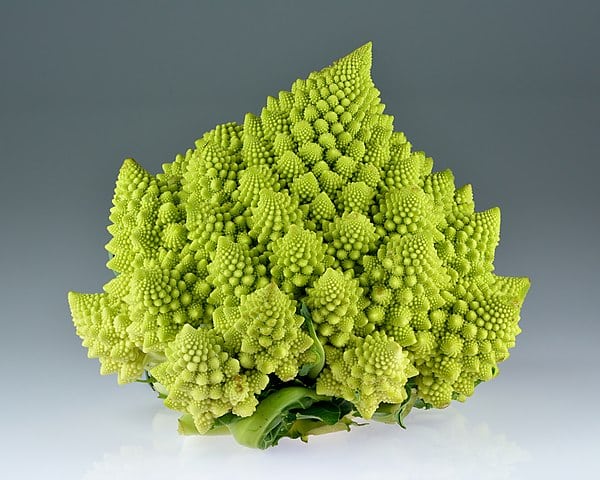
The Fibonacci sequence has made architecture and design efficient. Photography uses the golden ratio and the Fibonacci sequence; cell phone cameras have a Fibonacci spiral overlay these days. We can always be detectives and look for natural Fibonacci patterns. Here’s a nice picture of Romanesco broccoli. Each bud that grows outwards maintains a golden ratio of 1.6 with its predecessor.

Romanesco broccoli
Romanesco broccoli, Credit: Wikimedia/Ivar Leidus

Copyright @smorescience. All rights reserved. Do not copy, cite, publish, or distribute this content without permission.


Join 20,000+ parents and educators
To get the FREE science newsletter in your inbox!